
Spoiler-light review: discusses the setup and adaptation choices without revealing the finale’s outcomes.
HBO’s acclaimed video-game adaptation returns with a darker, more confrontational second chapter. Set five years after Season 1, the seven-episode season finds Joel and Ellie living in Jackson, but the stability around them cannot repair the distance developing between them.
This The Last of Us Season 2 review examines whether the series successfully follows its exceptional first season without revealing the finale scene by scene. The answer is complicated. Season 2 remains visually stunning, exceptionally performed and emotionally fearless. It also feels structurally incomplete, with pacing decisions that prevent several important characters and conflicts from receiving enough room to develop.
The result is ambitious television that delivers some of the series’ strongest individual moments—even when the season surrounding them does not always feel equally complete.
Story and Adaptation
Season 2 moves beyond the comparatively direct journey of the first season and embraces a story built around perspective, memory and consequence.
Its central conflict is not simply about surviving infected creatures. It is about the damage caused when people become convinced that their pain justifies whatever they do next. Revenge gives the characters direction, but it also narrows their ability to recognize the humanity of anyone standing against them.
Craig Mazin and Neil Druckmann make several meaningful adaptation changes. Events are reorganized, some motivations are revealed earlier, and new scenes expand the emotional history between characters. The television version also spends more time showing Jackson as a functioning community rather than merely a temporary safe location.
These choices generally work because television cannot reproduce the game’s long stretches of exploration and player-controlled violence in exactly the same way. The series must find dramatic alternatives, using dialogue, flashbacks and shifting relationships to communicate what the game often expressed through participation.
The adaptation becomes less successful when compression replaces development. Factions and ideological conflicts are introduced with intriguing detail, but some disappear for long periods. Several encounters feel like the beginning of larger storylines rather than fully developed parts of this season.
Readers looking for a detailed breakdown of the final episode can continue with our The Last of Us Season 2 ending explanation (full spoilers). This review will remain focused on the season’s overall quality.
Ellie Takes Center Stage
Bella Ramsey carries a significantly heavier dramatic responsibility in Season 2.
This Ellie is older and more capable, but not necessarily more emotionally mature. Her humor remains recognizable, yet it increasingly functions as a defense against fear, guilt and anger. The season asks Ramsey to move between youthful confidence, suppressed vulnerability and frightening determination—sometimes within the same scene.
Ramsey’s best work appears in quiet moments when Ellie cannot openly express what she needs. Small changes in posture and tone reveal the difference between the person Ellie wants others to see and the person struggling underneath.
The performance may challenge viewers expecting Ellie to behave with consistent wisdom or restraint. That inconsistency is part of the characterization. She is a traumatized young adult making irreversible decisions before she has fully understood her own grief.
Not every stage of that transformation receives enough screen time. The short season occasionally moves Ellie from one emotional position to another too quickly. Ramsey nevertheless keeps the journey coherent, even when the scripts compress the steps connecting those positions.
Joel’s Role in Season 2
Pedro Pascal has less conventional screen time than viewers might expect, but Joel’s presence shapes nearly every part of the season.
The emotional distance between Joel and Ellie is rooted in the unresolved consequences of Season 1. Rather than repeating their previous dynamic, the series examines what happens when love becomes entangled with secrecy, control and resentment.
Pascal gives a restrained performance built around what Joel cannot say. His physical stillness and careful pauses suggest a man who understands the cost of his decisions but remains uncertain about how to repair the relationship most important to him.
The season also gives Joel opportunities to appear more vulnerable than he was during the journey to Salt Lake City. His scenes with Gail, played by Catherine O’Hara, expose defensiveness and regret without simplifying either emotion.
Even when Joel is absent from a particular storyline, other characters are responding to decisions he made. That makes him structurally essential rather than merely reduced.
Abby and the Season’s Most Divisive Choices
Kaitlyn Dever’s Abby enters the season carrying an enormous narrative burden.
Abby must disrupt the relationship at the center of the series while remaining more than a functional antagonist. Dever approaches the role with controlled intensity. Her anger feels personal and specific, but the season deliberately withholds much of her wider perspective.
That decision reflects the larger structure of the source material, which challenges the audience to reconsider characters after forming powerful first impressions. In this season alone, however, Abby receives limited development after her initial impact on the story.
As a result, viewers unfamiliar with the game may understand her motivation without yet feeling that they know her. The performance plants the necessary emotional foundation, but the television series postpones much of the character exploration required to complete it.
The choice is dramatically bold and strategically risky. Season 3 may add considerable depth to what Season 2 establishes, but future development cannot entirely solve the present season’s feeling of imbalance.
The season’s adaptation choices have also sparked wider discussion about its major game changes and how television should reinterpret key moments from a video game.
Supporting Characters
Isabela Merced is the season’s most valuable new addition as Dina.
Dina brings warmth and spontaneity to a story that could otherwise become emotionally exhausting. Her chemistry with Ramsey feels natural, supported by playful exchanges as well as moments of genuine fear and tenderness. More importantly, Dina has enough personality to exist beyond her relationship with Ellie.
Young Mazino gives Jesse a calm, grounded presence. The season presents him as responsible and emotionally intelligent, although the compressed narrative leaves less time for his individual perspective than the character deserves.
Gabriel Luna remains convincing as Tommy, particularly when the safety of Jackson conflicts with loyalty to his family. Rutina Wesley brings similar authority to Maria, even though both characters occasionally feel underused.
Catherine O’Hara makes a strong impression as Gail, a character created for the television adaptation. Her conversations with Joel provide a different kind of tension: intimate, uncomfortable and free from the immediate threat of violence.
Jeffrey Wright also adds weight as Isaac, but the season offers only a limited view of his leadership and the larger conflict surrounding him. His material is compelling enough to make its brevity frustrating.
Direction, Cinematography and Production
Season 2 matches—and occasionally exceeds—the technical quality of Season 1.
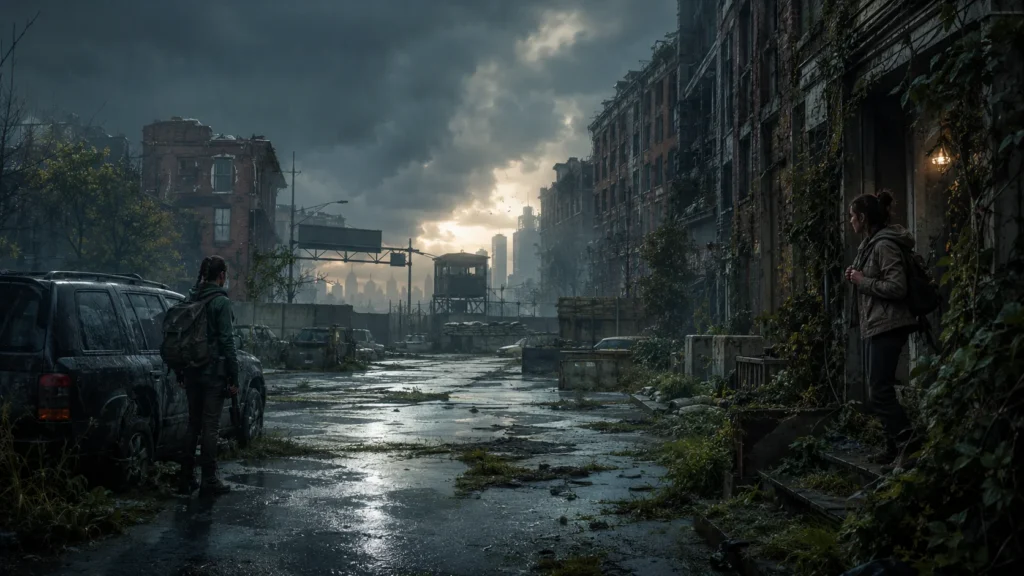
Jackson feels inhabited rather than constructed. Homes, communal spaces and defensive structures communicate years of organized survival. Seattle, by contrast, is wet, overgrown and oppressive, with the environment reinforcing the characters’ growing isolation.
The cinematography favors natural light, muted colors and carefully controlled darkness. Wide shots establish the scale of ruined environments, while intimate close-ups keep the emotional focus on the performers.
Action is used selectively. The largest infected sequence is an impressive combination of physical movement, visual effects and escalating tension. Smaller encounters are often more frightening because the infected remain unpredictable and difficult to control.
Gustavo Santaolalla and David Fleming’s music continues to support the drama without dictating every emotion. The familiar guitar textures create continuity with Season 1, while heavier, more unsettling sounds reflect the new season’s anger and instability.
The production is never the problem. Even when the storytelling feels compressed, the series remains one of HBO’s most convincing fictional worlds.
Pacing — Season 2’s Biggest Strength or Weakness?
Pacing is the season’s most significant weakness.
Individual episodes are often beautifully paced. Scenes are allowed to breathe, emotional conversations are not rushed, and silence is used more effectively than constant exposition. Viewed episode by episode, the season frequently demonstrates impressive control.
The larger seven-episode structure is less successful.
The story introduces multiple factions, personal relationships, moral questions and unresolved histories. It then ends before several of those elements can meaningfully converge. Some supporting characters need more development, while major changes in Ellie’s emotional state would benefit from additional connective scenes.
One flashback-focused episode is among the season’s best because it finally provides the emotional context missing from earlier chapters. Yet placing so much crucial development near the end also highlights how deliberately the season withheld it.
The incompleteness is partly intentional: HBO is adapting a much larger game across multiple seasons. But “part of a continuing story” and “satisfying season of television” are not automatically the same thing.
Why The Last of Us Season 2 Reviews Are Divided
Rotten Tomatoes’ Season 2 critics consensus praises the performances and moral complexity. Audience reactions are more divided. Current reviews are available on Rotten Tomatoes and Metacritic.
These sites use different rating systems and samples. Their scores do not establish why every viewer liked or disliked the adaptation.
CinePulse24 Verdict
CinePulse24 Rating: 8/10
The 8/10 rating reflects a beautifully produced, exceptionally acted season that takes meaningful creative risks but does not shape its portion of the story into a completely satisfying whole.
Season 2 is darker, less balanced and more structurally frustrating than Season 1. At its best, it is emotionally devastating prestige television. At its weakest, it feels like the first half of a larger narrative released before enough of that narrative was ready to stand on its own.
It remains absolutely worth watching—but viewers should expect an ambitious transition rather than a fully resolved destination.
Season 2 leaves several major storylines unresolved, but HBO has already confirmed that the story will continue. Our guide to The Last of Us Season 3 covers the latest release window, cast updates, production status and Abby’s expanded role.
HBO’s official Season 2 announcement confirms seven episodes and the five-year story jump. For wider TV coverage, see our trending series articles.

