
Full Spoiler Warning: This article reveals every major event in the Season 2 finale, including character deaths and the final cliffhanger.
The Last of Us Season 2 ending leaves Jesse dead and the result of Abby’s gunshot unresolved. The final scene then rewinds to “Seattle Day One,” opening Abby’s perspective on the same conflict.
Readers looking for analysis of the complete season can also read CinePulse24’s The Last of Us Season 2 review.
The Last of Us Season 2 Ending Explained
The ending begins taking shape when Ellie abandons her search for Tommy and continues toward the aquarium, believing she has finally located Abby.
Inside the aquarium, Ellie finds Owen and Mel instead. She attempts to repeat Joel’s interrogation method by forcing them to identify Abby’s location separately, but the situation immediately goes wrong. Owen reaches for a concealed weapon, prompting Ellie to shoot him. The same gunfire fatally wounds Mel.
Only after Mel collapses does Ellie learn that she is pregnant. Mel begs Ellie to save the baby, but Ellie is too shocked and overwhelmed to perform the emergency procedure Mel requests. Both Mel and the unborn child die.
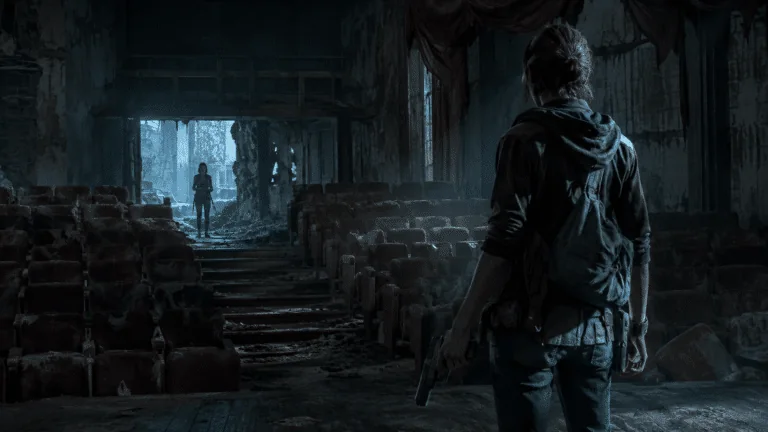
Tommy and Jesse eventually find Ellie and return her to the theater. Horrified by what she has done, Ellie agrees to abandon her search for Abby and leave Seattle with the others.
That decision comes too late.
Abby reaches the theater, apparently using the map Ellie left behind at the aquarium. When Jesse and Ellie hear a disturbance in the lobby, Jesse runs through the doorway and Abby shoots him in the head. His death is immediate.
Abby then holds Tommy at gunpoint. Ellie lowers her weapon and admits that she killed Abby’s friends.
Abby reminds Ellie that she allowed her to live in Jackson. From Abby’s perspective, Ellie answered that mercy by pursuing and killing the people closest to her. Abby points the gun toward Ellie and fires.
The screen cuts away before showing the bullet’s destination.
The final scene rewinds the timeline to Abby waking inside the WLF stadium. The words “Seattle Day One” appear, signaling that the next stage of the story will explore Abby’s experiences during the same three days viewers have already followed from Ellie’s perspective.
Why Does Abby Confront Ellie at the Theater?
Abby comes to the theater because Owen and Mel have been killed.
The finale does not present Abby’s arrival as an unrelated continuation of her revenge against Joel. This confrontation is a response to what Ellie and her allies have done in Seattle.
Abby initially appears to believe Tommy is responsible. Tommy has already been attacking WLF members, and Abby knows that Joel’s brother came looking for her. Ellie corrects that assumption by admitting that she killed Abby’s friends and that she was the reason Joel attacked the Firefly hospital.
For Abby, this confession completes a terrible circle.
She killed Joel because Joel killed her father. Ellie then pursued Abby because Abby killed Joel. That pursuit resulted in the deaths of Owen, Mel and other people connected to Abby. Each act presented as justice by one character becomes an unforgivable crime when experienced by the other.
Abby’s anger also comes from believing that she previously showed restraint. In Jackson, she killed Joel but allowed Ellie and Dina to live. Her statement that Ellie “wasted” that opportunity expresses Abby’s belief that mercy only created another threat.
That belief does not make Abby objectively right. It shows how deeply both characters have become trapped inside the same logic: violence appears justified when responding to personal loss, while the other person’s response is treated as proof that more violence is necessary.
What Happens to Jesse?
Jesse dies in the theater.
When he and Ellie hear a disturbance in the lobby, Jesse enters first. Abby fires immediately, shooting him in the head. The episode gives him no final speech or extended farewell.
His sudden death is important because it denies Ellie the illusion that revenge only affects willing participants. Jesse came to Seattle to help Ellie and Dina, but he repeatedly prioritized bringing everyone home over pursuing Abby.
Earlier in the finale, Jesse tells Ellie that he opposed Jackson’s proposed revenge mission. Despite that disagreement, he still left the safety of his community to protect the people he cared about.
Jesse and Ellie finally reach an understanding after he helps rescue her from the aquarium. Ellie thanks him, acknowledges his criticism and agrees that they should return home. Moments later, he is killed by the conflict she helped bring back to their shelter.
His death also leaves Dina’s unborn child without a father. Dina, Ellie and Tommy will consequently carry different forms of grief and responsibility if they survive the confrontation.
Unlike the status of Ellie and Tommy, Jesse’s fate is not ambiguous. The Season 2 finale confirms that he dies at the theater.
What Happens to Tommy?
Tommy’s ultimate condition remains unresolved when the theater scene cuts away. Abby has subdued him, and Ellie accepts responsibility for the aquarium deaths while pleading for him to be spared.
The episode does not establish his death or the outcome of the confrontation. Events from The Last of Us Part II should not be presented as confirmed television continuity.
Does Abby Shoot Ellie?
Abby raises her gun toward Ellie, a shot is heard and the scene cuts away. No visible impact establishes who is hit or whether Ellie dies.
The cliffhanger withholds the result of the gunshot. It does not justify declaring Ellie dead.
Why Does the Finale Suddenly Cut to Abby?
The transition to Abby announces a change in narrative perspective.
Until this point, the Seattle storyline has largely followed Ellie. Viewers experience the WLF, Seraphites and Abby’s friends through Ellie’s limited understanding of them. She knows that Abby killed Joel, but she knows very little about Abby’s life in Seattle or the relationships destroyed by her revenge mission.
After the theater gunshot, the story rewinds to Abby waking at the WLF stadium three days earlier. The shift tells viewers that the series is not ready to continue the confrontation because they are still missing half of the story.
This is more than a device for delaying the answer. The perspective change challenges the assumption that Ellie is automatically the sole protagonist and Abby merely the obstacle she must defeat.
The next part of the narrative must show what Abby experienced before entering the theater. Only after understanding how those three days looked from her position can the audience return to the confrontation with fuller knowledge of both characters.
What Does “Seattle Day One” Mean?
The title card returns to the start of Abby’s Seattle timeline, before the aquarium killings and theater confrontation. Manny wakes her at the WLF stadium and says Isaac wants to see her.
Relative to the theater scene, it is a flashback and a change in perspective. The story returns to the same period already followed through Ellie, allowing Abby’s experiences to supply missing context.
What Does The Last of Us Season 2 Ending Mean?
The ending argues that revenge does not close grief. It transfers grief to someone else.
Joel kills Abby’s father to save Ellie. Abby answers by killing Joel. Ellie responds by hunting Abby, but instead kills several people around her. Abby then arrives at the theater to avenge Owen and Mel.
Every character can point to an earlier act of violence as justification. That is precisely why the cycle cannot end by itself. Each retaliation creates another survivor with a legitimate reason to feel wronged.
Mel’s pregnancy breaks through Ellie’s revenge logic. Mazin emphasized that Mel did not restrain Ellie or hurt Joel, and had tried to intervene in Jackson. Her death exposes the collateral harm of Ellie’s mission.
Understanding Abby’s grief does not require approving her violence. The same distinction applies to Ellie: empathy can explain a character’s choices while still recognizing the harm they cause.
Guilt is equally important. Ellie is not pursuing Abby only because she loved Joel. She also lost years of closeness with him after discovering the truth about the Firefly hospital. Joel died shortly after Ellie expressed a willingness to try to forgive him, leaving her with grief mixed with regret.
Killing Abby cannot recover that lost time. Yet Ellie continues because revenge provides a simpler objective than accepting the complexity of her relationship with Joel.
The theater confrontation reveals that Abby has fallen into the same trap. Having already avenged her father, she again reaches for violence when confronted with new grief.
The ending’s central distinction is between justice and revenge. Justice attempts to establish responsibility and prevent further harm. Revenge seeks to make another person experience comparable pain. Ellie and Abby repeatedly call upon the language of justice while pursuing actions that produce additional victims.
How Does the Ending Compare With The Last of Us Part II?
Game Spoiler Warning: This section discusses the narrative structure of The Last of Us Part II
The television finale follows the game’s broad structural design.
In The Last of Us Part II, the narrative switches from Ellie’s Seattle journey to Abby’s experiences during the same period. The comparison here concerns that structure, without revealing later game outcomes.
The HBO adaptation changes numerous details leading to that moment. Character interactions, the order of certain discoveries and elements of Ellie’s journey through Seattle have been reworked for television. However, the crucial perspective reversal remains intact.
That decision preserves one of the game’s central narrative experiments. Abby is initially positioned as the object of Ellie’s revenge, then becomes a viewpoint character whose relationships and losses must be experienced directly.
Naughty Dog’s chronological-mode announcement describes the game’s nonlinear structure and intersecting Ellie/Abby timelines. The television finale echoes that perspective reversal.
For current renewal and production reporting, see our The Last of Us Season 3 guide.
What Does the Ending Set Up for The Last of Us Season 3?
HBO officially renewed The Last of Us for a third season in April 2025.
The network’s renewal announcement did not provide a release date, episode count or detailed plot description. Those details should not be assumed until HBO announces them.
The Season 2 ending itself strongly establishes the next narrative direction. Abby’s “Seattle Day One” scene indicates that the series must return to the beginning of the Seattle timeline and explore her experiences.
Season 3 is therefore positioned to answer questions including:
- What was Abby doing during Ellie’s three days in Seattle?
- What is her relationship with Isaac and the WLF?
- Why were Abby and her companions becoming separated?
- How does the war between the WLF and Seraphites affect her?
- What events lead her to discover Owen and Mel at the aquarium?
- What happens after the gunshot inside the theater?
This does not mean every episode must focus exclusively on Abby, but the perspective shift makes her story necessary before the confrontation can be resolved.
The final scene also suggests that previously incomplete storylines involving Isaac, the WLF and the Seraphites will gain greater context. Season 2 introduced those conflicts from the outside. Abby’s position inside the WLF can reveal what Ellie could not see.

