
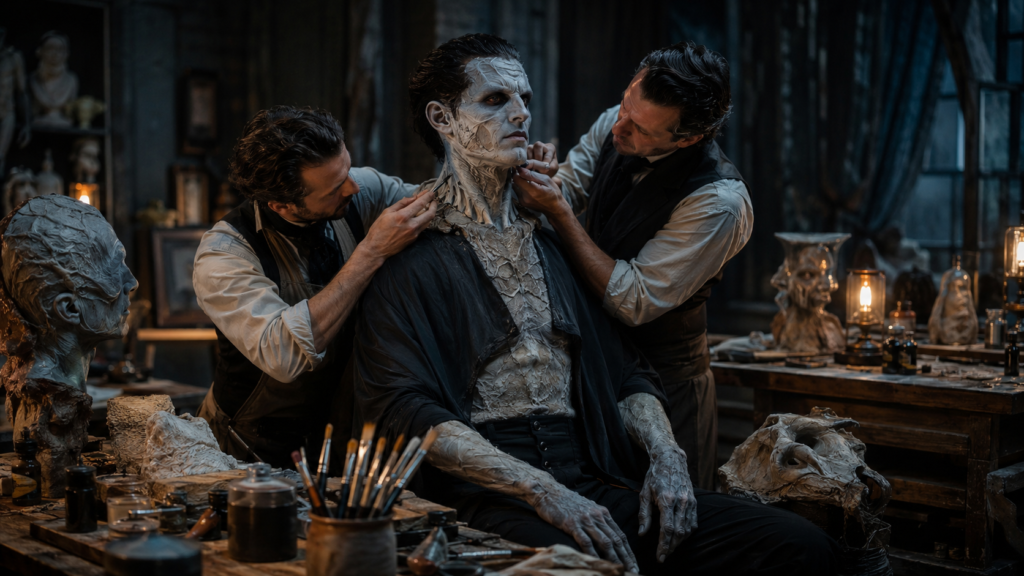
The Jacob Elordi Frankenstein makeup transformation became one of the most discussed visual elements in Guillermo del Toro’s 2025 Netflix film because it does more than hide a recognizable actor. The pale, sculptural prosthetics create a version of the Creature that feels handcrafted, physically imposing, and emotionally readable without repeating the familiar flat-headed screen icon.
Jacob Elordi plays the Creature, while Oscar Isaac portrays his creator, Victor Frankenstein. Working with prosthetic makeup designer Mike Hill, writer-director Guillermo del Toro built the character around a clear idea: this newly created being should look like an ambitious attempt at human perfection, not a rough copy of an earlier Frankenstein monster.
Why Jacob Elordi’s Frankenstein Makeup Looks Different
The design avoids the squared head, heavy brow, neck bolts, and obvious patchwork that many viewers associate with Boris Karloff’s Creature in James Whale’s Frankenstein (1931). That historic image remains influential, but del Toro and Hill did not want to reproduce it.
Instead, the Frankenstein 2025 Creature has a long, pale silhouette and carefully shaped anatomy. The joins and changes across the body are visible, yet the overall result is controlled and elegant rather than crudely assembled. That distinction reflects Victor’s goal inside the story: he believes he is creating an ideal man.
This version must also be distinguished from the designs in Mary Shelley’s Frankenstein (1994), I, Frankenstein, and Lisa Frankenstein. Del Toro’s interpretation belongs to his own adaptation and its mid-19th-century visual world, even while acknowledging the long history of the character on screen.
Who Designed the Frankenstein 2025 Creature?
Mike Hill served as the Creature’s prosthetic makeup designer and led the prosthetic makeup effects department. His previous work with del Toro includes The Shape of Water and Nightmare Alley, but the most relevant foundation for this project was their shared interest in Frankenstein imagery.
Hill and del Toro began discussing and developing the Creature years before Elordi arrived on set. According to Netflix’s behind-the-scenes look at the Creature, their design brief combined two ideas that could easily conflict: the being had to carry signs of his unusual construction while still possessing beauty.
The final appearance was therefore not simply a makeup effect added after casting. It was a character design shaped through sculpture, color, physical proportions, costume, and the needs of Elordi’s performance.
How the Jacob Elordi Frankenstein Makeup Was Created
1. A 42-piece full-body application
Hill’s team devised a full-body build made from 42 silicone prosthetic appliances. These separate pieces covered and reshaped areas of Elordi’s head and body, then had to read on camera as one continuous design.
Not every filming day required the complete set. Netflix reports that a smaller head-and-shoulders application still involved about 12 overlapping pieces. The two figures describe different versions of the same transformation rather than conflicting accounts.
2. A design fitted to Elordi’s body
Because Elordi was working in Australia while Hill needed to begin in Los Angeles, a mold of the actor’s head was created and shipped to Hill. His body was scanned, and Hill used the data to produce a three-dimensional body form on which the appliances could be fitted.
That preparation allowed the team to plan how the prosthetics would change the silhouette while remaining specific to the actor underneath. In the Motion Picture Association’s interview with Mike Hill, Hill explains that he added volume around the trapezius and deltoid areas to give the Creature greater upper-body presence.
3. Dentures and an asymmetrical contact lens
The face was altered with more than skin appliances. Elordi wore dentures that made the teeth appear larger, as well as one large brown contact lens that created a deliberate imbalance between the eyes.
That asymmetry had an expressive purpose. Hill said the filmmaking could favor the larger eye when the character seemed more threatening and the smaller eye when his human qualities came forward. It is a subtle example of the design supporting emotion rather than functioning only as disguise.
4. Color built from several restrained tones
The Creature’s skin is not painted in one simple shade. Hill described an oyster-gray base requested by del Toro, with blue-gray acknowledging the Karloff tradition and yellow connecting to Mary Shelley’s description. Alabaster, purple, red, and other quiet variations added depth.
These colors help explain why Frankenstein’s Creature can resemble carved stone in one image and a living body in another. The palette is pale, but it is not visually flat.
5. Costume and makeup working together
The Creature design extends beyond prosthetics. Early wraps leave much of the sculptural body visible, allowing the audience to understand him as a newly formed being. Later clothing and large furs change his outline and make him appear more like the imposing figure other characters believe they see.
This coordination matters because makeup alone does not determine how the Creature is perceived. Fabric, posture, lighting, and camera angle can either expose the handcrafted anatomy or conceal it inside a darker silhouette.
The Long Transformation Process
The full makeup application took about 10 hours a day, according to Hill. The team began at midnight so Elordi could be ready for filming after the lengthy process. That figure applies to the extensive transformation, not necessarily every head-and-shoulders day.
Netflix’s feature on Jacob Elordi and Mike Hill describes the nightly work involving Hill, prosthetics supervisor and hair stylist Megan Many, and other technicians. Elordi recalled opening his eyes after 10 hours to find the Creature fully formed.
His commitment was practical as much as performative. Sitting through a full application before beginning a shooting day required patience, while the overlapping pieces had to remain consistent enough for scenes filmed at different times to match.
The process also created daily collaboration between actor and makeup team. Hill was not designing a static display model; the finished work had to move with Elordi, preserve access to his expressions, and withstand the demands of filming.
Why the Creature Was Designed Like a Living Statue
Del Toro said he wanted the Creature to resemble a marble statue. That idea explains the pale surface, defined anatomy, and sense that Victor has tried to sculpt a human form rather than merely repair one.
The artistic reference also helps the design move away from the standard Frankenstein monster vocabulary. A statue can appear idealized and beautiful while remaining cold, unfamiliar, and slightly removed from ordinary life. The Creature occupies that tension from his first appearance.
Hill described the desired result as a “newly minted man,” a concise phrase that separates creation from repair. The body still bears evidence of Victor’s process, but the visual emphasis falls on form and intention rather than excessive damage.
Most importantly, the sculptural approach leaves room for the face—especially the eyes—to carry feeling. The prosthetics alter Elordi substantially without replacing the emotional center of the performance with a rigid mask.
How the Creature’s Appearance Changes During the Film
Minor visual-development spoilers follow, but this section does not reveal the ending.
The Creature does not maintain one pristine appearance throughout the story. He begins with a pale, newly formed quality and minimal wrappings, then becomes more weathered as he encounters the world. His costume grows heavier, and the color treatment becomes less luminous and more muted.
Hill compared the visual progression to moving from a butterfly toward a moth. The metaphor describes a loss of brightness and innocence, not a completely different makeup design. The same physical foundation remains recognizable while surface color, clothing, and accumulated wear communicate experience.
This progression gives the Creature’s design a narrative function without requiring dialogue to explain every change. Viewers can read time, exposure, and emotional hardship through the evolving surface.
Readers who have already watched the film can explore our Frankenstein 2025 ending explained guide for a closer look at the Creature’s final choices and the meaning of the last scene.
Practical Makeup Versus Digital Effects
The Creature’s identity was built around a practical, repeatable prosthetic application performed on Elordi. The 42 silicone appliances, dentures, contact lens, body shaping, paintwork, hair work, and costume gave the actor a physical character to inhabit on set.
That does not justify claiming the movie contains no digital visual effects. Modern productions can use visual effects for many purposes, and the cited sources do not establish that every Creature image is untouched digitally. The accurate point is that handcrafted prosthetics formed the transformation’s central visible foundation.
This approach fits del Toro’s broader preference for tangible production elements. Netflix’s making-of feature describes extensive real sets, locations, props, and handmade work across the production. For the Creature, practical construction also allowed lighting to fall across genuine contours and gave other performers a completed figure to face during filming.

