
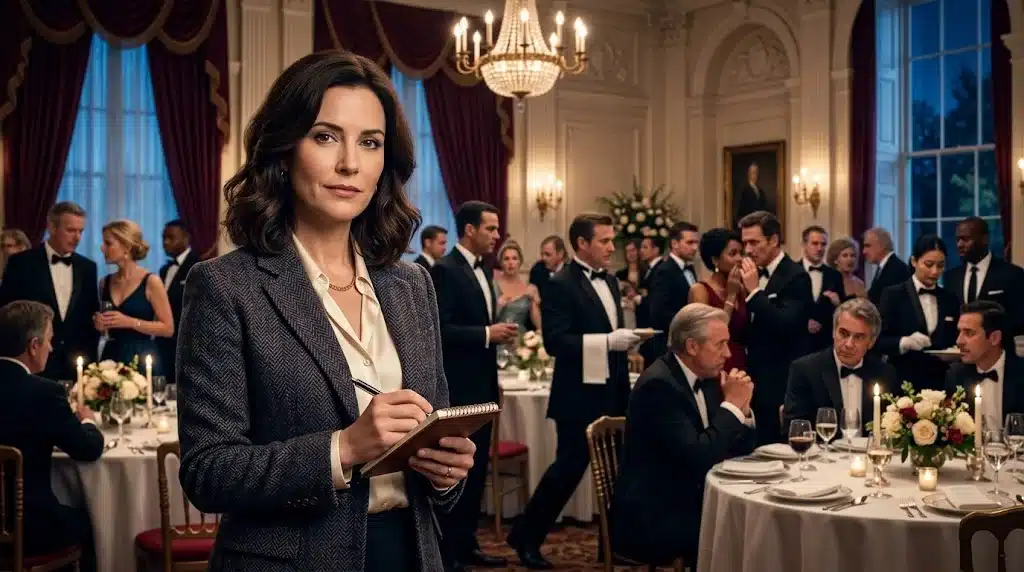
Spoiler-light: This article discusses the opening premise, characters and storytelling format without revealing the murderer or major finale developments.
The Residence turns a White House state dinner into a murder investigation, bringing the people who prepare meals, manage rooms and maintain the building into the spotlight. Its central attraction is that combination of an imposing public institution and a complicated private workplace. Behind the ceremony, everyone has responsibilities, relationships and something they would rather not explain.
For viewers deciding whether to start the Netflix series, the main consideration is its tone. This is an ensemble whodunit built around an unconventional detective and screwball comedy. It asks for attention to conflicting accounts and character dynamics across eight episodes, while treating the investigation as an opportunity for comic disorder.
What Is The Residence About?
Created by Paul William Davies and produced by Shondaland, The Residence follows detective Cordelia Cupp after White House chief usher A.B. Wynter is found dead during a state dinner for an Australian delegation.
Cordelia must investigate a household filled with staff members, guests and officials. The pressure extends beyond identifying a suspect: a prestigious event has unravelled, and the people responsible for the residence have different reasons to want the situation resolved.
The series also uses a congressional hearing to revisit what happened. That framing makes the story about both the investigation and the accounts people later give of it. A statement can tell viewers something about the evening while also revealing how its speaker wants to be perceived.
The White House Is Part of the Puzzle
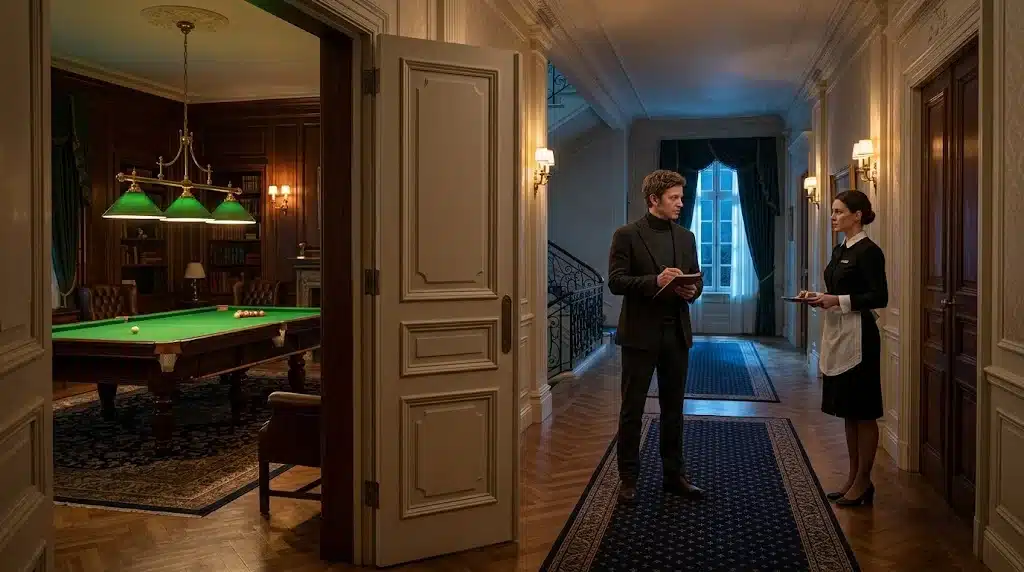
The setting is the strongest reason to distinguish The Residence from a more conventional detective series. Its White House is a household as well as an institution, with working kitchens, maintenance problems, guest accommodation and established routines.
That creates two overlapping sources of interest. There is the physical puzzle of where people could have gone, and the social puzzle of who has access, authority or knowledge that someone else lacks.
In Netflix’s feature on the White House production design, Davies explains that the building’s layout shaped the mystery. Production designer François Audouy and his team had to make separate sets connect convincingly, so that the residence could function as a coherent place.
For a mystery viewer, that specificity matters. Rooms and connecting routes can become information worth remembering. The location gives the investigation constraints, rather than merely providing an impressive background for interviews.
Cordelia Cupp: An Observer Who Refuses to Fit In
Uzo Aduba plays Cordelia as an investigator defined by confidence, concentration and an interest in birdwatching. The hobby has a practical connection to her approach: observing birds requires patience and attention to small differences, qualities that also belong to detective work.
Cordelia’s position as an outsider is equally important. She arrives in a setting where clothing, manners and hierarchy carry meaning, but she has little reason to follow its social expectations.
Aduba discusses that distinction in her interview about creating Cordelia. Her practical outfit, including a tweed blazer, was developed to give the detective a recognisable identity separate from the formal world surrounding her.
The analytical appeal is clear: a character who does not belong to the household can question behaviour that its members have learned to accept. Cordelia’s independence supplies a useful challenge to an institution accustomed to controlling appearances.
Edwin Park Gives the Investigation a Second Perspective
Randall Park plays FBI special agent Edwin Park, whose scepticism places him in contrast with Cordelia. He does not automatically share her confidence in her methods.
That difference provides a useful structure for a detective partnership. One investigator pursues an observation; the other questions its relevance or challenges the approach. Their disagreement gives the audience another way to assess what is happening.
Netflix’s official series guide positions Edwin as Cordelia’s investigative counterpart. The pairing is worth considering for viewers who enjoy mysteries driven by conversations and contrasting personalities, as well as by the evidence itself.
A Cast Built Around Workplace Relationships
Giancarlo Esposito plays A.B. Wynter, whose position as chief usher places him at the centre of the residence’s daily operations. His role connects the investigation to the people responsible for making the household work.
Susan Kelechi Watson’s assistant usher, Jasmine Haney, offers another perspective on that system. Her experience and professional ambitions bring questions of responsibility and advancement into the story. Edwina Findley’s butler Sheila Cannon adds a different position within the same workplace.
These connections are more useful to a prospective viewer than a long list of familiar actors. A mystery becomes more interesting when the people being questioned have reasons to disagree that existed before a crime occurred.
The ensemble invites viewers to distinguish between resentment, embarrassment, ambition and potential motive. A difficult working relationship may deserve attention without automatically supplying an answer.
Comedy Comes from Ceremony Colliding with Disorder
The Residence is deliberately conceived as a screwball whodunit. Davies identifies Charade as an inspiration, while his broader influences include Sherlock Holmes, Agatha Christie and ensemble murder mysteries.
That background helps explain the intended combination of an elaborate puzzle and heightened personalities. The state dinner is supposed to demonstrate control. A murder investigation forces the household to expose the arguments and complications beneath that formal surface.
The comic premise therefore has a clear foundation: people expected to remain composed must respond to an extraordinary situation while protecting their own interests.
Whether that humour suits an individual viewer is a matter of taste. Those who enjoy eccentric suspects and theatrical conflict have a reason to explore it. Viewers seeking understated realism or a consistently sombre crime drama should take the screwball description seriously before starting.
The Mystery Rewards Attention to Different Accounts
The investigation moves through testimony, interviews and earlier events. Its structure asks viewers to consider who is speaking, what they know and which parts of the evening they can actually explain.
This offers an appealing form of participation. Instead of simply waiting for the detective to announce a discovery, viewers can compare accounts and keep track of inconsistencies.
There is also a practical trade-off. A large ensemble and a story that revisits events require concentration. Someone who prefers a small suspect pool and a direct timeline may find this format less comfortable than a viewer who enjoys assembling a complicated picture.
Davies discusses his affection for classic detectives and all-star mysteries in his Shondaland interview about the series’ influences. That tradition is useful context for understanding what The Residence is attempting.
Eight Episodes Still Mean a Substantial Commitment
The Residence has eight episodes, but they are not uniformly short. Netflix lists running times between 47 and 87 minutes, with the final two instalments exceeding an hour.
The format gives one investigation space to explore the household and its relationships. It also means viewers should expect a longer commitment than a compact mystery film or a series of brief procedural cases.
The central pacing question is whether returning to earlier events provides enough new understanding to justify the time spent. That requires a viewing-based judgment; episode count alone cannot establish that a season is either tightly constructed or unnecessarily stretched.
What can be established before watching is the commitment: this is a season-long case with a substantial ensemble, rather than a succession of quickly resolved investigations.
Who Is Most Likely to Enjoy It?
The Residence is a relevant option for viewers who enjoy unconventional detectives, ensemble suspects and comedy within a murder mystery. Its household setting also offers a reason to watch for anyone interested in how powerful institutions depend on people whose work usually remains out of sight.
It may be a less natural fit for viewers who want a short, direct investigation or restrained, consistently serious crime storytelling.
For a darker alternative, CinePulse24’s spoiler-free Dept. Q review examines its cold-case story, Edinburgh setting and uneasy detective partnership.
Where to Watch and What to Know About Season Two
The Residence premiered on March 20, 2025. All eight episodes are listed on its official Netflix page, where viewers can check availability through their local account.
Netflix cancelled the series after one season, as TVLine confirmed in July 2025. There is no confirmed second-season release date.
The clearest reason to consider the show is its combination of a geographically specific mystery, an outsider detective and a household full of competing perspectives. The decision comes down to whether you want to spend a season untangling that puzzle in the company of deliberately eccentric characters.
Our Verdict: Who Should Watch The Residence?
Our overall impression of The Residence is positive, and we recommend giving it a watch. Its combination of a White House murder investigation, an unconventional detective and a household full of competing interests offers a distinctive premise for mystery fans.
The recommendation is strongest for viewers who enjoy ensemble whodunits and screwball comedy. Those who prefer restrained crime drama or a shorter, more direct investigation should consider its eccentric tone and eight-episode commitment before starting.
The Residence is a series we recommend, with the clearest appeal lying in its blend of mystery, workplace tensions and comic disorder.
Watch The Residence’s Official Trailer
The official trailer introduces Cordelia Cupp, the White House staff and the state dinner that becomes a murder investigation. It offers a preview of the series’ eccentric characters and comic tone, helping you decide whether its style suits your taste.

