

Spoiler warning: This article reveals the major twists and ending of all six episodes of Netflix’s Zero Day.
The Zero Day attack was an inside job. Richard Dreyer, Alex Mullen and a network of political and corporate insiders engineered the disaster, supposedly to force a divided America to unite. George Mullen ultimately exposes the conspiracy to Congress, including his own daughter’s involvement. He solves the central mystery, but the finale leaves his neurological symptoms and the country’s recovery unresolved.
That distinction matters: the attackers are identified, while the consequences remain unsettled. For an assessment of the series beyond its final twists, read our full Zero Day review. Here, we’re concentrating on what Episode 6 reveals and what those revelations mean.
Zero Day Ending Explained: Who Was Behind the Attack?
The conspiracy links House Speaker Richard Dreyer and Representative Alexandra “Alex” Mullen with technology billionaire Monica Kidder, finance billionaire Robert Lyndon and lawmakers from both parties. George’s final address identifies powerful Americans who helped manufacture the emergency they publicly claimed to be solving.
Kidder’s arrest initially offers a convenient stopping point: a technology executive can be blamed, and the investigation can close. The deeper revelation makes that explanation inadequate. She belongs to a larger operation whose participants have access to both the machinery of government and private technological infrastructure.
The twist changes the meaning of the investigation. George has been searching for an enemy threatening American institutions, only to discover people inside those institutions treating the public as expendable. The danger isn’t simply that outsiders can break the system. It’s that insiders believe breaking it gives them permission to rebuild it on their terms.
Why Was the Zero Day Attack Carried Out?
The conspirators’ stated goal is to overcome political paralysis by creating a shared national crisis. Alex describes a plan intended to shock the country into recognizing its vulnerabilities. What was presented to her as a brief disruption becomes a catastrophe that kills thousands.
Their justification depends on a monstrous assumption: people with power can decide how much fear everyone else needs. They substitute their private judgment for public consent, then use the resulting emergency to argue for greater control.
Our reading is that the finale deliberately separates a claimed motive from moral innocence. Wanting cooperation does not excuse engineering mass suffering. The plan’s failure also exposes its arrogance: a population traumatized by an attack cannot be programmed to respond with the tidy solidarity its architects imagined.
This makes the conspiracy more disturbing than a straightforward ransom scheme. Its participants can portray themselves as responsible adults saving the country, even as their methods destroy the trust necessary to govern it.
What Was Alex Mullen’s Role?
Alex is a participant, not merely someone who discovers the scheme afterward. Her involvement is revealed to viewers at the end of Episode 5, before George learns the truth in the finale. Her written confession eventually supplies the basis for his public disclosure.
That revelation recasts her scrutiny of the commission. A daughter questioning her father can look like a principled check on his extraordinary authority. Once her involvement is known, those exchanges also carry the possibility of self-protection. Her position places family loyalty, political responsibility and personal exposure in direct conflict.
Alex’s remorse matters, but it cannot reverse what happened. The finale gives her a way to acknowledge responsibility without turning that acknowledgment into absolution. George’s dilemma becomes painfully specific: a public commitment to accountability now requires refusing special treatment for his own child.
This is the strongest emotional feature of the ending. An abstract argument about transparency becomes a choice that could dismantle a family. Alex is both someone George loves and someone the country has a right to investigate.
What Was Richard Dreyer’s Plan?
Dreyer hopes the crisis will give him the authority to reshape the country. He expects to lead the commission, but President Evelyn Mitchell appoints George instead. George’s investigation therefore becomes an obstacle to a plan that depended on controlling the official response.
Before the congressional address, Dreyer argues against revealing the conspiracy. His defense shifts attention from the attack to the instability disclosure might cause: exposing leaders, he suggests, could damage the country further.
The maneuver is revealing. Dreyer wants to decide both when citizens should be frightened and when they should be protected from information. In either case, their right to know comes second to his assessment of what serves the national interest.
His argument also presents George with a false sense of responsibility for the fallout. The people who created the disaster would benefit if the person exposing it accepted blame for every consequence of disclosure. The finale asks whether preserving order becomes another form of complicity when that order depends on concealment.
What Is Proteus in Zero Day?
Proteus is a fictional NSA-developed weapon associated with remotely inflicted brain injury. Netflix Tudum’s official finale explanation also describes modified technology from the project being used in the attack, with malware distributed through Kidder’s app updates and onward connections between devices.
Two questions must be kept separate: how the mass attack was enabled, and whether George’s mind was deliberately targeted. The explanation of the attack does not conclusively resolve the second question.
George discovers suspicious material in a bird feeder, but the analysis fails to establish what it is. His hallucinations consequently remain open to interpretation. The series does not supply a definitive on-screen diagnosis or proof that a neurological weapon was used against him.
As a dramatic device, Proteus makes George’s vulnerability difficult to separate from the threats surrounding him. A conspiracy is real, yet that does not mean every perception he has is reliable. That uncertainty is unsettling, though viewers expecting a clean technical answer may reasonably find it frustrating.
What Does George Mullen Do After Learning the Truth?
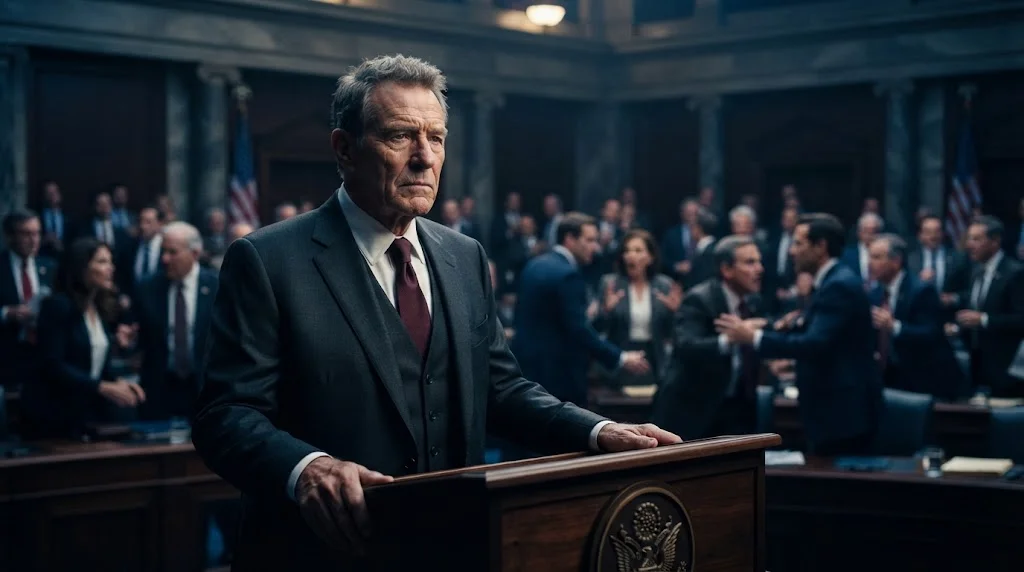
George ultimately names the conspirators in his address to Congress. He begins with a controlled account before abandoning that approach and reading Alex’s confession. His public disclosure includes her, rather than carving out an exception for his family.
The decisive action is speaking, not catching another suspect. By this stage, the important question is whether knowledge will become public accountability or remain a secret managed by powerful people.
George’s decision does not erase the commission’s troubling methods. He has wielded extraordinary investigative authority, and the ending need not be read as approval of everything done under his leadership. It is a narrower moral victory: he refuses to let his personal interest determine which truths citizens receive.
Nor does the speech magically repair the country. Naming perpetrators begins a process of accountability; it does not show completed prosecutions, rebuilt institutions or a public suddenly united in its interpretation of events.
What Happens to the Main Characters?
George, Alex and Sheila Mullen
George returns home and burns the draft of his memoir. Alex has admitted her involvement and faces the consequences of being exposed; the finale does not depict a completed trial or sentence. Sheila’s relationship with George is left deeply strained, with their marriage’s future uncertain rather than definitively settled.
The family’s unresolved future is important. A neat reconciliation would soften the cost of George’s choice, while a fully specified punishment would turn the final minutes into a legal epilogue. Instead, the ending leaves the damage present without pretending it has all been processed.
Dreyer, Kidder and Roger Carlson
Dreyer is publicly implicated, but his ultimate legal fate remains beyond the ending. Kidder is already dead in custody before the conspiracy is fully exposed. Roger Carlson is killed earlier, with his death staged as an overdose; the information he leaves behind helps move the investigation toward Kidder.
Roger’s contribution underlines the difference between possessing institutional power and making a consequential choice. He does not survive to receive vindication. The investigation’s progress carries a personal cost that George’s final speech cannot undo.
What Does the Zero Day Ending Really Mean?
The burning memoir is the clearest image of George relinquishing control over his legacy. A memoir lets its author organize a life into a preferred narrative. After the congressional disclosure, that kind of self-authored closure no longer fits what he has done.
We read the gesture as an acceptance that integrity and reputation are different things. George can choose his action, but he cannot dictate whether people will remember him as principled, reckless, disloyal or heroic.
His final pause beside the water offers stillness rather than a victory celebration. The national crisis has produced a personal decision, not a guarantee of collective healing. That restraint gives the ending more weight than a closing montage of arrests would have.
There is a limitation, too. Putting so much emphasis on one honorable man can simplify a story about systemic failure. The institutions remain vulnerable, and the public must still judge what it has learned. The finale is most persuasive when George’s honesty is treated as necessary but insufficient: an opening for accountability, rather than its completion.
Does the Ending Set Up Zero Day Season 2?
As of October 10, 2026, our check of Netflix’s official information found no Season 2 renewal announcement. Netflix still lists Zero Day as a limited series with six episodes. Unresolved consequences should not be mistaken for confirmation of another season.
In their February 2025 interview with TheWrap, the creators described a complete story while expressing openness to revisiting the characters. Those comments were possibilities, not a production announcement. For the renewal question in detail, see our Zero Day Season 2 status guide.
A continuation could examine prosecutions, public reactions or the Mullen family’s future. That is editorial speculation. The finale already completes George’s central decision, so another installment would need a compelling new conflict rather than simply postponing the consequences of this one.
Final Thoughts
The Zero Day finale answers who carried out the attack more firmly than it explains George’s symptoms. Its real endpoint is his refusal to hide Alex’s involvement. The mystery resolves into a test of whether truth still matters when revealing it hurts the person speaking.
That gives the ending emotional clarity without complete factual closure. George keeps his integrity, but neither his family nor the country receives an easy reset.
Watch the Zero Day Cast and Creators Discuss the Finale
These interviews explore George Mullen’s final decision, the political themes behind the conspiracy and the personal cost of revealing the truth.
Is Zero Day Based on a True Story?
No. Its characters and central conspiracy are fictional, although the series draws on real concerns about cyberattacks, disinformation and political distrust.

