
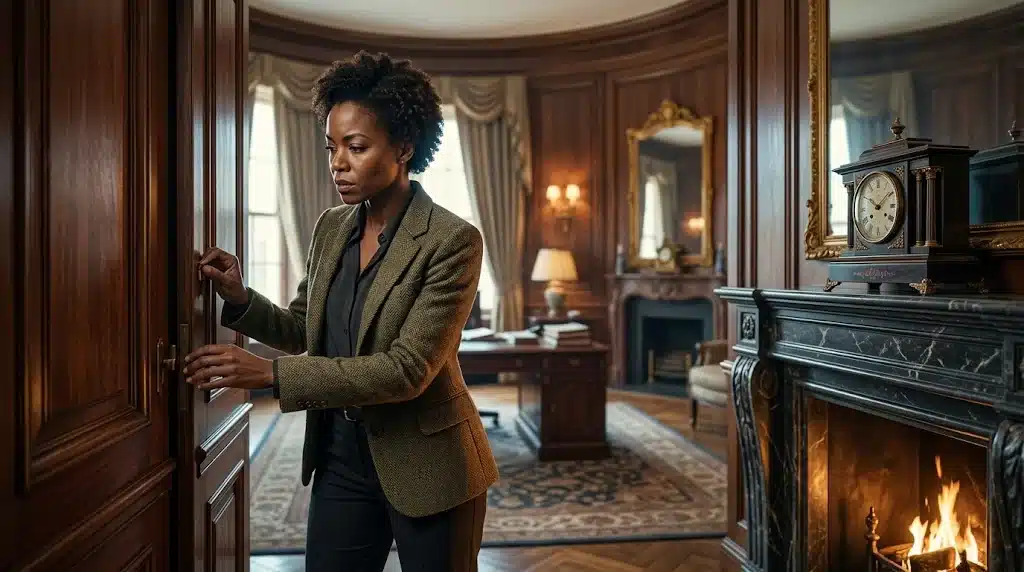
Spoiler warning: This article reveals the killer and the resolution of Season 1.
The Residence ending explained begins with one distinction that makes the finale easier to follow: the person who kills A.B. Wynter is not responsible for everything that happens to his body afterward. Lilly Schumacher is the murderer, but other people interfere with the scene for reasons of their own.
That is why identifying the killer only answers part of the puzzle. To understand the rest, it helps to separate the murder, the movement of the body and the evidence Cordelia Cupp eventually uses to expose Lilly.
For an assessment of the series without the finale reveal, read our The Residence review.
Who killed A.B. Wynter, and why?
White House social secretary Lilly Schumacher, played by Molly Griggs, kills A.B. after he documents her criminal and financial misconduct. His records threaten to expose abuses that could send her to prison.
Losing her job is not the whole motive. Lilly has money and status beyond the White House. What she cannot comfortably dismiss is the possibility of being held accountable. Netflix’s official finale explainer makes that distinction explicit.
How did Lilly kill him?
Lilly gives A.B. scotch containing a toxic herbicide in the Yellow Oval Room. He recognises that something is wrong and pours the remaining drink into a vase of roses. The poison affects him, but Lilly continues the attack.
She throws a vase, misses, then strikes him with a heavy clock. The clock becomes the crucial hidden weapon.
The damaged roses explain a detail that might otherwise look incidental: they connect what happened to the drink with what happened to A.B. They are evidence of the attempted poisoning rather than a separate mystery.
Why was the body found in a different room?
The body changes location because two people make separate decisions after the murder.
| Person | What they do | Why they do it |
|---|---|---|
| Bruce Geller | Moves A.B. from the Yellow Oval Room, through the Lincoln Bedroom and into Room 301 | He believes Elsyie killed A.B. and wants to protect her |
| Tripp Morgan | Wakes beside the body in Room 301 and moves it to the Game Room | He fears being implicated |
This chain is the source of much of the confusion. Someone who moves a body has interfered with the investigation, but that action alone does not establish that they committed the murder.
Bruce’s assumption about Elsyie sends the evidence in the wrong direction. Tripp’s panic then changes the scene again. Cordelia has to reconstruct those interventions before the physical evidence can tell a coherent story.
Was A.B.’s death a suicide?
No. The apparent suicide is assembled from misleading evidence.
Lilly takes a page from A.B.’s journal that can be read as a suicide note when removed from its context. Later, Tripp finds the page and alters the body with a knife to reinforce that explanation.
The writing itself is real; the interpretation placed on it is false. Likewise, the injuries visible when the body is discovered do not all belong to the original attack.
For viewers trying to reconcile the note with the murder, the key is timing: A.B.’s words, Lilly’s attack and Tripp’s interference are three different events.
How does Cordelia prove Lilly is the killer?
Two details undermine Lilly’s account.
First, she reveals knowledge of where the supposed suicide note was on A.B.’s body, despite not being present when Cordelia recovered it. Her attempt to explain the crime exposes information she should not possess.
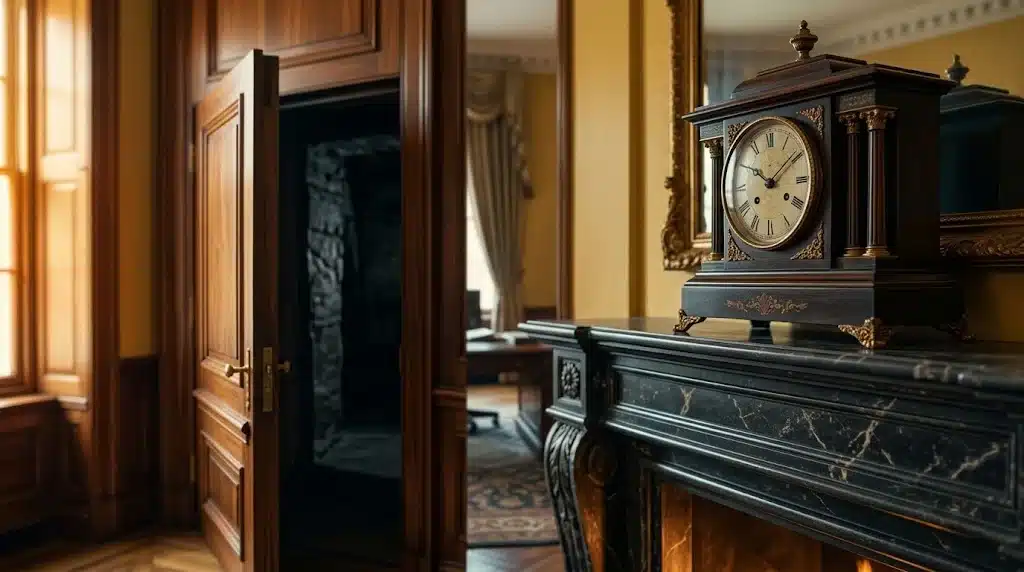
Second, the passage beside the Yellow Oval Room has been sealed. The order is traced to Lilly’s impersonation of First Gentleman Elliot Morgan. When Cordelia opens the concealed space, she finds the missing clock.
The passage matters because it links Lilly’s later cover-up to the original murder weapon. Her story about protecting other people cannot explain away the evidence hidden there.
Why does the investigation take so long?
The first investigation ends without a solution, and the death is treated as a suicide. Later congressional testimony from Patrick Doumbe brings the case back into focus, leading to Cordelia’s return.
The delay reflects the difference between closing a case and explaining it. A convenient account can satisfy the household’s immediate need to move on while leaving the evidence unresolved. The finale revisits that evidence instead of accepting the earlier conclusion.
What does the ending mean for Cordelia and Edwin?
Edwin learns to recognise the moment a suspect’s story slips. His growing understanding of Cordelia’s methods gives their partnership a more equal intellectual footing, even though she remains the leading investigator.
Our reading of the ending is that the household’s many acts of self-protection explain why the truth was so difficult to recover. Lilly commits the murder; other people’s fear and assumptions help obscure it. Cordelia succeeds by asking what each person actually did, rather than treating every suspicious action as proof of the same crime.

