
Spoiler Warning: This article reveals the ending and major plot developments from Christopher Nolan’s The Odyssey.
For a spoiler-free look at the movie’s performances, pacing, and IMAX presentation, read our The Odyssey 2026 review
This The Odyssey Ending Explained article examines Odysseus’s return to Ithaca, the confrontation with Penelope’s suitors, the meaning of Zeus’s Law, and Christopher Nolan’s biggest departure from Homer’s poem. Instead of ending with Odysseus restored permanently to his throne, the 2026 film sends him and Penelope toward a different future while Telemachus becomes king.
What Happens at the End of The Odyssey?
After surviving his long journey home from the Trojan War, Odysseus finally reaches Ithaca. However, he does not immediately announce that its missing king has returned.
He enters his kingdom in disguise and discovers how much has changed during his absence. Penelope remains under pressure from suitors who want to marry her and gain control of Ithaca, while Telemachus faces the difficult task of protecting his family without possessing his father’s authority.
Penelope eventually presents the suitors with a contest involving Odysseus’s bow. The weapon becomes both a practical challenge and a test of identity because Odysseus possesses a unique connection to it.
Still disguised, Odysseus successfully handles the bow and reveals who he really is. The contest leads into his final confrontation with the suitors.
Odysseus defeats them with assistance from Telemachus and loyal allies. The film presents this confrontation as more than a king reclaiming his home. It is also the decision that makes Odysseus’s continued rule impossible.
Why Does Odysseus Fight the Suitors?
The suitors have taken advantage of Odysseus’s long absence. They occupy his household, compete for Penelope, threaten Telemachus’s future, and seek the political power connected to the queen.
Their behavior also violates the film’s idea of Zeus’s Law. This principle is connected to the ancient Greek concept of xenia, which concerns the obligations between hosts, guests, and strangers.
Odysseus has encountered both hospitality and hostility throughout his journey. By the time he returns to Ithaca, he understands that the law protecting guests can be abused by people who enter another person’s home and refuse to respect its boundaries.
His confrontation with the suitors is therefore personally understandable, but it carries political and moral consequences. Their defeat cannot simply return Ithaca to its previous condition because they belong to influential families whose response could create another conflict.
What Is Zeus’s Law?
Zeus’s Law represents the basic principle that strangers and guests should receive humane treatment. It is one of the moral ideas connecting the different parts of Odysseus’s journey.
The concept matters because the film repeatedly examines what happens when people stop recognizing their obligations toward others. Hospitality can help preserve civilization, while betrayal, conquest, and revenge can accelerate its collapse.
Odysseus is not presented as someone who has always obeyed that principle. His participation in the Trojan War and his choices afterward force him to recognize his own failures.
This is essential to the ending. He cannot condemn the suitors while pretending that he has never violated the same moral order. His final decision acknowledges that restoring peace requires more than defeating his enemies.
Why Does Odysseus Accept Exile?
Odysseus understands that remaining king after the confrontation would place Ithaca in danger. The families connected to the suitors could seek revenge, continuing the same cycle of violence that followed him home from Troy.
By taking responsibility and accepting exile, Odysseus separates his actions from Telemachus’s future rule. He gives up the throne he spent years trying to reach so that his son can govern without carrying the full political burden of his father’s choices.
This makes the conclusion deliberately bittersweet. Odysseus reaches Ithaca, reunites with his family, and protects his household, but he does not receive a simple restoration.
Homecoming is no longer defined by ownership of a palace or title. It becomes the recovery of his relationship with Penelope and the opportunity to leave Ithaca in Telemachus’s hands.
Why Does Penelope Leave With Odysseus?
Penelope chooses to accompany Odysseus into exile rather than remain in Ithaca as the mother of its new king.
Her decision completes an idea established around their long separation: what they wanted was not simply political power but the chance to have a life together outside the demands of war and leadership.
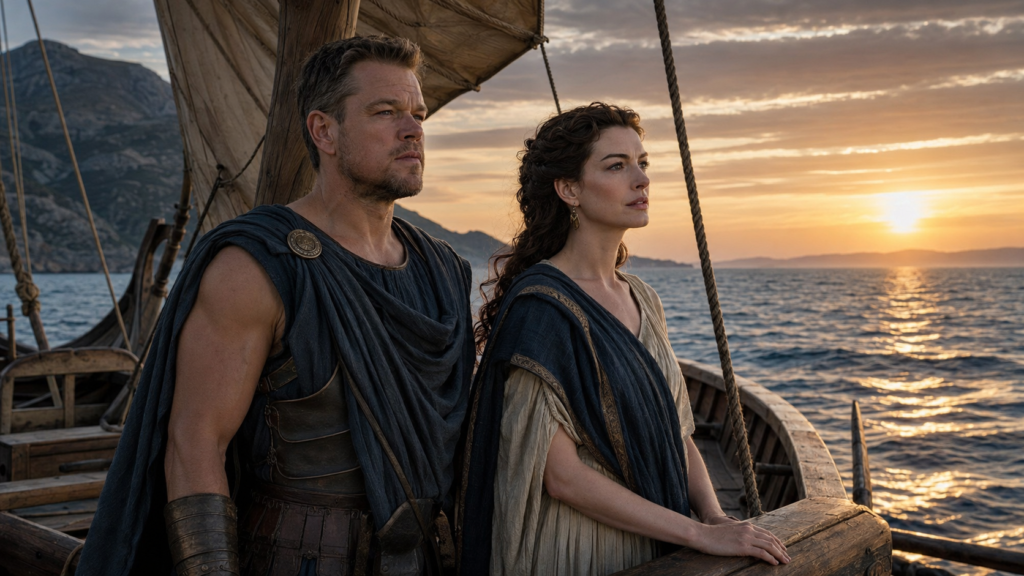
In the final sequence, they sail west while Telemachus remains behind. The journey is different from Odysseus’s earlier travels. He is no longer returning from a war or trying to recover his throne.
The voyage represents a new beginning built on acceptance. Odysseus cannot undo what happened at Troy or during his years away, but he can choose what kind of life follows his return.
Does Odysseus Die at the End?
No. Odysseus survives the film’s ending.
His final departure with Penelope is presented as a real continuation of their lives rather than a confirmed vision, dream, or symbolic death. The movie does not establish that he dies during the final sequence.
The ending gives him a future, but not the future viewers may expect. He loses his position as king while gaining the possibility of living beyond the role of warrior and ruler.
Who Becomes King of Ithaca?
Telemachus becomes the new king of Ithaca.
Odysseus’s departure creates a clean transfer of authority to his son. Telemachus has spent much of his life living with the consequences of a missing father, and the ending requires him to move beyond that absence.
Becoming king also completes his development from an uncertain heir into a leader responsible for Ithaca’s future. Odysseus protects that future by removing himself from the political conflict surrounding the suitors.
The conclusion is therefore not only the end of Odysseus’s journey. It is the beginning of Telemachus’s rule.
Who Are the “People From the Sea”?
The “people from the sea” are ultimately connected to Odysseus and the returning Greek forces.
Earlier references make them sound like an outside threat capable of destabilizing established societies. The final interpretation turns that fear inward: the returning warriors have become the destructive force that other communities fear.
This revelation connects the fall of Troy to the larger decline of Bronze Age civilization. The danger does not come only from monsters, gods, or unknown invaders. It also comes from celebrated warriors who carry the habits of war into the places they encounter.
Odysseus recognizes that he cannot separate himself from this destruction. His intelligence helped win the war, but victory did not automatically make his choices morally right.
That realization gives his exile a second meaning. He is leaving Ithaca not only because of the suitors but because he understands what prolonged war has turned him into.
What Does the Final Voyage Mean?
The final voyage combines accountability with hope.
Odysseus and Penelope leave behind the kingdom that defined their earlier lives. Telemachus represents continuity because Ithaca still has a ruler, while his parents represent the possibility of stepping outside the cycle that shaped their generation.
Their voyage west also connects with the film’s repeated use of the horizon and the movement of the sun. Civilization may decline, knowledge may be lost, and stories may change, but another period of growth can eventually follow.
In Christopher Nolan’s explanation of the ending, the director connects the conclusion to cycles of collapse and renewal. The ending is cautious rather than purely optimistic: history can repeat its failures, but rebuilding remains possible.
How Is the Movie’s Ending Different From Homer’s Poem?
Nolan makes a major change to Homer’s conclusion.
In the original poem, Odysseus reclaims his position in Ithaca. The conflict caused by the suitors threatens to continue when their families demand justice, but divine intervention brings the dispute to an end.
The film removes that restoration. Odysseus does not remain on the throne, and Penelope leaves Ithaca with him. Telemachus becomes king instead.
The movie also excludes some of the poem’s harsher final material and reduces the role of direct divine intervention. This places greater responsibility on human decisions.
As Time’s examination of Zeus’s Law and the ending explains, the film reframes exile as the price of Odysseus’s actions and the path that allows him and Penelope to depart together.
Why Did Christopher Nolan Change the Ending?
Nolan’s ending supports the film’s focus on war, responsibility, and historical cycles.
A straightforward return to the throne could suggest that Odysseus’s suffering and victories have restored the old order. The film instead argues that the old order has already been damaged beyond simple repair.
Odysseus must give up political power because reclaiming it through another confrontation would continue the pattern established at Troy. His exile becomes an act of responsibility rather than another defeat.
The change also gives Penelope and Telemachus more active positions in the conclusion. Penelope chooses her future, while Telemachus inherits responsibility for Ithaca rather than remaining permanently defined as Odysseus’s waiting son.
The Odyssey Ending Explained: Final Meaning
The ending is about what happens after a warrior reaches the home he has spent years trying to recover.
Odysseus discovers that returning does not erase his past or automatically restore his former life. Protecting his family requires him to surrender the throne, accept responsibility, and allow Telemachus to lead.
The revelation concerning the people from the sea broadens that personal conclusion. War has not only damaged Odysseus; it has helped destabilize the civilization he believed he was defending.
This The Odyssey Ending Explained conclusion is ultimately bittersweet. Odysseus loses Ithaca as a ruler but regains Penelope as a partner in a new journey. Telemachus inherits the kingdom, and the final voyage suggests that renewal is still possible after collapse.
Frequently Asked Questions
Does Odysseus return to Ithaca?
Yes. Odysseus reaches Ithaca and reunites with Penelope and Telemachus before choosing exile.
Does Odysseus reclaim his throne?
No. Although he returns and defeats the suitors, he does not remain king of Ithaca.
Why does Odysseus leave Ithaca?
He accepts responsibility for the final conflict and leaves to prevent its political consequences from defining Telemachus’s rule.
Does Penelope recognize Odysseus?
Yes. Penelope ultimately recognizes and reunites with her husband before choosing to accompany him.
Who becomes king after Odysseus?
Telemachus becomes king of Ithaca.
Are the people from the sea real?
Within the movie’s interpretation, the description points toward Odysseus and other returning Greek warriors whose campaigns have helped destabilize surrounding civilizations.
Is the ending the same as Homer’s poem?
No. Homer’s poem restores Odysseus to Ithaca, while Nolan’s movie sends Odysseus and Penelope into exile and leaves Telemachus as king.
Does The Odyssey have a post-credits scene?
No. Reliable reports confirm that the film has no mid-credits or post-credits scene.