Article Type: Trending Movie Article — Spoiler-Free
The Odyssey box office performance has become one of the clearest reasons Christopher Nolan’s new film is dominating movie discussion.
Released by Universal Pictures on July 17, 2026, the adaptation of Homer’s ancient Greek epic has attracted attention through its large-format presentation, unusual production method, recognizable cast, and strong theatrical results. This article explains seven verified reasons behind that interest without revealing the ending or major story developments.
1. The Odyssey Has Become a Major IMAX Event
The Odyssey was shot entirely with IMAX film cameras, making the format part of the production rather than an enhancement added after filming.
The official Universal Pictures movie page promotes the all-IMAX production as one of the film’s defining features. This has encouraged viewers to distinguish between standard screenings, digital IMAX presentations, and the much rarer IMAX 70mm film version.
Availability matters. IMAX 70mm projection requires specialized equipment, trained projectionists, and physical film prints. Only a limited number of theaters can present the movie in that format, creating stronger demand around particular locations and screening times.
IMAX reported a $52 million global opening for the film in its theaters. The company then announced a record $48 million IMAX second weekend on July 27. Those figures provide measurable evidence that premium-format interest is contributing significantly to the film’s theatrical performance.
2. Christopher Nolan’s Name Creates Major Audience Interest
Nolan’s involvement gave the project visibility before viewers knew exactly how he would approach the material.
The subject is a notable change from the historical drama of Oppenheimer and the science-fiction concepts associated with several of his other films. Here, Nolan is working with an ancient poem involving war, leadership, gods, monsters, survival, and a difficult journey home.
The question attracting attention is not simply whether Nolan can produce another large film. It is how his preference for physical locations, practical production, film photography, and grounded human conflict can be applied to Greek mythology.
That combination has helped make Christopher Nolan’s The Odyssey interesting to two groups: viewers who follow his filmmaking and readers curious about a modern interpretation of Homer.
3. The Film Reimagines One of the World’s Most Famous Epics
Homer’s Odyssey has influenced literature, theater, art, and screen storytelling for centuries. Its basic idea—a traveler facing repeated obstacles while attempting to return home—remains easy to recognize even for people who have never read the poem.
Adapting it into a modern feature film raises difficult questions. The source is episodic, contains a large number of characters, and mixes human decisions with divine intervention. A filmmaker must decide what to retain, shorten, combine, reinterpret, or exclude.
That challenge has encouraged discussion about the film’s treatment of mythology, ancient societies, costumes, and the balance between realism and fantasy.
The renewed interest is not limited to the movie itself. Discussions surrounding the adaptation have also brought Homer’s poem and modern translations back into cultural conversation. This gives the movie popularity beyond an ordinary opening-weekend release.
4. The Large Cast Expands the Movie’s Audience
Matt Damon leads the movie as Odysseus, the king of Ithaca attempting to return home after the Trojan War.
The supporting cast includes performers associated with different audiences and genres. Tom Holland plays Telemachus, while Anne Hathaway appears as Penelope and Robert Pattinson as Antinous. Zendaya, Lupita Nyong’o, and Charlize Theron also hold important roles connected to the film’s mythological world.
The cast is not generating interest simply because it contains recognizable names. It brings together established collaborators from Nolan’s earlier projects and performers with large audiences outside his usual following.
Damon gives the movie an experienced central lead, while Holland and Zendaya connect it with younger moviegoers and major contemporary franchises. Hathaway, Pattinson, Nyong’o, and Theron add further interest without making the project dependent on one fan base.
5. The Odyssey Box Office Is Being Closely Watched
The latest available figures show that the movie’s attention has translated into substantial ticket sales.
According to Box Office Mojo’s current totals, The Odyssey box office reached approximately $320.6 million domestically and $683.2 million worldwide as of July 30, 2026.
The movie opened with approximately $123.5 million domestically. Universal’s opening-weekend estimates, reported by Reuters on July 19, placed the global debut at $264.1 million.
Premium formats played an important role from the beginning. Reuters reported that approximately half of opening-weekend viewers selected enhanced formats, with IMAX accounting for 23% of the audience.
By the end of its second weekend, Variety reported that the movie had generated approximately $140 million from IMAX screenings worldwide. This does not mean every viewer specifically chose IMAX 70mm, since the total includes different IMAX presentation types.
The figures confirm a successful start, but future milestones should not be treated as guaranteed. The worldwide total will continue changing throughout the theatrical run.
6. Viewers Are Debating Nolan’s Adaptation Choices
The movie’s cultural attention also comes from disagreement about how a famous ancient work should be adapted.
Some discussion concerns historical and visual interpretation. Homer’s poem combines mythology with traditions connected to the ancient Greek world, but it is not a modern historical record. Costumes, ships, language, and the appearance of mythological figures therefore involve interpretation rather than one unquestionably accurate design.
Other conversations focus on Nolan’s changes to the poem’s structure and characters. Compressing a long episodic work into a feature film requires omissions and rearrangements. Readers familiar with Homer may judge those decisions differently from viewers encountering the story for the first time.
Casting has also generated debate, particularly around how ancient mythological figures should be represented by a modern international cast. The most useful discussion examines whether the performances and creative decisions serve the adaptation. Offensive or unsupported social-media attacks do not provide reliable evidence about the movie’s quality or popularity.
These disagreements help explain why The Odyssey is so popular as a discussion topic: it invites arguments about literature, mythology, filmmaking, and who gets to reinterpret culturally important stories.
7. The Movie Was Designed as a Theatrical Experience
The film’s production supports the idea that it was built for theaters.
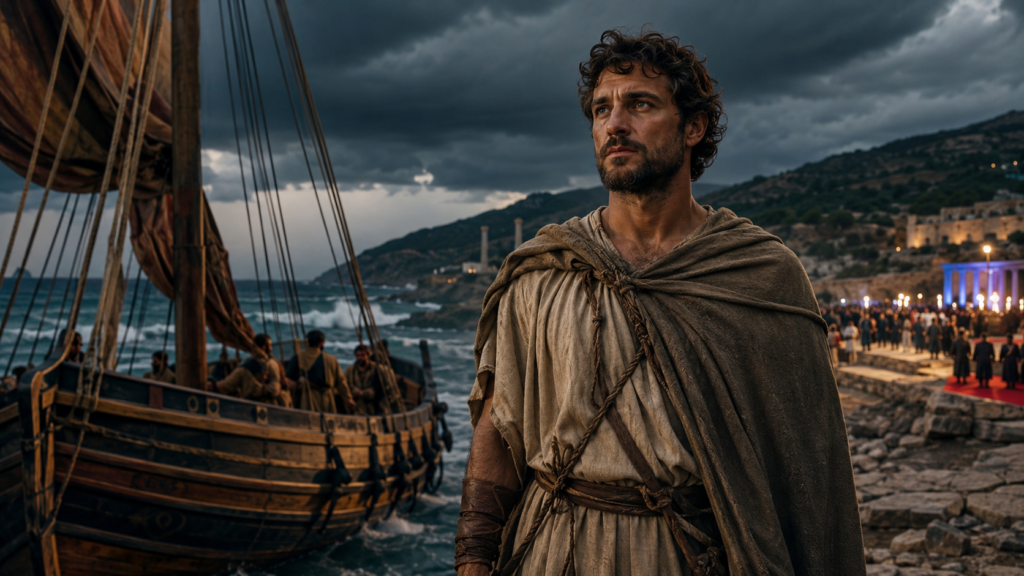
Nolan and cinematographer Hoyte van Hoytema filmed across real coastlines, open water, rugged landscapes, and large physical environments. Ships, costumes, natural weather, and large-format photography give the production a scale that is easier to appreciate on a cinema screen.
This section is broader than the rarity of IMAX 70mm. The theatrical appeal also comes from the relationship between image, sound, landscape, and physical production.
Audiences do not need access to a 70mm venue to understand the movie. However, the strong IMAX contribution to its revenue indicates that many ticket buyers consider presentation format part of the attraction.
That makes The Odyssey IMAX success relevant to the wider conversation about theatrical releases. The film provides audiences with a specific reason to choose a cinema rather than wait for home viewing.
Is The Odyssey Trending for the Right Reasons?
The available evidence shows that the attention is not based entirely on marketing or short-lived social-media activity.
The strongest reasons are measurable: a $683.2 million worldwide total as of July 30, substantial IMAX revenue, limited access to IMAX 70mm screenings, and continued interest after the opening weekend.
The cultural conversation surrounding Homer’s poem and Nolan’s adaptation also has more depth than ordinary promotional attention. Viewers are discussing how an ancient episodic work can be turned into a modern blockbuster and how creative freedom should operate when adapting mythology.
Some online claims remain temporary or difficult to measure. Search activity, individual posts, and isolated reactions cannot prove what the entire audience thinks. The most reliable signs of sustained interest remain ticket sales, premium-format demand, and continued reporting about the adaptation.
Is The Odyssey Worth Watching?
The Odyssey is most relevant to viewers interested in Christopher Nolan’s filmmaking, Greek mythology, practical production, and large-scale theatrical movies.
Anyone looking for a short or simple adventure should first consider the movie’s nearly three-hour commitment and dense source material.
Readers who have already watched the movie can explore our The Odyssey ending explained for a full spoiler-filled breakdown of the finale.
Why Is The Odyssey Trending? Final Answer
Why is The Odyssey trending? The strongest verified reasons are its unusual all-IMAX production, limited 70mm availability, commercially successful theatrical run, recognizable ensemble cast, and the cultural debate surrounding Nolan’s interpretation of Homer.
The The Odyssey box office figures show that the attention has moved beyond advance marketing. Meanwhile, discussion about mythology and adaptation gives the movie a subject that can remain relevant after its opening weeks.
Follow the film’s latest domestic and worldwide earnings through Box Office Mojo’s The Odyssey box-office report
Frequently Asked Questions
Why is The Odyssey trending right now?
The movie is receiving attention because of its strong box-office performance, all-IMAX production, limited 70mm screenings, large cast, and debates about its interpretation of Homer’s poem.
When was The Odyssey released?
Universal Pictures released the film theatrically on July 17, 2026.
Who plays Odysseus in The Odyssey?
Matt Damon plays Odysseus.
Was The Odyssey filmed for IMAX?
Yes. The film was shot entirely using IMAX film cameras. IMAX 70mm film screenings are available only at a limited number of equipped theaters.
Is The Odyssey based on a true story?
No. It adapts Homer’s ancient Greek epic and includes mythology. It is not a straightforward account of verified historical events.
Is The Odyssey a box-office success?
The movie has made approximately $320.6 million domestically and $683.2 million worldwide as of July 30, 2026. Those figures represent a strong theatrical performance, although the totals will continue changing.
Does this article contain spoilers?
No. It discusses the movie’s popularity, production, and theatrical performance without revealing the ending or major surprises.