
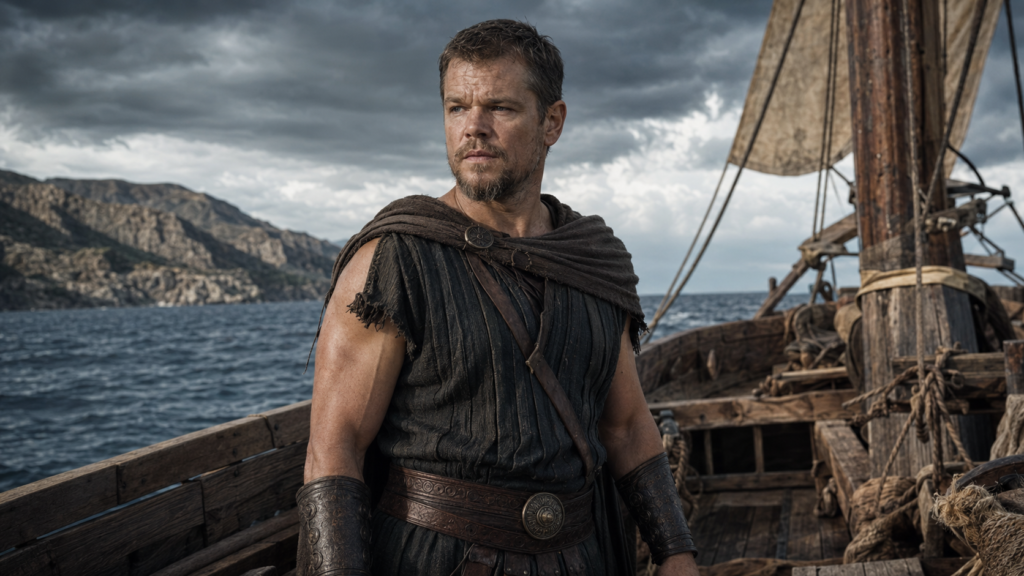
Article Type: Spoiler-Free Review
This The Odyssey 2026 Review examines Christopher Nolan’s ambitious adaptation of Homer’s ancient Greek epic without revealing the ending or its major surprises. Released theatrically by Universal Pictures on July 17, 2026, the film follows Odysseus, played by Matt Damon, as he attempts to return home after the Trojan War. The scale is enormous, but the more important question is whether Nolan turns that scale into a clear and involving movie.
What Is The Odyssey About?
Odysseus is the king of Ithaca, a warrior and a skilled strategist who has spent years away from his kingdom because of the Trojan War. When the conflict ends, he begins the dangerous journey back to his wife, Penelope, and their son, Telemachus.
The film is based on Homer’s Odyssey, one of the foundational works of ancient Greek literature. Its central idea is simple: a man wants to return home. The journey becomes complicated by hostile environments, mythological forces, difficult decisions, and the consequences of Odysseus’s own personality.
This review will not list every destination, explain the film’s surprises, or reveal how Nolan resolves the journey.
How Does Christopher Nolan Adapt Homer’s Epic?
Adapting The Odyssey presents an unusual structural problem. Homer’s poem is episodic, moving between locations, encounters, memories, and different forms of storytelling. A modern feature film still needs momentum and a recognizable emotional direction.
Nolan’s clearest organizing principle is the idea of homecoming. The mythology, survival challenges, political tension, and large-scale action all return to the same question: what remains of a person’s home after years of war and absence?
The approach also gives Odysseus more than one type of conflict. He must survive physical danger, lead other people, judge when force is necessary, and confront the consequences of his choices. That combination helps prevent the film from becoming a simple collection of mythological attractions.
However, the adaptation cannot give every section of Homer’s poem equal attention. Some viewers familiar with the source may question what has been shortened, rearranged, or reinterpreted. Nolan’s version should therefore be treated as a cinematic interpretation rather than a complete visual translation of the poem.
Matt Damon as Odysseus
Matt Damon’s Odysseus is not built as an uncomplicated action hero. The character is a king, soldier, strategist, husband, and father, but his intelligence does not protect him from pride or poor judgment.
That complexity gives Damon a demanding central role. Odysseus must appear capable enough to command others while remaining vulnerable to exhaustion, uncertainty, and the consequences of leadership. His most important quality is not physical power but his ability to observe a situation and search for a way through it.
Published responses to Damon’s performance have varied in enthusiasm, but the role is clearly designed around endurance and decision-making rather than constant speeches or heroic posing. This makes Matt Damon as Odysseus the film’s main human anchor even when the production expands into mythic territory.
The Supporting Cast and Characters
Tom Holland plays Telemachus, the son who has grown up largely without his father. His presence gives the homecoming story another perspective: Odysseus is not only trying to reach a place, but also a family that has continued to live in his absence.
Anne Hathaway plays Penelope, Odysseus’s wife and the queen of Ithaca. Her position carries its own pressure because waiting is not presented as an empty or passive activity. Ithaca has political uncertainty, and Odysseus’s continued absence affects everyone connected to his household.
Robert Pattinson appears as Antinous, one of Penelope’s suitors. Zendaya plays Athena, while Lupita Nyong’o portrays Helen and Clytemnestra. Charlize Theron appears as Calypso. These characters connect different sides of the story, including divine influence, the effects of the Trojan War, and the competing demands placed on Odysseus.
The size of the cast adds depth to the world, although it also creates a challenge. Viewers unfamiliar with the mythology may need time to remember names and relationships, especially when several characters enter during different stages of the journey.
Visual Style, IMAX, and Practical Scale
The most distinctive production fact is that The Odyssey was shot entirely with IMAX film cameras. IMAX’s official presentation page confirms that it was designed from the beginning as a large-format theatrical production rather than merely converted for premium screens.
Nolan and cinematographer Hoyte van Hoytema use real coastlines, open water, constructed ships, costumes, and physical environments to give the myth a tangible foundation. Filming in locations across countries including Greece, Morocco, Italy, Iceland, and Scotland allowed the journey to move through landscapes with visibly different textures.
That matters because the story depends on distance and isolation. A wide view of the sea or a figure surrounded by a large natural environment communicates how far Odysseus is from safety without requiring additional explanation.
A regular theater can still present the narrative, but IMAX offers more of the image captured by the large-format cameras. The larger screen also makes the relationship between the characters and their environments more immediate. Viewers primarily interested in the filmmaking will gain the most from seeing The Odyssey IMAX presentation.
Action, Pacing, and Runtime
The official runtime is approximately two hours and 52 minutes. That length gives the film room to establish its world, but it also asks for patience.
The episodic source remains visible in the movie’s structure. Odysseus faces a sequence of changing locations, people, and problems, and not every section carries the same speed. The film alternates between mythic danger, strategic conversations, political tension, and quieter attention to the meaning of home.
This variety prevents the journey from becoming one continuous action sequence. It can also make the middle portion feel less direct for viewers expecting the tighter momentum of a conventional adventure movie.
The main question is not whether the film contains enough incident. It is whether each episode strengthens Odysseus’s larger journey. The homecoming theme provides coherence, although the large cast and number of transitions occasionally make the narrative feel dense.
Music and Sound
Ludwig Göransson composed the score, continuing his collaboration with Nolan after Oppenheimer. The music combines the scale expected from a mythic action epic with sounds intended to suggest an older and less familiar world.
The score does more than announce danger. Its percussion, metallic textures, and historically influenced instruments help connect the mythology to the film’s physical environments. Music can enlarge a landscape, while quieter sound design emphasizes separation and uncertainty.
As with other large-format Nolan productions, the sound is part of the theatrical experience. A properly equipped auditorium gives the sea, ships, weather, and score a physical presence that smaller speakers may not reproduce as effectively.
Does The Odyssey Work for Viewers Who Have Not Read Homer?
Newcomers can understand the main story without reading the poem first. The essential motivation—Odysseus trying to return to Ithaca and reunite with his family—is clear enough to guide viewers through the changing locations and characters.
Basic knowledge of Greek mythology can still improve the experience. Recognizing the relationships among the gods, rulers, and figures connected to the Trojan War adds context that the film cannot always stop to explain in detail.
Reading a short, spoiler-free introduction to Homer may help, but it is not required. The movie is designed as a large-scale adventure as well as a Homer adaptation.
What Works Well?
The strongest element is the connection between the production method and the story. Real locations, physical ships, changing weather, and large-format cinematography are appropriate for a narrative about distance, danger, and human vulnerability.
The central character is another strength. Odysseus succeeds through intelligence and adaptability, but his flaws keep the journey from becoming a straightforward celebration of heroic power.
The theme of homecoming also gives the movie an accessible emotional foundation. Viewers do not need specialist knowledge of ancient literature to understand the desire to return to one’s family after years of separation.
Finally, Nolan treats the mythology seriously without removing its strangeness. The movie grounds the world in physical environments while allowing divine influence and ancient beliefs to remain part of its identity.
What Could Have Been Better?
The film’s greatest strength is also its main difficulty. The source contains many characters and episodes, and compressing that material into one feature creates a dense narrative.
Some supporting characters receive limited time compared with the importance their names may suggest. Viewers attracted by the ensemble cast should understand that Odysseus remains the center of the movie.
The runtime may also test viewers who prefer fast, linear action. Several sections prioritize atmosphere, political context, or character decisions over immediate spectacle.
The adaptation has also produced disagreement about emotional depth and faithfulness to Homer. In Christopher Nolan’s detailed interview with Time, the director discusses treating the poem as foundational material while making deliberate cinematic choices. Those choices will not satisfy every reader who wants the film to preserve the structure and complexity of the original.
Is The Odyssey Worth Watching?
Yes, with clear expectations. The Odyssey is worth watching for viewers interested in Christopher Nolan’s filmmaking, Greek mythology, practical production, large-format cinematography, and character-driven historical or fantasy epics.
It may be less suitable for anyone expecting a short, continuously fast action film. The nearly three-hour runtime, episodic structure, and large cast require attention.
Theatrical presentation matters more here than it does for an average drama. An IMAX screen is the preferred option when reasonably available, although it is not necessary for understanding the story.
The Odyssey 2026 Review Verdict
This The Odyssey 2026 Review finds a carefully constructed mythic epic whose scale supports its central themes of survival, leadership, absence, and homecoming. Matt Damon’s Odysseus gives the film a clear center, while the locations and IMAX photography make the journey feel physically demanding.
The dense structure and long runtime may create distance for some viewers, particularly those unfamiliar with Homer or expecting a conventional action movie. Still, the production offers a distinct theatrical interpretation of one of literature’s most influential journeys.
The final recommendation is positive but measured: see it for the filmmaking, the central character, and Nolan’s interpretation of Greek mythology—not simply for the size of its cast.
Frequently Asked Questions
Is The Odyssey 2026 a true story?
No. The movie is based on an ancient Greek epic poem containing legendary characters, historical traditions, and mythology. It is not presented as a verified historical account.
Is The Odyssey based on Homer’s poem?
Yes. Christopher Nolan wrote and directed the film as an adaptation of Homer’s Odyssey.
Who plays Odysseus in The Odyssey?
Matt Damon plays Odysseus, the king of Ithaca attempting to return home after the Trojan War.
Who directed The Odyssey?
Christopher Nolan directed the film and wrote its screenplay.
Is The Odyssey suitable for viewers unfamiliar with Greek mythology?
Yes. The central journey is understandable without prior reading, although familiarity with Greek mythology can make certain characters and relationships easier to follow.
Does The Odyssey contain spoilers for Homer’s original story?
As an adaptation, the movie covers characters and events derived from Homer’s poem. Anyone completely unfamiliar with the original will naturally learn parts of its story by watching the film.
Is The Odyssey worth seeing in IMAX?
Yes, particularly for viewers interested in cinematography and theatrical scale. The film was shot entirely with IMAX film cameras, so the format is closely connected to its visual design.
Does The Odyssey have a post-credits scene?
No reliable reports indicate a mid-credits or post-credits scene. Current confirmation states that the film ends without an additional scene after the credits.
Discover more movie news, updates, and popular releases in our Trending section