
This review is spoiler-free and reveals only the movie’s basic premise.
The short answer is yes—with realistic expectations. Jurassic World Rebirth is worth watching for audiences who want a polished, suspenseful dinosaur adventure, even if it does not reinvent a franchise now seven films deep. It is more controlled and atmospheric than some recent entries, but its human story never becomes as memorable as its creatures.
That split helps explain why Jurassic World Rebirth reviews have been mixed. Gareth Edwards brings scale, tactile environments, and several carefully staged survival sequences, while David Koepp’s screenplay relies on familiar franchise machinery and thinly developed supporting characters. This review finds a satisfying summer creature feature—not a return to the dramatic power of Steven Spielberg’s original.
What Is Jurassic World Rebirth About?
Set five years after Jurassic World Dominion, the story begins in a world where most dinosaurs can no longer survive. The remaining animals are concentrated in isolated equatorial environments similar to the prehistoric climates in which they once flourished.
Covert-operations specialist Zora Bennett is hired to lead a dangerous expedition alongside paleontologist Dr. Henry Loomis and boat captain Duncan Kincaid. Their objective is to obtain genetic material from three enormous prehistoric creatures—one associated with land, one with the sea, and one with the air—because that material could support a potentially lifesaving medical breakthrough.
The mission brings them into contact with a stranded civilian family and pushes the group toward a forbidden former research location. That is all viewers need to know before watching. The film functions as the fourth Jurassic World installment and the seventh feature in the wider Jurassic Park franchise, but its new central cast makes it reasonably accessible to casual viewers.
Directed by Gareth Edwards and written by original Jurassic Park screenwriter David Koepp, the film opened in the United States on July 2, 2025. Universal Pictures released the 133-minute, PG-13 action-adventure.
Jurassic World Rebirth Review: What Works
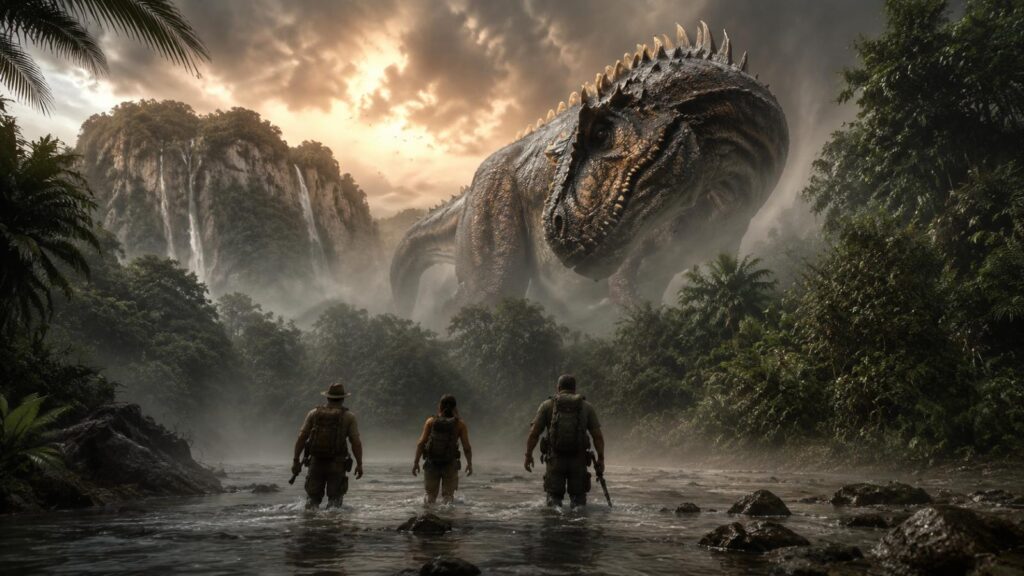
Edwards understands that size is most effective when the camera gives viewers something human against which to measure it. The tropical locations, open water, towering structures, and dense vegetation make the expedition feel physically vulnerable. Rather than presenting every creature encounter as an effects demonstration, he frequently lets geography and restricted visibility create tension first.
The strongest action sequences are built around simple survival problems: characters must cross exposed spaces, remain quiet, or react when an environment suddenly becomes hostile. Clear staging makes the danger easy to follow. The film is at its best when it slows down long enough for the audience to anticipate where a threat might emerge.
John Mathieson’s cinematography also gives the adventure a welcome sense of texture. Wide compositions sell the scale of the locations, while shadows, water, and obstructed sightlines restore some of the suspense that the franchise loses whenever dinosaurs become ordinary background traffic.
The visual effects are not uniformly invisible, but the major creatures have weight and presence. Alexandre Desplat’s score supports the new expedition while using the franchise’s musical heritage selectively rather than leaning on recognition in every scene.
Readers interested in another effects-driven science-fiction adventure can also read our Project Hail Mary review.
The Dinosaurs Are Still the Main Attraction
The dinosaurs are treated less like familiar mascots and more like unpredictable animals. That shift matters. The best encounters emphasize patience, scale, and the uncomfortable knowledge that the humans have entered territory they cannot control.
Rebirth also offers useful variety. Land, marine, and airborne creatures allow Edwards to change the visual language and physical rules of the danger rather than repeat the same chase. Some sequences pursue wonder, while others lean toward monster-movie horror.
The creature designs combine recognizable prehistoric silhouettes with deliberately engineered abnormalities. Purists may prefer the more naturalistic animals, but the altered specimens fit the film’s darker research-island atmosphere. Crucially, the movie does not forget that a quiet approach, a partial glimpse, or a distant sound can be more frightening than constant roaring.
Not every encounter has equal impact. A few exist mainly to provide another escalation, and digital compositing is more noticeable in some fast-moving shots. Even so, the dinosaurs remain the film’s clearest reason to watch it on a large screen.
Scarlett Johansson, Mahershala Ali and the Cast
Scarlett Johansson gives Zora Bennett the composed authority needed to make an experienced operations leader credible. She handles the physical demands without turning Zora into an invulnerable action figure, and small moments of hesitation hint at a more complicated person than the screenplay fully explores.
Mahershala Ali brings quiet gravity to Duncan Kincaid. His understated work gives the expedition an emotional center, especially when the script allows personal loyalty to matter more than mission logistics. He often communicates concern without overplaying it.
Jonathan Bailey provides the most open enthusiasm as Dr. Henry Loomis. His sense of awe keeps the science from becoming pure exposition and gives the group a warmer energy. The contrast between Loomis’s curiosity and Zora’s pragmatism is one of the ensemble’s more engaging dynamics.
Rupert Friend is effective as pharmaceutical representative Martin Krebs, while Manuel Garcia-Rulfo and the actors playing the Delgado family bring an ordinary civilian perspective to the danger. The cast is capable throughout; the limitation is that several roles are defined more by function than by meaningful development.
Where Jurassic World Rebirth Falls Short
Rebirth’s largest weakness is its familiarity. The isolated facility, questionable corporate motives, improvised survival plan, and clash between scientific wonder and commercial exploitation all belong to the franchise’s established vocabulary. Koepp rearranges those pieces efficiently, but rarely finds a new idea beneath them.
The screenplay also divides attention between the professional expedition and the civilian family. That structure creates more bodies to place in danger, yet it reduces the time available to deepen either group. Several relationships arrive as quick sketches and are then expected to carry emotional weight during the action.
Pacing is uneven across the 133-minute runtime. The suspense sequences are usually deliberate in a productive way, but the connective material contains exposition and character beats that feel more mechanical. The movie sometimes pauses to explain its objective without making the people pursuing it substantially more complex.
Nostalgia is handled with more restraint than it could have been, but the film remains caught between honoring Jurassic Park and establishing an identity of its own. Edwards restores tension and visual grandeur; the story itself rarely makes “rebirth” feel like more than a franchise label.
Jurassic World Rebirth Reviews: What Are Critics Saying?
Rotten Tomatoes’ critics consensus highlights the energetic set pieces while criticizing familiar story ideas. Its audience summary is more positive about the dinosaur spectacle. See the current scores and individual reviews on Rotten Tomatoes.
CinePulse24’s 7/10 assessment reflects that balance: strong creature staging and atmosphere, limited by familiar plotting and underwritten characters.
For current U.S. streaming, rental and purchase options, see our Jurassic World Rebirth streaming guide.
Jurassic World Rebirth Rating
CinePulse24 Rating: 7/10
The rating reflects a technically confident, entertaining creature adventure with several genuinely tense sequences and a dependable lead trio. It loses points for underwritten supporting roles, uneven pacing, and a story assembled from ideas the franchise has already used.
The film is officially rated PG-13 by the MPA for intense sequences of violence/action, bloody images, some suggestive references, language, and a drug reference. Parents should expect sustained creature peril and occasional frightening imagery, not graphic horror.
Is Jurassic World Rebirth Worth Watching?
Jurassic World Rebirth is worth watching for franchise fans, dinosaur-movie enthusiasts, and audiences looking for a straightforward action-adventure with moments of real suspense. Its scale and sound design benefit from a large screen, but the recommendation still applies at home if spectacle is the main attraction.
Casual viewers do not need to remember every detail of the previous trilogy. The early setup explains the state of the world and introduces a new team, although familiarity with Dominion helps establish why the dinosaurs are now geographically restricted.
The final verdict is positive but measured: Rebirth recovers some of the danger and wonder associated with the Jurassic name without discovering a genuinely new evolutionary path. Watch it for Edwards’ creature staging and the lead performances, not for a revolutionary story.
After watching, readers seeking spoiler-heavy discussion can browse CinePulse24’s Ending Explained guides. That coverage remains separate from this spoiler-free review.
For another character-driven genre film, see our spoiler-free Sinners review.

