
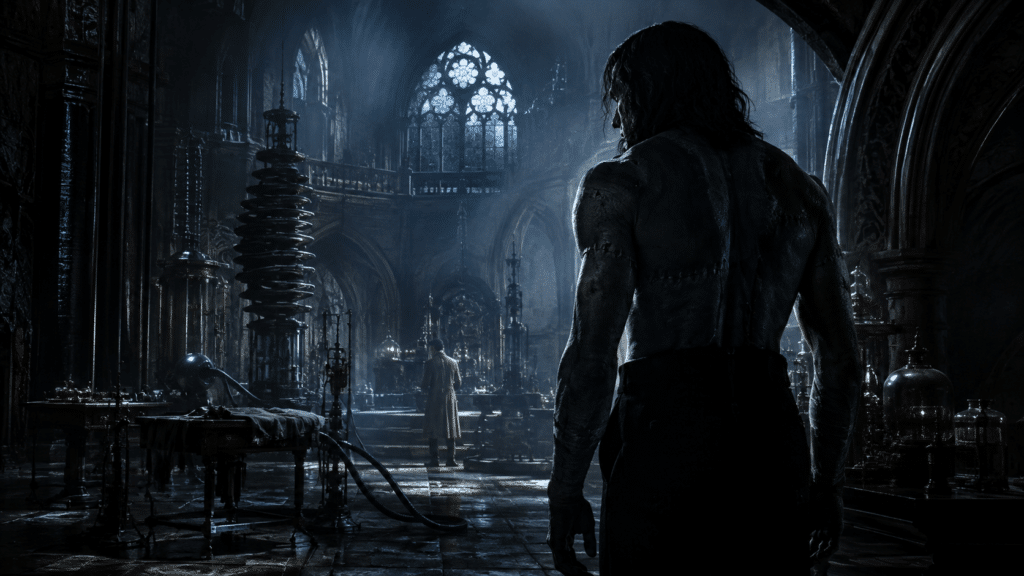
Guillermo del Toro’s Frankenstein revisits Mary Shelley’s story through loneliness, responsibility and the bond between creator and creation. Its Gothic design and central performances are compelling, though the deliberate pace sometimes weakens the drama.
Frankenstein (2025) is a dark, visually ambitious and deeply emotional interpretation of Shelley’s novel. Rather than treating the Creature as a simple horror figure, del Toro focuses on loneliness, responsibility, obsession and the painful relationship between a creator and the life he brings into the world.
Oscar Isaac plays Victor Frankenstein, while Jacob Elordi takes on the role of the Creature. Mia Goth also has a major role in the film, with Christoph Waltz and Felix Kammerer among the supporting cast.
The result is not a fast-paced horror movie. It is a Gothic tragedy that prefers atmosphere, character and emotion over constant scares.
Story and Themes — No Major Spoilers
The basic story remains familiar.
Victor Frankenstein is a gifted scientist whose ambition pushes him toward an extraordinary experiment: creating life. His success changes both his own existence and that of the being he creates.
But the movie is less interested in the mechanics of the experiment than in its consequences.
One of the film’s strongest themes is responsibility.
Creating life is presented not only as a scientific achievement but also as an enormous moral obligation. Victor wants the glory of creation, yet the film repeatedly questions whether he understands the responsibility that comes with it.
Another major theme is isolation.
Both Victor and the Creature experience loneliness, although in very different ways. Victor separates himself from other people through obsession, while the Creature must discover what it means to exist in a society that judges him before understanding him.
That contrast gives the characters emotional depth.
There is also an important question running underneath the story: what actually makes someone a monster?
Del Toro does not answer that question in a simple way. Instead, he allows the audience to examine cruelty, rejection, pride and compassion from different perspectives.
Guillermo del Toro’s Direction
Del Toro’s recurring interests make him a natural fit for Shelley’s story.
Films such as Pan’s Labyrinth, The Shape of Water and Crimson Peak have already shown the director’s fascination with monsters, Gothic architecture, fairy tales and emotionally damaged characters.
Here, those interests fit Mary Shelley’s story extremely well.
Del Toro creates a world that feels romantic, strange and frequently unsettling. The environments are large and elaborate, but the movie still feels personal because the visual design reflects the emotions of the characters.
Victor’s world often feels controlled, mechanical and obsessive.
The Creature’s journey, by comparison, feels more uncertain and emotionally exposed.
Del Toro also gives the story an operatic quality. Characters experience enormous emotions, the production design is deliberately grand, and the movie rarely tries to hide the fact that it is telling a tragic story.
That approach works beautifully in many scenes.
However, it also contributes to one of the film’s biggest problems: pacing.
The director sometimes allows scenes and ideas to continue longer than necessary. The result is a movie that can feel heavy in its middle section.
Still, the patience allows important character moments to breathe.
Jacob Elordi as Frankenstein’s Creature
Jacob Elordi plays the Creature, opposite Oscar Isaac as Victor Frankenstein.
His performance is one of the movie’s strongest elements.
The physical transformation naturally attracts attention, but Elordi does more than rely on makeup or size.
His Creature communicates through movement, expression and silence as much as dialogue. There is uncertainty in the way he observes the world and sadness in the way he reacts to it.
That vulnerability is crucial.
The Creature could easily have become nothing more than an impressive visual design. Instead, Elordi makes him feel like a character trying to understand both himself and the people around him.
> >Oscar Isaac and the Supporting Cast
Oscar Isaac brings very different energy to Victor.
His Victor Frankenstein is charismatic, intelligent and obsessive. He is the kind of person whose confidence can quickly become arrogance.
Isaac understands that Victor needs to remain interesting even when the audience begins questioning his choices.
Instead of portraying him as a stereotypical mad scientist, the performance emphasizes ambition, ego and emotional damage.
That makes the relationship between Victor and the Creature more complicated.
Mia Goth also fits naturally into del Toro’s Gothic world. Her presence brings another emotional dimension to a story otherwise dominated by obsession and conflict.
The supporting cast includes Christoph Waltz, Felix Kammerer and Charles Dance.
Anyone looking for the complete cast and production credits can find them on the film’s IMDb page.
Visuals, Cinematography and Production Design
Visually, Frankenstein is exactly the kind of production many viewers would expect from Guillermo del Toro.
It is rich, textured and deliberately Gothic.
The sets rarely feel like empty digital environments. Rooms are filled with machinery, fabrics, books, stone, metal and objects that make the world appear physically lived in.
Victor’s laboratory is especially memorable.
Rather than presenting science as clean and futuristic, the movie makes experimentation feel physical, dangerous and almost ritualistic.
Lighting is equally important.
Warm candlelight frequently competes with cold shadows, creating images that can feel beautiful and threatening at the same time.
The costume design also helps establish personality and social position without demanding attention from the story.
And most importantly, the Creature’s design allows Jacob Elordi to remain emotionally visible.
The makeup creates something unnatural without completely hiding the actor underneath it.
The production design deserves special recognition because the film’s visual world does much more than simply look expensive. It supports the themes and characters.
What Could Have Been Better
The clearest weakness is the pacing.
The movie sometimes takes too long to communicate ideas that are already clear.
A more disciplined middle section could have made the dramatic momentum stronger.
Some supporting characters also receive less development than Victor and the Creature.
That is understandable given where the film places its emotional focus, but a few relationships could have benefited from additional depth.
Another important point concerns expectations.
Anyone approaching this as a conventional horror movie may be surprised.
Despite its disturbing imagery and dark atmosphere, the film is better understood here as a combination of Gothic drama, horror and science fiction. Rotten Tomatoes also categorizes the movie as Horror, Drama and Sci-Fi.
The film wants to make viewers feel sadness and discomfort as much as fear.
Frankenstein Movie Rating
CinePulse24 Rating: 8.5/10
Our 8.5/10 rating reflects the film’s exceptional production design, strong central performances and clear emotional vision.
Jacob Elordi is the standout, while Oscar Isaac gives Victor the intensity necessary to keep the creator-versus-creation relationship compelling.
The pacing prevents the film from reaching a higher score, but its strongest scenes are powerful enough to remain memorable after the credits.
Viewers interested in comparing our editorial rating with the wider critical reception can check the film’s current page on Rotten Tomatoes. Its score may change as additional reviews are added.
Final Verdict
Frankenstein is strongest as a Gothic tragedy about responsibility and the need to be understood. Elordi’s vulnerability, Isaac’s intensity and the physical detail of del Toro’s world give it an emotional center, even when the pacing slows.
The film is listed on its official Netflix page. For a closer look at the practical transformation, see our guide to Jacob Elordi’s Frankenstein makeup.

