
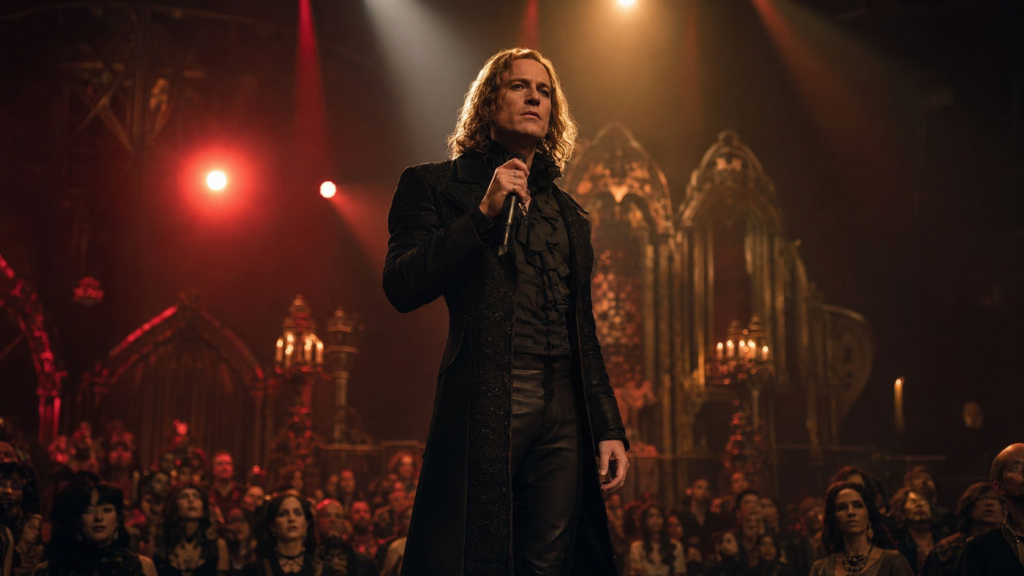
The Vampire Lestat gives the central vampire from AMC’s Anne Rice universe a louder, stranger and more theatrical stage. The seven-episode season places Lestat de Lioncourt at the centre of the story as he enters the modern music world and attempts to control the narrative surrounding his past.
This spoiler-free The Vampire Lestat review looks at the performances, pacing, music and gothic presentation without revealing the season’s major developments.
Although AMC presents it under a fresh title, the show is effectively the third season of the Interview with the Vampire TV series. That connection matters because the new chapter builds on established characters and emotional conflicts rather than beginning an entirely independent story.
What Is The Vampire Lestat Series About?
The story follows Lestat as he forms a band and prepares to take his music on tour. His growing fame gives him a new way to influence both humans and vampires, but it also forces him to confront people and memories connected to his long history.
Music is more than a decorative addition to the season. It becomes part of Lestat’s identity and another method through which he tries to shape how the world sees him.
The premise gives the series room to mix gothic horror, psychological drama and rock-star spectacle. This combination separates it from many other new TV shows, even when its theatrical presentation occasionally becomes excessive.
The premise is detailed on AMC’s official series page, which follows Lestat’s growing influence as he takes his music on tour.
Sam Reid Commands the Series
Sam Reid remains the strongest reason to follow the show. His performance embraces Lestat’s confidence, anger, humour and need for attention without reducing the character to a simple supernatural celebrity.
Reid appears comfortable with the season’s heightened style. He can dominate a large musical sequence while still making the quieter conversations feel important. The performance also communicates that Lestat’s public confidence often hides uncertainty and unresolved pain.
Jacob Anderson brings a calmer presence as Louis de Pointe du Lac. His scenes provide an important contrast to Lestat’s unpredictable energy, while Eric Bogosian continues to give Daniel Molloy a sharp and sceptical voice.
Assad Zaman, Delainey Hayles and Jennifer Ehle help connect the new storyline to the wider Anne Rice universe. The supporting characters do not always receive equal attention, but the ensemble gives the season more emotional weight than its rock-tour premise initially suggests.
A Strong Gothic and Musical Identity
This spoiler-free The Vampire Lestat review finds that the series combines the elegant darkness of the earlier seasons with concert lighting, performance spaces and modern celebrity culture.
The production works best when those two identities support each other. Lestat looks convincing as both an old supernatural figure and a contemporary performer surrounded by cameras, audiences and publicity.
Costume design remains an important part of the character storytelling. Lestat’s clothing communicates his need to control every entrance, while the darker environments remind viewers that the glamour exists inside a dangerous supernatural world.
The original music also helps distinguish the season from other popular TV shows. Some viewers may find the musical emphasis surprising, but it fits a character who has always treated life as a performance.
The Vampire Lestat Review: Pacing and Structure
The seven-episode structure keeps the season relatively focused, but its pacing is not always smooth. Certain episodes move confidently between past and present, while others pause the central momentum to explore older conflicts.
Those slower sections contain useful character material, particularly for viewers already familiar with Lestat and Louis. However, audiences expecting every episode to advance the tour storyline at the same speed may find the structure uneven.
The show also assumes that viewers understand several relationships established in the first two seasons. Newcomers can follow the immediate premise, but much of the emotional meaning will be stronger for those who have already watched Interview with the Vampire.
This is therefore not a complete reset, despite the new title and AMC displaying it as the first season of The Vampire Lestat.
What Works Best?
The season’s greatest strength is its commitment to a specific personality. It does not turn Lestat into a safer or more conventional television lead.
Sam Reid’s central performance, the ambitious production design and the use of music give the show a clear identity. The writers also continue exploring memory and personal perspective, allowing different characters to challenge the stories told about them.
The result is a TV series that feels extravagant without losing its emotional foundation. It understands that Lestat’s appeal comes from the tension between his commanding public image and his complicated private history.
The season’s strong critical reception is reflected in its Rotten Tomatoes review page, where critics particularly praised Sam Reid’s commanding performance.
What Does Not Work as Well?
The season’s ambition can occasionally work against it. Some theatrical moments risk overwhelming the underlying character drama, while the shifts between timelines and perspectives may require close attention.
The supporting cast also has to compete with a protagonist designed to dominate almost every scene. Viewers primarily interested in Louis or the wider ensemble may wish that certain characters had received more space.
Its tone will not suit everyone either. The mixture of horror, melodrama, dark humour and rock performance is deliberate, but viewers looking for a restrained supernatural drama may find it too intense.
The main weakness identified in this The Vampire Lestat review is the uneven balance between theatrical spectacle and supporting-character development.
Is The Vampire Lestat Worth Watching?
The Vampire Lestat is worth considering for viewers who enjoy gothic fantasy, character-driven horror and visually ambitious television. It should be particularly rewarding for established fans of AMC’s Anne Rice adaptations.
Anyone beginning with this season may understand the main story, but watching the previous two seasons first will provide valuable context for the relationships and past events.
The show is less suitable for viewers who dislike musical performance or nonlinear storytelling. Its seven episodes demand attention, and its emotional impact depends heavily on understanding why these characters remain connected.
Overall, this The Vampire Lestat review finds a bold and sometimes uneven continuation that succeeds because it fully embraces its central character. Sam Reid’s magnetic performance and the confident gothic presentation make it one of the more distinctive fantasy dramas among 2026’s new releases.
Ultimately, this The Vampire Lestat review recommends the series most strongly to existing fans of AMC’s Anne Rice universe.
Readers interested in the show’s future can read our The Vampire Lestat Season 4 update for confirmed details about Queen of the Damned.