
Spoiler Warning: This article contains major spoilers for The Vampire Lestat Episode 7, “The Failures,” including the final scene and the setup for Season 4.
Viewers looking for a spoiler-free assessment should begin with our The Vampire Lestat review.
The season finale does not end with the straightforward concert spectacle that earlier episodes appeared to promise. Instead, it places Lestat inside a surreal reckoning with his past before jumping forward to reveal the devastating consequences of his choices.
This The Vampire Lestat ending explained guide examines Lestat’s survival, Louis and Armand’s confrontation, the meaning of the imagined tribunal and the final glimpse of a ruined New York.
1. Is Lestat Dead at the End?
No, Lestat does not die permanently.
Episode 6 ended with Lestat and Louis apparently killed after Armand and Daniel separated them from their bodies. The finale explains that their supernatural strength gives them a limited period in which they can still be saved.
While Lestat remains physically helpless, his mind enters an elaborate vision. The people gathered around him inside this imagined space are not holding a literal trial. They represent his memories, regrets and unresolved relationships.
Lestat is eventually rescued and restored before it becomes too late. He later awakens on his tour bus, confirming that the surreal gathering took place inside his mind while his physical survival remained uncertain.
2. What Does Lestat’s Imagined Tribunal Mean?
The tribunal forces Lestat to examine the harm caused by his choices.
Magnus initially appears to hold authority over the gathering, but Lestat refuses to let his maker control the final judgment. He instead gives Gabrielle a more important position, recognising her as another powerful influence on the person he became.
The guests represent different parts of his history. Some reflect people he loved, while others recall those who suffered because of him. Their presence challenges the heroic version of himself that Lestat has attempted to present throughout the season.
For most of the series, Lestat has treated memory as a performance. He selects the details, controls the setting and places himself at the centre. The tribunal removes that control by allowing other perspectives to confront him.
This section of The Vampire Lestat ending explained is therefore less about whether Lestat is legally innocent or guilty. It is about whether he can finally acknowledge that his pain does not erase the pain he caused.
3. Why Does Gabrielle Take Control?
Gabrielle’s role reflects Lestat’s complicated relationship with family, freedom and abandonment.
Lestat considers both Magnus and Gabrielle responsible for creating different parts of his identity. Magnus made him a vampire, while Gabrielle helped shape his understanding of independence and emotional distance.
By placing Gabrielle in charge of the tribunal, Lestat stops allowing Magnus to define the meaning of his existence. However, this does not mean that he completely forgives Gabrielle or resolves every part of their relationship.
The decision shows that Lestat is beginning to choose which influences still have authority over him. It is a small but meaningful step towards taking responsibility for his own behaviour.
4. What Happens Between Louis and Armand?
Louis remains separated from Lestat during much of the finale and is placed under Armand’s control.
Armand demands an apology for the pain he believes Louis caused him. He also reveals that Regina’s repeated encounters with Louis were arranged rather than accidental, showing how carefully he had manipulated the situation.
Louis eventually communicates an apology to Armand. His words recognise Armand’s earlier suffering and his need to be loved, but they do not restore their former relationship.
The exchange gives Armand some of the acknowledgment he wanted, yet it also exposes the destructive methods he uses to obtain emotional validation. His actions suggest that his need for control remains stronger than his willingness to accept rejection.
Louis survives the confrontation, but the finale leaves his future with both Armand and Lestat unresolved.
5. Why Does the Talamasca Save Lestat?
The Talamasca does not rescue Lestat simply because it considers him an ally.
The organisation has its own interest in the approaching Great Conversion and the large gathering of vampires expected around Lestat’s concert. Saving him allows the concert to continue and supports a much larger plan involving the supernatural community.
Raglan James also remains interested in Lestat for reasons that extend beyond the immediate rescue. His actions indicate that the Talamasca sees ancient vampires as subjects to study, control or use.
This makes the organisation difficult to classify as either heroic or villainous. It helps Lestat survive, but that intervention also moves him towards an event with catastrophic consequences.
6. What Is the Great Conversion?
The Great Conversion refers to the rapid creation and expansion of the vampire population.
Lestat’s music, fame and influence attract vampires on an unprecedented scale. His concert becomes more than a public performance: it creates the conditions for different supernatural factions to gather in one place.
The finale does not show every stage of the concert or its immediate aftermath. Instead, it jumps forward and allows the ruined city to reveal that the event changed the world.
That missing period is intentional setup for the next chapter. It leaves important questions about the concert, the Talamasca’s plan and Akasha’s involvement unanswered.
The official AMC series description also connects Lestat’s growing influence with the threat of the Great Conversion.
7. What Does the Final Scene Mean?
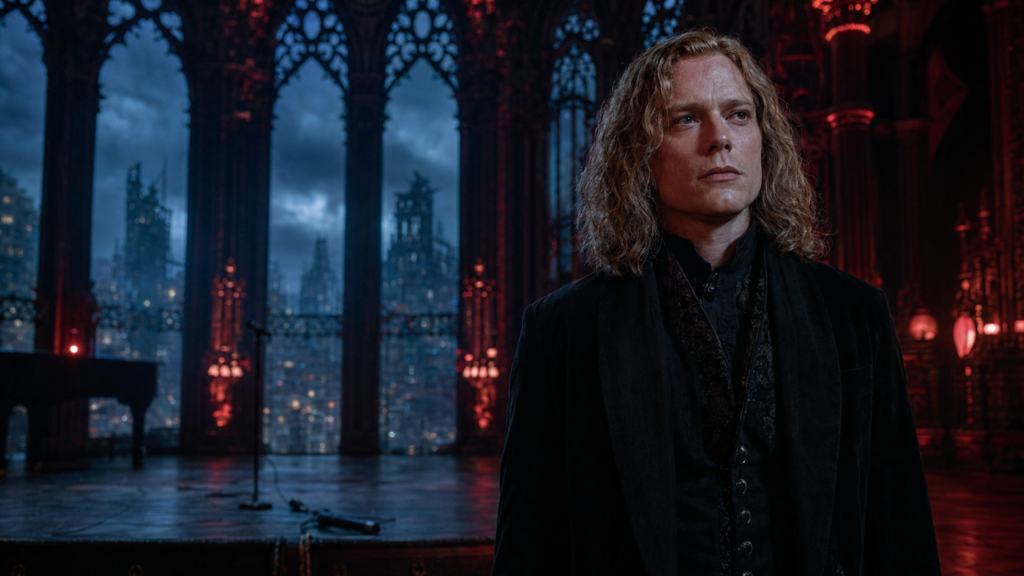
In the closing scene, Lestat is recording “The Failures” and reflecting on the story he has told.
He questions whether he accurately communicated his feelings before stepping outside and looking over a devastated New York. The destroyed city confirms that the catastrophe teased earlier in the season has happened.
Lestat initially speaks as though he merely contributed to the disaster. After seeing the destruction, he corrects himself and accepts that the fault was his.
This is the most important moment in The Vampire Lestat ending explained because it completes the emotional argument of the finale. During the tribunal, Lestat is pushed to recognise the consequences of his past. The final scene shows him applying that lesson to the present.
His admission does not mean he caused every part of the catastrophe alone. Akasha, the Talamasca and the vampires gathered around his concert all have their own roles. However, Lestat understands that his fame and decisions helped create the conditions in which the destruction became possible.
How Does Akasha Connect to the Ending?
Akasha is the ancient vampire queen whose return changes the direction of the story.
Although she does not dominate the finale itself, the final scene suggests that Lestat’s concert helped unleash a force much larger than he expected. His connection to Akasha will become central to the consequences of the Great Conversion.
The ending therefore functions as a bridge rather than a complete conclusion. Lestat has survived and acknowledged his responsibility, but he has not yet faced the full results of awakening the queen.
Is The Vampire Lestat Returning for Season 4?
Yes. The continuation is officially confirmed.
AMC renewed Interview with the Vampire for a fourth season titled Anne Rice’s Queen of the Damned. The next chapter will shift more attention towards Akasha and the fallout from Lestat’s actions.
The title also confirms that the series will continue adapting Anne Rice’s Vampire Chronicles while changing its identity to match the character driving each new part of the story.
The official AMC renewal announcement confirms both the fourth season and its Queen of the Damned title.
What Questions Remain Unanswered?
The finale leaves several major storylines open.
Akasha’s complete plan is still unclear, as is the true scale of the Great Conversion. The show must also reveal exactly what happened during and after Lestat’s concert.
Louis and Lestat survive, but their relationship remains fragile. Armand’s future is equally uncertain after his confrontations with Louis and Daniel, while the Talamasca’s long-term objective has not been fully explained.
Most importantly, the ruined city confirms that the conflict is no longer limited to one vampire family. The consequences now threaten the wider world.
The Vampire Lestat Ending Explained: Final Meaning
The finale is ultimately about responsibility.
Lestat survives the attempt to stop him, confronts the people who shaped his life and recognises that suffering does not excuse every choice he has made. His final admission shows genuine self-awareness, but it arrives after the world has already paid a severe price.
The season ends without resolving the Great Conversion because the story is designed to continue in Queen of the Damned. Akasha’s rise, the Talamasca’s hidden plan and Lestat’s responsibility for the catastrophe will drive the next chapter.
The central conclusion of this The Vampire Lestat ending explained guide is that Lestat survives physically but can no longer escape the consequences of his performance. The stage made him powerful, yet it also helped unleash the destruction he now accepts as his fault.

