
Spoiler-light review: discusses the Season 1 ending and Season 2 setup without revealing the final outcome.
Few television shows turn office life into something as strange, frightening, and emotionally complex as Severance. After a long absence, Apple TV+’s acclaimed science-fiction thriller returns with bigger ambitions, deeper mysteries, and far more dangerous consequences for everyone trapped inside Lumon Industries. This Severance Season 2 review examines how the series expands its world without losing the unsettling atmosphere that made its first season so distinctive.
Season 2 begins in the shadow of the overtime contingency rebellion. Mark, Helly, Irving, and Dylan briefly experienced the outside world, discovered disturbing truths about their lives, and challenged the boundaries separating their “innie” and “outie” identities. Lumon cannot simply pretend that nothing happened—but the company is certainly willing to try.
The result is a season that feels more expansive while remaining deeply personal. Its mythology grows more complicated, but its strongest material still comes from a simple question: What happens when a person realizes that the life created for them is a prison?
A Darker and More Ambitious Return
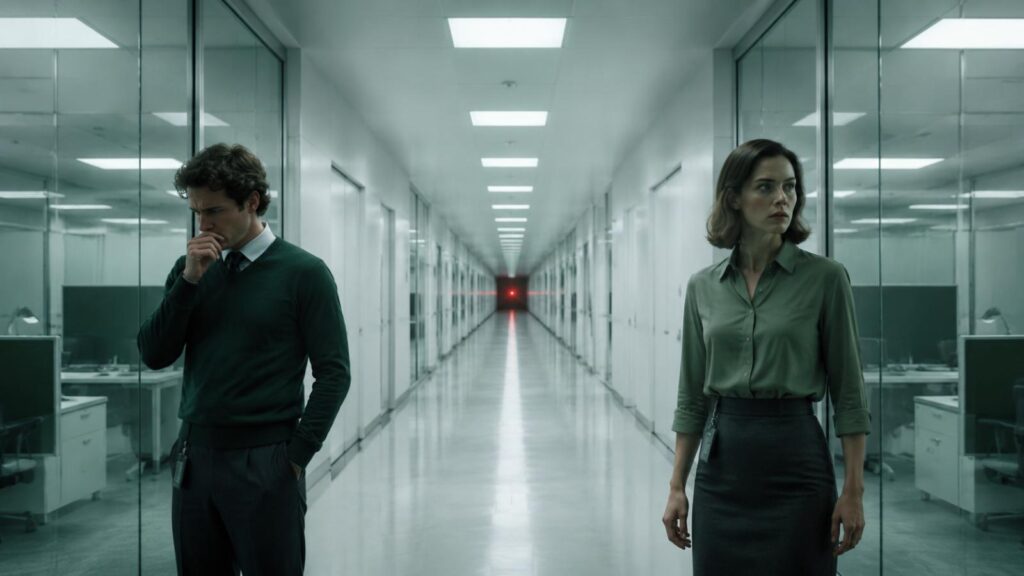
The first season established Lumon as a sterile corporate nightmare built from fluorescent lights, empty hallways, outdated technology, and cheerful language hiding institutional cruelty. Season 2 preserves that visual identity while pushing the characters into unfamiliar environments and increasingly unstable relationships.
The severed floor no longer feels like a perfectly controlled experiment. Mark and his colleagues have seen too much, and their new awareness changes the atmosphere. Every wellness session, workplace reward, and management announcement now carries an additional layer of threat.
This shift gives the season a darker emotional tone. The employees are not merely curious about Lumon anymore. They are dealing with grief, betrayal, romantic confusion, and the frightening possibility that their outies may not share their desire for freedom.
Creator Dan Erickson and the directing team understand that the show’s mysteries work best when they remain connected to character. Strange departments, corporate rituals, and unexplained projects are intriguing, but they matter because of how they affect Mark, Helly, Irving, and Dylan.
The official Apple TV page for Severance describes a workplace where employees’ memories are surgically divided between their professional and personal lives. Season 2 takes that premise further by questioning whether those divided identities can continue to exist without destroying one another.
Story and Themes
Season 2 continues Mark’s attempt to understand what Lumon is doing and why his supposedly dead wife, Gemma, appears inside the company as Ms. Casey. His search provides the main narrative engine, but the season is equally interested in the emotional cost of finding the truth.
Mark’s innie and outie may share a body, but they do not necessarily want the same future. That conflict turns the severance procedure into more than a clever science-fiction concept. It becomes a way to explore competing versions of identity, each believing that its needs and relationships are real.
Helly’s storyline develops this idea from another direction. Her connection to the Eagan family makes her existence especially complicated. The contrast between Helly R. and Helena Eagan raises uncomfortable questions about privilege, responsibility, and whether one identity has the right to control another simply because it existed first.
Irving’s search for Burt remains one of the show’s most tender elements. Their relationship offers a quiet form of resistance against a system designed to limit intimacy and independent thought. At the same time, Irving’s growing suspicion reveals how difficult it is to trust anyone when memory itself can be manipulated.
Dylan initially appears more comfortable with Lumon’s incentives, but knowledge of his outside family transforms him. His storyline examines the pain of being shown a meaningful life that he is not allowed to experience. Zach Cherry gives that conflict humor without reducing its sadness.
Across these storylines, Season 2 explores freedom, memory, grief, corporate control, and the artificial separation between work and personal life. The show exaggerates modern workplace culture, yet its central fear remains recognizable: a company that claims ownership not only over an employee’s labor, but also over part of their consciousness.
Performances and Cast
The Severance Season 2 cast remains one of the series’ greatest strengths. Adam Scott gives Mark two related but distinct emotional identities. Outie Mark carries exhaustion and grief, while Innie Mark has developed a more urgent sense of purpose. Scott makes the differences clear without turning either version into a completely separate character.
Britt Lower delivers some of the season’s most challenging work. Helly’s anger, vulnerability, and determination must coexist with Helena’s connection to Lumon’s ruling family. Lower makes the tension between them feel unsettling because both identities understand how much power the other possesses.
John Turturro brings restraint and emotional precision to Irving. His performance captures a man whose belief in Lumon has collapsed but whose need for connection remains powerful. Zach Cherry also receives more dramatic material as Dylan begins to understand that a few corporate rewards cannot replace a family or a life of his own.
Tramell Tillman’s Seth Milchick becomes even more fascinating. His polished smile and controlled movements suggest a manager trying to embody Lumon’s values perfectly, even when the company’s demands place him in an uncomfortable position. Patricia Arquette remains unpredictable as Harmony Cobel, whose devotion to Lumon is mixed with anger, personal history, and an apparent need to prove that the company still needs her.
The ensemble is large, but the series usually gives its central characters enough room to develop. Viewers who need a reminder of individual episodes and credited appearances can consult the Severance Season 2 episode guide on IMDb.
Writing, Direction and Production Design
The writing remains sharp because it rarely explains Lumon too quickly. Dialogue that sounds harmless can become menacing through repetition, performance, or context. Even absurd corporate language carries consequences when it comes from people with complete control over the workers’ memories.
The direction is equally confident. Long hallways, carefully centered compositions, and empty spaces continue to make Lumon feel both enormous and claustrophobic. The camera often isolates characters within the frame, visually reinforcing how little power they have inside the company.
Production design plays a major role in the storytelling. Lumon’s combination of retro computers, institutional furniture, green carpeting, and blank white walls creates a workplace disconnected from any recognizable period. It feels deliberately separated from the outside world—as if time, technology, and normal social rules stop at the elevator.
The sound design and music intensify that unease. Quiet scenes can feel threatening before anything happens, while sudden changes in rhythm turn ordinary movement through an office into suspense.
Most importantly, Season 2 gives its mysteries an emotional foundation. Mark’s investigation matters because it is connected to love and grief. Helly’s rebellion matters because her existence is being denied. Irving and Dylan are not simply trying to solve Lumon’s secrets; they are trying to prove that their lives have value.
Rotten Tomatoes’ Season 2 critics consensus praises the balance between character study and surreal unease. This review shares that appreciation while finding some detours slow the narrative.
For the latest release-date news, filming details, and cast updates, read our complete guide to Severance Season 3
Where the Season Stumbles
The season’s ambition occasionally works against its momentum. Some episodes pause the main storyline to explore supporting characters, Lumon history, or another corner of the mystery. These detours often contain valuable information, but their placement can feel frustrating when the central conflict is approaching a critical point.
Season 2 also adds new questions before resolving many of the old ones. That is part of the show’s appeal, but viewers hoping for a straightforward explanation of Lumon’s purpose may find the mythology increasingly demanding.
The difference between mystery and deliberate confusion is sometimes narrow. Severance usually remains on the right side of that line because its characters provide emotional direction, but certain developments appear designed to delay answers rather than deepen them.
There is also a risk that the show’s larger mythology could overshadow the simplicity of its original premise. The first season was powerful partly because its world felt contained. Season 2 opens that world, and while the expansion is often fascinating, not every new element carries the same dramatic weight.
These weaknesses do not undermine the season, but they prevent it from feeling perfectly balanced. Patience is still required, especially during the middle stretch.
Severance Season 2 Finale and Overall Impact
Mild spoilers follow.
The Severance Season 2 finale brings several character conflicts together while refusing to offer an easy resolution. Mark faces a deeply personal choice involving Gemma, Helly, and the competing desires of his two identities. The decision reinforces the season’s central argument: an innie is not simply a temporary employee or an incomplete copy. That person has relationships, fears, and a genuine claim to life.
The finale delivers urgency and emotional weight without resolving every Lumon mystery. Instead, it changes the nature of the conflict and forces viewers to reconsider what freedom would mean for each character.
That unresolved ending may frustrate anyone expecting complete answers, but it is dramatically consistent with the season. The story is no longer only about escaping Lumon. It is about deciding which version of a person gets to escape—and what may happen to the other one.
For full spoilers and a detailed discussion of Mark’s choice and Cold Harbor, read our Severance Season 2 ending explanation.
Final Verdict
This Severance Season 2 review finds the Apple TV+ series more ambitious, emotionally intense, and visually confident than before. The pacing occasionally slows, and its expanding mythology creates nearly as many questions as answers, but the character development gives the mystery real purpose.
Adam Scott, Britt Lower, John Turturro, Zach Cherry, Tramell Tillman, and Patricia Arquette deliver layered performances that make Lumon’s strange world feel painfully human. The production design remains exceptional, the tension is carefully controlled, and the finale provides a powerful reason to continue watching.
Season 2 succeeds because it understands that the show’s deepest mystery is not what Lumon is building. It is whether two identities living inside one body can both be considered fully human.
For viewers who enjoy patient science fiction, psychological drama, and stories that reward close attention, Severance Season 2 is absolutely worth watching.
Score: 9/10

