

If you searched Adolescence Netflix who is the killer, the answer is not saved for a last-minute twist: Jamie Miller killed his classmate Katie. Netflix’s four-part limited series confirms his guilt in Episode 1, then spends the remaining episodes asking a harder question — why a 13-year-old boy became capable of doing it.
This Adolescence ending explained guide breaks down Jamie’s guilt, the evidence against him, the factors behind the killing, his disturbing session with Briony, his decision to plead guilty, and the meaning of Eddie’s devastating final scene.
For a spoiler-free assessment of the performances and one-shot format first, see our spoiler-free Adolescence Netflix review.
SPOILER WARNING: Major spoilers for all four episodes of Adolescence follow.
Who Is the Killer in Adolescence on Netflix?
Jamie Miller is the killer in Adolescence. He murdered his schoolmate Katie, and the series confirms his guilt near the end of Episode 1 through CCTV footage showing the attack. The remaining episodes therefore become less of a whodunit and more of an investigation into why Jamie committed the crime.
That choice is central to how the series works.
At first, Jamie appears terrified, young and vulnerable. His father Eddie is also desperate to believe that the police have made a mistake. But investigators eventually show video evidence that removes the central uncertainty surrounding the crime.
Netflix’s official Tudum ending explainer confirms that the creative team deliberately wanted viewers to know the killer’s identity early. Co-creator Jack Thorne described the story as effectively becoming a “why-done-it” rather than a traditional whodunit.
Netflix Tudum’s official Adolescence ending explainer
Did Jamie Really Kill Katie?
Yes. Jamie really killed Katie. The evidence shown in Episode 1 is intended to remove doubt rather than create another mystery. CCTV footage records Jamie attacking Katie, making his guilt clear to the police, his father and the audience.
The important question is why viewers initially hesitate to believe it.
Jamie is only 13. During the police raid, he reacts like a frightened child rather than the threatening figure audiences might expect from a murder suspect. Stephen Graham has explained that this was deliberate: the creators wanted viewers to initially stand emotionally beside Jamie and Eddie before confronting them with what he had done.
That reversal matters.
The series does not reveal that Jamie is secretly innocent, nor does it introduce another killer. Instead, it asks viewers to hold two uncomfortable truths at once: Jamie is unmistakably a child, and Jamie has committed an appalling act of violence.
That contradiction drives the rest of the story.
Why Did Jamie Kill Katie?
Jamie kills Katie after a combination of insecurity, humiliation, perceived rejection, bullying and exposure to misogynistic incel ideology. The series does not present one simple cause. Instead, it shows how his low self-worth and distorted beliefs about girls and masculinity intensify his reaction to Katie.
The official Netflix explanation is more specific about the sequence.
Jamie has absorbed online incel propaganda that encourages him to see attraction, rejection and male status through a deeply distorted framework. He already struggles with self-esteem and believes he is unattractive. Katie then publicly identifies him as an incel on Instagram, humiliating him in front of others. According to Tudum’s finale explanation, his embarrassment and anger contribute to the violence that follows.
However, saying “Jamie killed Katie because she rejected him” would be far too simplistic.
The series presents several overlapping pressures:
- Jamie is deeply insecure about how others perceive him.
- He craves recognition and validation.
- He interprets attraction and rejection through ideas shaped by misogynistic online spaces.
- He appears obsessed with what being desirable or undesirable says about his masculinity.
- Public humiliation intensifies emotions he is poorly equipped to manage.
None of those factors excuses his actions.
Nor does the drama argue that exposure to one piece of online content automatically creates a murderer. Its concern is how existing insecurity can interact with resentment, misogyny and social isolation until Jamie’s way of understanding himself and other people becomes dangerously warped.
What Does Episode 3 Reveal About Jamie?
Episode 3 is the psychological center of the series.
Almost the entire hour focuses on Jamie’s conversation with clinical psychologist Briony Ariston. By this stage, viewers already know Jamie killed Katie. The purpose is therefore not to uncover a hidden culprit, but to understand the boy behind the evidence.
Netflix describes the episode as a discussion of masculinity, attraction and Jamie’s descent into misogynistic propaganda. His resentment sometimes turns toward Briony herself, while his responses reveal how strongly his self-image depends on being liked and recognized by others.
One of the most revealing elements is Jamie’s need for validation.
Owen Cooper explained to Tudum that Jamie simply wants to be “liked and recognized.” When he realizes his sessions with Briony are ending, his emotional control deteriorates dramatically.
That does not amount to a medical diagnosis, and the series does not need one.
What Episode 3 demonstrates is a pattern: Jamie wants emotional reassurance but often responds to vulnerability with defensiveness, anger or attempts to control the interaction. He is highly sensitive to rejection while also holding damaging beliefs about women.
Briony’s presence exposes that contradiction.
He wants her approval, yet he also appears threatened by her ability to see through him.
Why Does Jamie Plead Guilty?
Jamie decides to plead guilty in Episode 4 because his denial has finally given way to acceptance of what he did and what his future now holds. During a phone call with Eddie, he reveals that he will change his plea, forcing the Miller family to confront the crime without the remaining protection of denial.
This is a major emotional turning point even though the audience has known Jamie is guilty since Episode 1.
Until this moment, Jamie has repeatedly resisted full responsibility. He especially wants Eddie to continue believing in him. Thorne explains that Jamie knows what he has done but has struggled to comprehend how final his actions are.
By Episode 4, something has changed.
His decision to plead guilty signals that he can no longer maintain the emotional version of events that allowed him to preserve hope of returning to his old life.
For Eddie, Manda and Lisa, the call destroys the last remaining possibility that the legal process might somehow restore their family.
The guilty plea does not reveal Jamie’s guilt.
It makes Jamie finally acknowledge it.
Adolescence Ending Explained
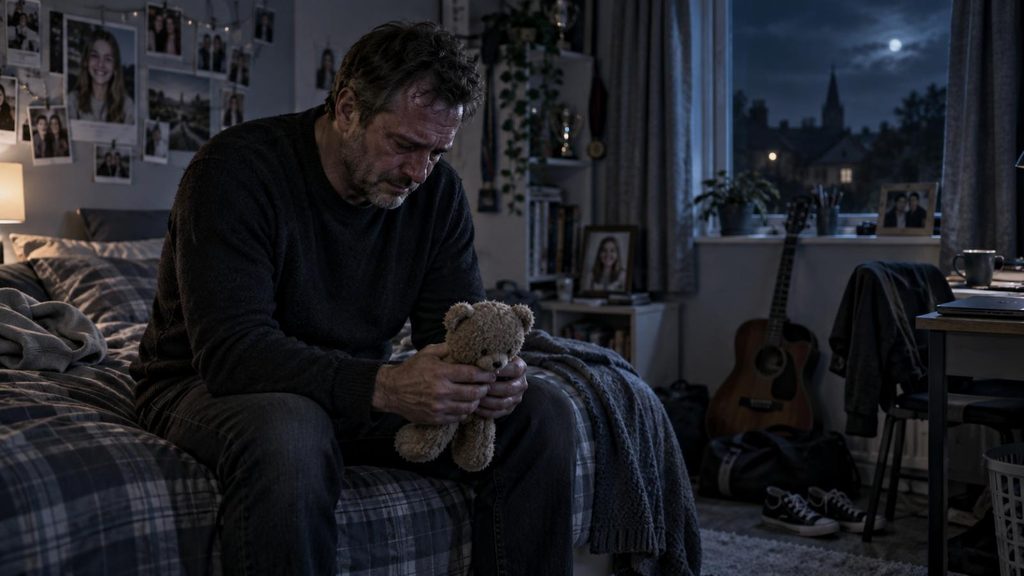
Adolescence ends with Eddie returning to Jamie’s bedroom after learning that his son will plead guilty. Alone, he holds Jamie’s teddy bear, tucks it into the bed and breaks down. The scene represents Eddie’s grief, parental guilt and helplessness as he confronts the child Jamie once was and the person he became.
Episode 4 takes place 13 months after Jamie’s arrest and focuses primarily on the Miller family.
They attempt to continue with ordinary life, but Jamie’s crime has reshaped everything. Their relationships, their public identity and even routine family moments are now filtered through what happened.
The phone call revealing Jamie’s guilty plea brings that emotional tension to a breaking point.
Eddie eventually returns to Jamie’s room.
This location matters because it takes the series back to where the story began. Stephen Graham explained that the creators deliberately wanted the journey to end in the same room. Tudum also notes the significance of that bedroom as the private space in which Jamie consumed the online material that helped shape his worldview.
The teddy bear is equally important.
It represents Jamie before the crime — not as an abstract murderer or defendant, but as Eddie’s child.
Eddie cannot reach his son in that moment, but he can hold something Jamie once held.
What Does Eddie’s Final Scene Mean?
Eddie’s breakdown is not a confession that he caused Katie’s murder.
In fact, both Stephen Graham and Jack Thorne have been careful not to frame Jamie’s parents as simple villains. The official Episode 4 material emphasizes that the creators did not want audiences to conclude that Jamie became violent because Eddie was simply an abusive or uncaring father.
The scene is instead about parental guilt.
Parents often look backward after tragedy and ask which signs they missed, what they should have said differently and whether greater attention could have changed the outcome.
Eddie cannot answer those questions.
His grief is intensified by the realization that Jamie had an entire psychological and online life that existed partly beyond his parents’ awareness.
The bedroom therefore becomes symbolic.
It was physically inside the family home, yet parts of Jamie’s world remained invisible to the people living only a few feet away.
The teddy bear reinforces the contradiction between the innocent child Eddie remembers and the teenager capable of murdering Katie.
Graham has described the final scene as part of the show’s intention to encourage conversations between parents and children, particularly around experiences that adults may not fully understand.
Stephen Graham’s official Tudum interview about the final scene
Why Does the Finale Focus on Jamie’s Family?
A conventional crime drama might end with a trial, a verdict or an extended explanation from the killer.
Adolescence chooses something quieter.
The finale examines the people who must continue living after the crime.
Stephen Graham has explained that the writers wanted to explore the ripple effects of Jamie’s actions on his family. Director Philip Barantini similarly describes the family as the emotional heart of the final episode.
The choice also prevents the story from pretending that solving the murder resolves anything.
Katie remains dead.
Jamie faces the consequences of killing her.
His parents and sister must live with a permanent connection to what he did.
The Miller family are not portrayed as directly responsible for Katie’s murder, but Eddie and Manda inevitably question their parenting. That distinction is important: feeling responsibility as a parent is not the same as being responsible for another person’s violent act.
Episode 4 exists in that uncomfortable space.
For more coverage of Netflix dramas, you can also browse our latest Netflix reviews.
What Does Adolescence Say About Online Culture and Masculinity?
The series treats online culture as one factor in Jamie’s development, not a magical explanation that removes his agency.
Episode 2 begins revealing how social-media language among teenagers can be largely invisible to adults, while Episode 3 connects Jamie’s insecurity with misogynistic beliefs about attraction, women and male status. Tudum’s official material specifically identifies his exposure to incel propaganda as one of several factors behind his actions.
The larger concern is how teenage insecurity can be redirected.
Jamie feels inadequate.
Online ideology offers him a framework that appears to explain why he feels rejected. Instead of encouraging self-reflection, that framework can redirect frustration toward girls and women.
The show also examines masculinity.
Jamie is concerned with whether he appears strong, attractive and worthy of respect. Vulnerability becomes difficult for him to express directly, while humiliation feels intolerable.
The tragedy comes from the interaction between those pressures.
Adolescence does not argue that every insecure teenager exposed to misogynistic content will become violent. It asks what can happen when adults fail to recognize how powerfully those ideas may shape a young person’s developing sense of identity.
Netflix Tudum’s official series guide
Adolescence Finale Explained: The Real Meaning
The Adolescence finale explained in its simplest form is not really about discovering who killed Katie. That question was answered in Episode 1.
The ending is about consequences.
Jamie became capable of violence through a complicated mixture of personal insecurity, resentment, social experiences and toxic ideas. His parents loved him, but love alone did not mean they fully understood what was happening inside his life.
The final bedroom scene captures that tragedy.
Eddie is surrounded by evidence of the son he thought he knew while confronting the reality of the son he did not fully know.
The ending therefore refuses a comforting solution.
There is no final clue that makes everything understandable.
There is no single person or influence onto which all blame can conveniently be transferred.
There is only Jamie’s responsibility for killing Katie and a family forced to live with an irreversible act.
What does the ending of Adolescence mean?
The ending means that discovering the killer was never the series’ real destination. Jamie’s guilt is established early; the deeper tragedy is how a child became capable of murder while his family remained unaware of important parts of his inner and online life. Eddie’s breakdown represents grief, guilt and helplessness.
Final Thoughts
So, who is the killer in Adolescence on Netflix? Jamie Miller killed Katie, and the CCTV footage shown in Episode 1 removes any genuine doubt.
But that answer is only the beginning of the series’ argument.
The remaining episodes explore the influences, insecurities and distorted beliefs surrounding Jamie without reducing the murder to one convenient explanation. His guilty plea signals the collapse of denial, while Eddie’s final breakdown shows the devastating consequences extending far beyond the killer himself.
That is why the Adolescence ending returns to Jamie’s bedroom rather than a courtroom.
The series ends not with the mystery solved, but with a father staring at the place where his son grew up and realizing how much of him he never truly saw.

