
Luxury may offer comfort, privacy, and beautiful surroundings, but it cannot protect people from their own anxieties. That idea remains central to Mike White’s acclaimed resort anthology as it relocates to Thailand for its darkest and most spiritually curious chapter yet.
This spoiler-free white lotus season 3 review examines how the new setting, ambitious themes, sprawling ensemble, and patient storytelling shape a season that is frequently absorbing—even when it takes too long to reveal the full purpose of its many storylines.
Created, written, and directed by Mike White, the third season premiered on HBO on February 16, 2025. According to HBO’s official Season 3 announcement, it consists of eight episodes and is available to stream on Max. The season retains the show’s familiar blend of social satire, personal crisis, mystery, and uncomfortable comedy, but its interest in spirituality and mortality gives the drama a heavier, stranger atmosphere.
The result is not the fastest or funniest season of The White Lotus. It may, however, be the show’s most ambitious examination of what privileged people seek when money is no longer enough to make them feel secure.
What Is The White Lotus Season 3 About?
The third season follows several groups of wealthy guests and resort employees whose lives intersect during one week at an exclusive wellness resort in Thailand.
The Ratliff family arrives hoping for a peaceful vacation, but financial pressure and competing personal desires gradually expose tension beneath their polished image. Timothy and Victoria Ratliff travel with their three children—Saxon, Piper, and Lochlan—each of whom has a very different understanding of success, identity, and personal freedom.
Elsewhere, longtime friends Jaclyn, Kate, and Laurie reunite for a luxury trip that initially looks like a celebration of their lasting friendship. Beneath their warm conversations, however, old resentments, comparisons, and questions about their different life choices begin to surface.
Rick Hatchett travels with his younger girlfriend, Chelsea, but he remains emotionally distant and preoccupied with a personal matter connected to Thailand. Their relationship combines genuine affection with a growing sense that Chelsea is being pulled into a conflict she does not fully understand.
The resort’s employees also receive meaningful attention. Belinda, returning from the first season, visits Thailand as part of a professional exchange, while security guard Gaitok and health mentor Mook navigate their own hopes and responsibilities.
These stories allow the season to examine people searching for peace while repeatedly carrying their unresolved problems into an environment designed to sell serenity.
White Lotus Season 3 Review: Darker, Stranger and More Spiritual
Season 3 expands the series beyond its established criticism of class and wealth. Those subjects remain important, but Mike White also explores spirituality, desire, identity, fear, family expectations, and the ways people use belief to justify what they already want.
The resort promises transformation through meditation, wellness treatments, digital disconnection, and exposure to Buddhist traditions. Yet many of the guests treat spirituality as another luxury service—something to consume briefly before returning to familiar habits.
That contrast creates some of the season’s most effective satire. The characters speak about self-discovery while remaining obsessed with money, appearance, social status, and the judgment of others. Their pursuit of enlightenment often becomes another expression of privilege.
The comedy is more restrained than in the Sicily-set second season. There are still wonderfully uncomfortable conversations, social mistakes, passive-aggressive exchanges, and moments of absurd entitlement. However, the humor exists within a more ominous framework.
Mike White repeatedly turns ordinary interactions into quiet contests for control. A friendly conversation can become an interrogation. A compliment can carry an insult. A casual silence can expose years of resentment.
The season’s treatment of spirituality occasionally feels too broad, particularly when symbolic imagery is asked to carry more meaning than the writing has fully developed. Even so, its willingness to move beyond familiar rich-people satire gives the story a distinct identity.
The White Lotus Season 3 Cast and Performances
The white lotus season 3 cast is one of the show’s largest ensembles, and its strongest performances make even the slower storylines compelling.
Walton Goggins brings emotional weight and nervous intensity to Rick Hatchett. Rick’s silence frequently communicates more than his dialogue, while his interactions with Chelsea reveal a man caught between tenderness and self-destructive obsession.
Aimee Lou Wood gives Chelsea an appealing combination of warmth, optimism, and emotional intelligence. The character could easily have been presented as naïve, but Wood gives her a perceptiveness that makes the relationship more complicated. Her chemistry with Goggins is among the season’s most convincing elements.
Parker Posey is perfectly cast as Victoria Ratliff. Her unusual delivery, distracted expressions, and devotion to comfort create some of the funniest moments without reducing Victoria to a simple caricature.
Jason Isaacs delivers a controlled performance as Timothy Ratliff, a wealthy financier whose ability to maintain a calm public image is tested by mounting private pressure. Isaacs is especially effective when the character tries to appear present while mentally retreating from his family.
Patrick Schwarzenegger plays Saxon Ratliff with aggressive confidence, but the performance also hints at the insecurity behind his obsession with masculinity, money, and social dominance. Sarah Catherine Hook brings determination and uncertainty to Piper, while Sam Nivola gives Lochlan a convincing mixture of awkwardness and emotional dependence.
The friendship storyline is equally well served. Carrie Coon’s Laurie carries years of frustration beneath a controlled exterior. Michelle Monaghan gives Jaclyn the polished confidence of someone accustomed to attention, while Leslie Bibb makes Kate’s apparent friendliness feel increasingly difficult to interpret.
Together, Coon, Monaghan, and Bibb understand that longtime friendships can contain affection, competition, envy, and resentment at the same time. Their smallest expressions often reveal the judgments their characters refuse to say openly.
Natasha Rothwell brings welcome continuity as Belinda. Her return does not feel like empty fan service; instead, it allows the series to revisit questions about opportunity, trust, and the unequal relationships between hotel workers and wealthy guests.
Among the Thai characters, Tayme Thapthimthong gives Gaitok an earnest quality that contrasts with the cynicism surrounding him, while Lalisa Manobal brings charm and confidence to Mook. Lek Patravadi also provides authority and composure as resort owner Sritala.
Although the white lotus season 3 cast is impressive, the size of the ensemble creates an unavoidable problem: some characters receive far more psychological depth than others. Several supporting figures primarily function as sources of temptation, pressure, or information rather than fully developed individuals.
Thailand Becomes More Than a Beautiful Backdrop
Thailand is essential to the identity of the season. Production took place in and around Koh Samui, Phuket, and Bangkok, with multiple resorts and locations combined to create the fictional White Lotus property.
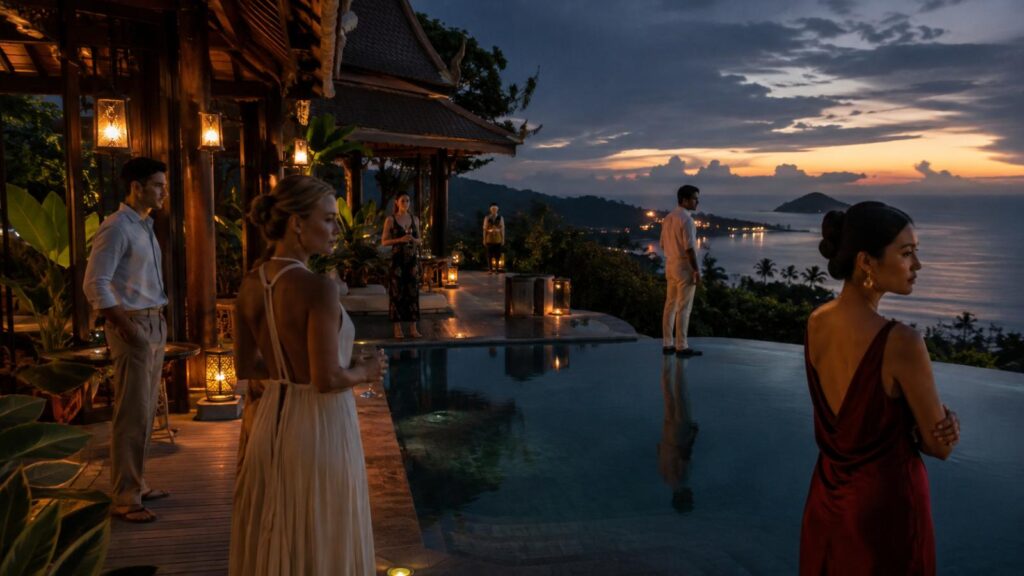
The cinematography captures bright beaches, dense vegetation, ornate interiors, temples, pools, and open water with an almost dreamlike beauty. Yet the camera rarely allows that beauty to feel completely safe.
Wildlife, distant movement, shadows, and natural sounds create the impression that the environment is watching the guests. The resort may be carefully controlled, but the surrounding landscape feels older and more powerful than the people temporarily occupying it.
This tension between artificial luxury and the natural world strengthens the season’s themes. The guests expect the resort to organize their experiences, eliminate inconvenience, and provide answers. Thailand instead becomes a place where their existing identities feel less stable.
The season sometimes risks using Buddhist imagery as a generalized symbol for Western dissatisfaction. However, it is also critical of the guests who approach local traditions as decorative paths toward personal improvement. Their failure to understand the environment becomes part of the satire.
Visually, this is arguably the series’ richest season. The contrast between warm daylight, dark interiors, moonlit gatherings, and carefully composed resort spaces supports the gradual shift from relaxation to unease.
Do the Eight White Lotus Season 3 Episodes Maintain the Tension?
HBO officially structured the season across eight episodes, making it longer than either of the first two installments. That additional space allows for more characters and thematic development, but it also exposes the limitations of Mike White’s slow-burn approach.
The opening episodes patiently establish relationships, unspoken conflicts, and possible dangers. The tension often comes from knowing that small emotional fractures will eventually become harder to contain.
In the best scenes, that patience pays off. A conversation introduced as casual can develop into a sharp examination of jealousy, family loyalty, or self-deception. The series is skilled at making viewers study body language and question what characters genuinely believe.
However, the middle portion occasionally feels overextended. Certain conflicts are repeated in slightly different forms, and not every subplot earns the amount of time it receives. Viewers expecting rapid plot developments may find some of the white lotus season 3 episodes frustratingly slow.
The large cast also causes uneven narrative balance. A storyline may disappear for an extended period just as it becomes interesting, while another receives several scenes without advancing significantly.
Momentum becomes stronger as the characters’ separate problems begin to overlap. The later episodes benefit from the careful foundation, even if the journey toward that payoff could have been more economical.
This is a season designed for viewers who enjoy accumulating tension, character observation, and thematic clues rather than constant twists.
Music, Sound and an Unsettling Opening Theme
Cristóbal Tapia de Veer returned as composer, adapting the series’ musical identity to the Thailand setting. His score combines percussion, electronic textures, animal-like sounds, chanting effects, and unsettling rhythmic patterns.
Cristóbal Tapia de Veer returned as composer, adapting the series’ musical identity to the Thailand setting. His score combines percussion, electronic textures, animal-like sounds, chanting effects, and unsettling rhythmic patterns.
The opening theme is less immediately playful than its Season 2 predecessor. It develops gradually, shifting from spiritual calm toward something more urgent and chaotic. That progression accurately represents the season’s movement from carefully marketed tranquility to emotional instability.
Sound design is equally important. Birds, insects, water, distant voices, bells, and nighttime activity are frequently pushed forward in the mix. These sounds prevent the resort from feeling isolated from the natural environment.
At times, the score draws attention to danger too aggressively, signaling unease before a scene has earned it. More often, though, the music transforms peaceful images into warnings without relying on obvious horror techniques.
What Works and What Does Not
The season’s greatest strength is its ensemble. Goggins, Wood, Coon, Posey, Isaacs, Monaghan, and Bibb all create characters whose contradictions are more interesting than their surface identities.
Mike White’s dialogue remains sharply observant. He understands how people disguise competition as concern and how privileged characters turn personal discomfort into a crisis demanding everyone else’s attention.
Thailand also gives the season a distinctive visual and thematic identity. The resort is not merely a new version of Hawaii or Sicily. Its wellness culture and proximity to religious traditions directly challenge the guests’ ideas about fulfillment.
The mystery generates suspense, but the character dynamics are ultimately more compelling than the mechanics of the plot. Rick and Chelsea’s emotional imbalance, the Ratliffs’ competing expectations, and the tension among the three friends provide the season with its strongest material.
The main weakness is pacing. Eight episodes provide room for complexity, but the season does not always use that time efficiently. Some scenes reinforce ideas that are already clear, and several supporting storylines feel overcrowded or comparatively underdeveloped.
The treatment of spirituality can also be uneven. The season asks thoughtful questions about attachment, identity, and mortality, but it occasionally settles for ominous symbolism instead of exploring those ideas with greater cultural specificity.
Its comedy is also less consistent than before. Viewers who primarily enjoyed Season 2 for its faster pace and more openly comic energy may find this installment colder and more demanding.
How Does Season 3 Compare With Previous Seasons?
The third season keeps the anthology’s central formula: wealthy travelers enter a beautiful resort believing they can control their experience, only for their relationships and self-images to become increasingly unstable.
Season 1 was the most direct examination of wealth and service. Season 2 placed greater emphasis on sex, romantic jealousy, and performance within relationships. Season 3 is broader, darker, and more concerned with spirituality, family roles, and fear.
It is visually more expansive than the previous seasons and possibly more ambitious in its themes. It is also less tightly constructed. The larger ensemble and longer runtime produce richer individual moments, but not always a more focused whole.
That difference will divide viewers. Those who prefer patient psychological drama may consider Thailand one of the show’s most rewarding destinations. Those who want the speed, humor, and concentrated relationship drama of Sicily may find it less immediately satisfying.
For another acclaimed drama built around psychological pressure and carefully controlled environments, read our Severance Season 2 review
Is The White Lotus Season 3 Worth Watching?
Yes—especially for viewers who enjoy ensemble dramas, uncomfortable social comedy, slow-building mysteries, and character studies about deeply flawed people.
The season rewards attention to gestures, social hierarchies, repeated imagery, and changes in character behavior. It is not ideal background viewing, and its patient middle episodes may test viewers expecting constant revelations.
Fans of Walton Goggins, Carrie Coon, Parker Posey, Jason Isaacs, or Aimee Lou Wood will find particularly strong performances. Viewers interested in how luxury culture turns spirituality into a product will also find plenty to consider.
Anyone searching for a light resort comedy should adjust expectations. This season is more anxious and morally severe than its postcard imagery suggests.
All eight episodes are available on Max, allowing viewers to watch the season without the interruptions of its original weekly schedule.
Final Verdict
Mike White’s third visit to the White Lotus is an atmospheric, intelligent, and sometimes overextended examination of people who can afford nearly everything except emotional honesty.
The Thailand setting gives the series a striking visual identity, while its strongest performances create genuine tension without depending entirely on the central mystery. The slower pacing, crowded ensemble, and uneven exploration of spirituality prevent it from becoming the show’s most consistently effective season.
Still, this white lotus season 3 review finds the season worth watching for its acting, dark comedy, visual confidence, and ambitious attempt to examine what wealth cannot resolve.
Rating: 8/10
To discover the real Thailand hotels and destinations seen onscreen, explore our guide to The White Lotus Season 3 filming locations.