
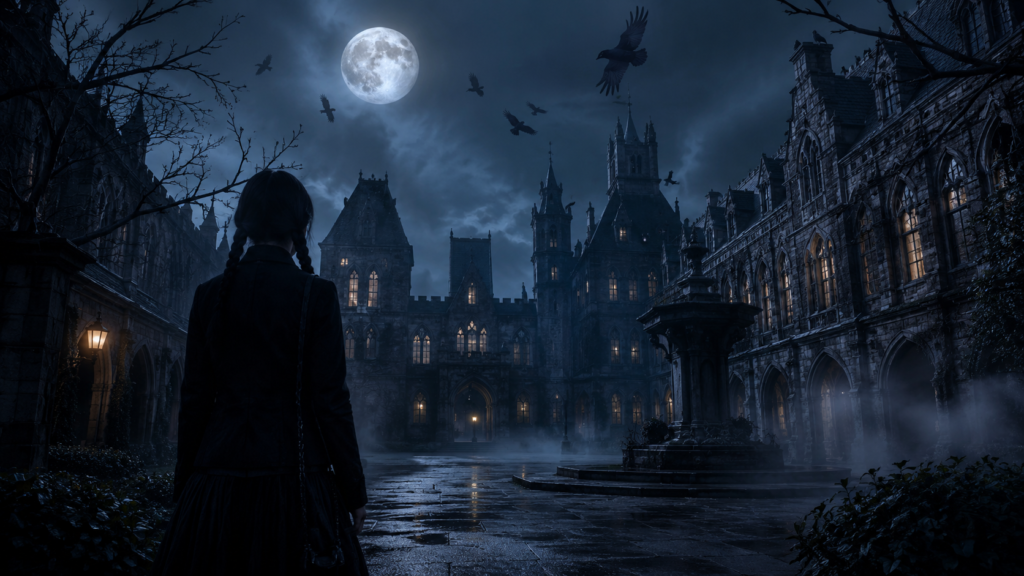
Wednesday returns to Nevermore Academy with a darker mood, a larger canvas, and much more attention on the Addams family. Jenna Ortega remains the show’s essential center, while the second year aims for greater horror, broader mythology, and more complicated relationships.
That ambition produces many of the season’s best moments, but it also makes the story feel crowded. Season 2 is stylish, entertaining, and often sharper about family than its predecessor, yet its expanding collection of mysteries and supporting characters sometimes competes with the emotional material that deserves more room.
A Spoiler-Free Overview
Wednesday Addams begins another year at Nevermore with more confidence in her investigative abilities and less patience for the attention surrounding her. The school is familiar, but its social order has changed. New authority figures, students, supernatural complications, and family members all place fresh pressure on Wednesday’s belief that she can solve every problem alone.
The season expands the mystery structure that powered the first year. Several dangers and personal conflicts develop at once, making the result busier than Season 1 but more closely connected to Wednesday’s unusual family history.
Netflix’s official Season 2 guide confirms that all eight episodes are available. The season was divided into two four-episode parts.
A Darker Return to Nevermore Academy
Season 2 leans further into gothic horror without losing the playful absurdity that makes Wednesday accessible. Nevermore again functions as more than a decorative school. Its corridors, towers, woods, and hidden spaces create a world in which danger can feel ancient even when the characters’ problems are recognizably modern.
The darker approach suits Wednesday. Supernatural threats carry a little more weight, and the season is more willing to let unease build before a joke breaks the tension.
Jenna Ortega Remains the Show’s Greatest Strength
Jenna Ortega’s performance as Wednesday Addams continues to provide the series with its identity. The controlled posture, precise delivery, and refusal to soften every reaction make Wednesday funny without turning her into a standard sitcom outsider. Ortega also finds small changes inside that rigid style, especially when Wednesday’s certainty begins to collide with consequences she cannot simply outthink.
The writing sometimes relies too heavily on deadpan remarks to carry a scene. Even then, Ortega’s timing keeps the character compelling. For viewers asking whether Wednesday Season 2 is good, her confident lead performance is the most dependable reason to continue.
Wednesday and Enid’s Friendship Keeps Evolving
The friendship between Wednesday and Enid remains one of the series’ most effective contrasts. Emma Myers brings warmth and speed to Enid without reducing her to a cheerful opposite. She has her own expectations, frustrations, and changing social life, which prevents the relationship from standing still.
Season 2 tests the imbalance between them. Wednesday often assumes that protecting someone gives her permission to exclude that person from the truth. Enid is increasingly willing to challenge that habit. Their scenes work best when the series allows affection and irritation to exist together rather than forcing an easy reconciliation.
The crowded plot sometimes moves the pair from tension to urgent teamwork too quickly. Still, Ortega and Myers preserve the bond’s credibility and give the supernatural stakes a human center.
The Addams Family Takes a Larger Role
The decision to place more of the Addams family inside Wednesday’s school life is Season 2’s most important creative change. Pugsley becomes part of Nevermore, while Morticia and Gomez have stronger connections to events around the academy. Their presence creates exactly the kind of discomfort Wednesday cannot solve with a clue board: family knows how to challenge the version of herself she presents to everyone else.
Catherine Zeta-Jones gives Morticia elegance, authority, and a quiet competitive edge. Her scenes with Ortega benefit from the sense that mother and daughter are alike in ways neither finds convenient. Luis Guzmán continues to make Gomez openly affectionate and eccentric, providing warmth without erasing the family’s macabre humor. Isaac Ordonez gives Pugsley a more distinct place as he tries to establish an identity outside his sister’s shadow.
Joanna Lumley’s arrival as Grandmama Hester Frump adds another strong personality. The expansion enriches the show’s ideas about inheritance and control, although there are more interesting people than eight episodes can serve equally.
Netflix’s official cast guide provides more information about returning family members and new characters.
Returning and New Cast Members
Familiar Faces Bring Continuity
The returning Wednesday Season 2 cast helps Nevermore feel lived in rather than rebuilt. Joy Sunday maintains Bianca’s poise while revealing the pressure beneath it. Georgie Farmer, Moosa Mostafa, Fred Armisen, and Hunter Doohan return in roles of varying size, and each reconnects the new story to relationships or conflicts established in Season 1.
New Arrivals Add Talent—and More Crowding
Steve Buscemi is a natural fit for Nevermore’s peculiar institutional world. His presence adds dry unpredictability and makes school leadership part of the season’s tension. Billie Piper brings confidence to her role, while Evie Templeton makes a memorable impression among the younger additions. Joanna Lumley quickly feels at home in the Addams family’s heightened style.
Owen Painter and Noah B. Taylor broaden the student and supernatural sides of Nevermore. Lady Gaga appears as guest star Rosaline Rotwood in Part 2, in a distinctive but limited role.
The casting is rarely the problem. The question is whether the story has enough space for everyone. Several newcomers arrive with intriguing personalities or histories, but the season sometimes introduces possibilities faster than it can develop them.
Tim Burton’s Gothic Visual Style Still Defines the Series
Tim Burton, an executive producer who directs selected episodes, remains central to the show’s visual language. The production combines imposing stone architecture, cold landscapes, elaborate interiors, and carefully controlled color. Black, gray, blue, and muted purple dominate, allowing occasional brighter details to stand out sharply.
Camera movement, exaggerated design, creature effects, and physical comedy give Nevermore a storybook quality. The craft remains one of the strongest arguments for watching on the largest screen available.
Mystery, Horror, Humor, and Supernatural Mayhem
The series continues to blend detective fiction, school drama, supernatural horror, and dry comedy. Season 2 increases the horror emphasis, but it does not become a radically different show. The mystery remains the engine, while humor usually comes from Wednesday’s reactions, the Addams family’s values, and the absurd rules of the outcast world.
This combination is entertaining when every genre supports the same character conflict. It becomes less effective when separate mysteries and subplots appear to be competing for urgency. Viewers who want one clean investigation may find the structure scattered. Those who enjoy Nevermore as an entire supernatural playground may appreciate the wider scope.
Pacing Across Part 1 and Part 2
The eight Wednesday Season 2 episodes do not move at a steady speed. Part 1 must reintroduce the school, establish family involvement, present new characters, and launch several dangers. The amount of setup makes some emotional beats feel brief.
Wednesday Season 2 Part 2 has the opposite challenge. It must reconnect those threads and accelerate toward resolution. The second half contains strong confrontations and imaginative set pieces, yet it sometimes depends on compressed explanations or abrupt shifts of attention. The season moves quickly without always feeling focused.
Did the Two-Part Release Help or Hurt?
Splitting the season gave Part 1 a clear stopping point and allowed Netflix to keep the conversation active for a month. It also made four episodes look like a complete season to viewers encountering the first release. Four episodes were only the first half.
As a viewing experience, the break did not improve the storytelling. The narrative was designed as one eight-episode arc, and the pause interrupted momentum while encouraging the midpoint to carry extra cliffhanger pressure. Now that both parts are available, watching the episodes closer together creates a more coherent experience.
Where the Season Struggles
The central weakness is overcrowding. Too many mysteries, relationships, family tensions, and newcomers seek equal importance. The season frequently offers an appealing idea, then moves away before that idea reaches its full dramatic potential.
The larger Addams family focus is valuable, but it also changes the balance. Viewers primarily invested in Nevermore’s student ensemble may feel that some classmates have been pushed toward the edges. More ambition gives Season 2 richer themes, yet it also makes the season less cleanly structured than the first.
Does Season 2 Improve on Season 1?
Season 2 improves in some areas rather than surpassing its predecessor outright. It has a stronger Addams family identity, a darker atmosphere, and more willingness to challenge Wednesday’s independence instead of simply celebrating it.
Season 1 remains the more streamlined mystery and offers a cleaner introduction to Nevermore’s students and rules. The second season is more ambitious but less disciplined. Which one feels better will depend on whether a viewer values narrative focus or a broader exploration of the Addams family and supernatural world.
Who Will Enjoy the New Season?
Fans of Ortega, Enid, the Addams family, and Burton’s gothic aesthetic should find plenty to enjoy. The season also suits viewers who prefer supernatural mysteries with stylized scares rather than graphic horror.
Casual viewers should begin with Season 1. Although the new episodes provide enough reminders to restore basic context, important relationships and earlier events carry more weight when experienced in order. Anyone seeking a tightly contained detective story may be frustrated by the number of parallel threads.
Final Verdict: Is Wednesday Season 2 Worth Watching?
Netflix’s return is worth watching, especially for Jenna Ortega’s precise lead performance, the richer Addams family material, and the consistently atmospheric production. The season is darker and more ambitious, but those ambitions create uneven pacing and an overcrowded narrative.
Season 2 does not replace the first season’s freshness or focus. It deepens the family side and takes bolder supernatural swings, but tries to fit too many strong ideas into eight episodes.
Verdict: A visually assured and entertaining return elevated by Ortega and the Addams family, even when its crowded mysteries keep it from feeling fully controlled.
For confirmed news about the next season, see our Wednesday Season 3 updates.

