
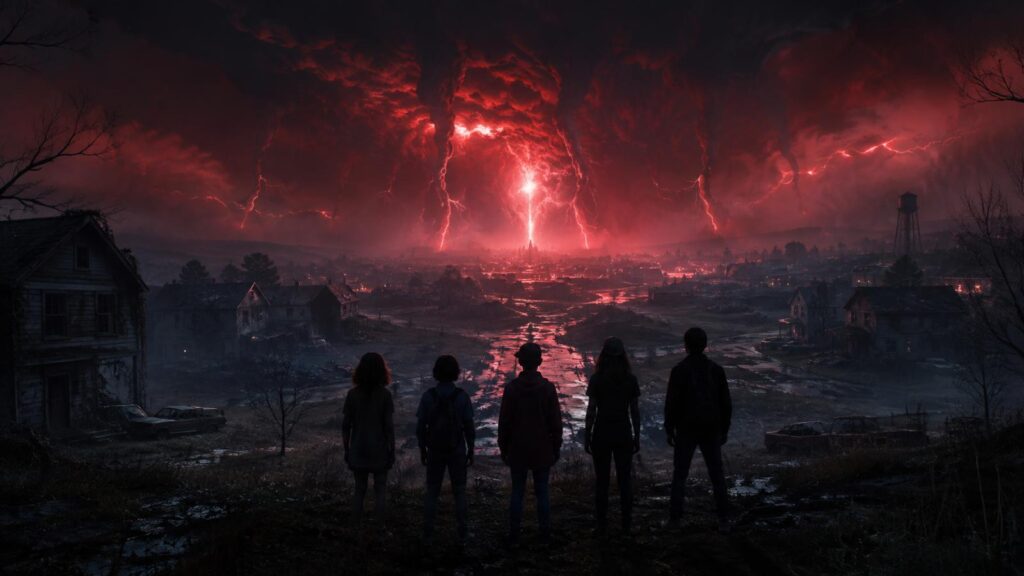
After nearly a decade of monsters, secret experiments, and friendships tested under impossible pressure, Netflix brings the Hawkins story to its final chapter. This Stranger Things Season 5 review finds a finale that is worth watching, especially for longtime viewers invested in Eleven and the original group.
The season is tense, visually enormous, and often genuinely moving without forgetting the eerie science-fiction mood that made the series distinctive. It is not the cleanest season: long episodes, heavy exposition, and a crowded ensemble sometimes slow its momentum. Still, the Duffer Brothers give the characters enough emotional space to make the farewell matter. No deaths, major twists, or details of the ending are revealed below.
Quick Verdict: Is Stranger Things Season 5 Worth Watching?
Yes. This Netflix Stranger Things Season 5 review recommends the final season to viewers who have followed Hawkins from the beginning and want a character-driven conclusion wrapped inside a large-scale supernatural thriller.
Its strongest elements are the committed performances, renewed focus on the core party, oppressive horror atmosphere, and substantial emotional payoff.
The main weakness is excess. Several episodes juggle so many objectives, explanations, and character pairings that urgency can turn into narrative traffic. Even so, the season works more often than it stalls.
CinePulse24 rating: 7.5/10.
Stranger Things Season 5 Review: One Final Battle for Hawkins
The story begins in fall 1987, with Hawkins scarred by the rifts opened at the end of Season 4. Vecna has disappeared, the town is under military quarantine, and the government is still hunting Eleven.
That setup reunites the heroes around a simple objective while preserving uncertainty about where the danger will emerge next.
Netflix released the eight-episode final season in three parts in the United States: four episodes on November 26, 2025, three on December 25, and the series finale on December 31. Those details, along with the official premise and returning cast, are confirmed by Netflix Tudum.
Rather than building an entirely new mythology, the season concentrates on unfinished conflicts and relationships. It treats Season 4 as a direct launchpad, so newcomers should not start here. The advantage is immediacy; the cost is that the opening assumes a strong memory of earlier events.
The Story Is Ambitious but Not Always Balanced
The final season operates like a sustained endgame. Missions overlap, plans change, and separate groups carry pieces of the same larger problem.
This structure creates momentum when the story moves cleanly between characters, but it also leaves some episodes packed with explanation before the next major set piece can begin.
Extended runtimes help the quieter material. Conversations are allowed to breathe, grief does not disappear when the action starts, and old relationships receive more attention than a standard network-length episode could provide. That space is especially valuable because the series must resolve emotional threads accumulated across five seasons.
Length is less helpful when information is repeated or a plan requires several rounds of clarification. The season occasionally explains stakes that the performances and visual storytelling have already made clear.
A tighter edit could have preserved the scale while giving the middle stretch a sharper pulse.
The Cast Gives the Final Season Its Emotional Weight
Millie Bobby Brown keeps Eleven at the emotional and strategic center without reducing her to a display of power. Finn Wolfhard gives Mike a steadier leadership presence, while Noah Schnapp handles Will’s long connection to the supernatural threat with controlled vulnerability.
Their shared history makes small exchanges feel as important as the louder confrontations.
Gaten Matarazzo brings visible grief beneath Dustin’s intelligence and humor. Caleb McLaughlin plays Lucas with restraint, grounding his hope for Max in patience rather than melodrama.
Sadie Sink communicates the weight of Max’s unresolved condition from Season 4 even when the story places unusual demands on the character.
David Harbour and Winona Ryder remain essential as Hopper and Joyce. Their performances give the adult side of the story warmth, fatigue, and hard-earned trust.
The ensemble is now large enough that not every relationship receives equal attention, yet the strongest scenes understand that audiences care about these people before they care about the mythology.
Readers looking for similarly focused verdicts can explore CinePulse24’s more spoiler-free TV reviews.
Horror, Visual Effects and the Atmosphere of Hawkins
Season 5 leans into apocalyptic imagery without abandoning physical textures. Damaged streets, military barriers, dark interiors, and the corruption spreading through familiar spaces make Hawkins feel occupied rather than merely threatened.
The visual effects are most effective when they alter recognizable environments instead of overwhelming them with constant digital motion.
The horror mixes body horror, pursuit sequences, and psychological unease. Sound design often does as much work as the creatures: low mechanical rumbles, sudden silence, and distorted environmental noise build pressure before a threat is visible.
The familiar synth score and period details preserve the 1980s atmosphere, though nostalgia is no longer the show’s main engine.
The larger scale strengthens the sense of consequence, but it occasionally weakens the intimate mystery that defined Season 1. Stranger Things is now closer to a blockbuster war story than a suburban supernatural puzzle.
The production earns that evolution, even if some viewers will miss the earlier simplicity.
What Stranger Things Season 5 Does Best
Emotional Payoff
The season’s best choices connect present danger to years of friendship, fear, and growing up. Emotional callbacks usually serve a character decision rather than functioning as decoration.
The result is a farewell that recognizes how much the cast has changed without pretending that Hawkins can return to its old normal.
Ensemble Chemistry
Pairings shift, but the original group again feels like the center of the series. Humor comes from established personalities instead of interrupting the tension with unrelated jokes.
Even when the plot becomes dense, the cast can make a planning scene feel lively through rhythm, disagreement, and affection.
Blockbuster Production
The action has clarity as well as scale. Geography matters, objectives are understandable, and the visual effects support the physical performances.
The season also knows when to step away from spectacle. Some of its most memorable work depends on faces, pauses, and what characters cannot easily say.
Where the Final Season Falls Short
The crowded cast remains the biggest structural problem. Several characters compete for limited emotional space, and a few arcs feel compressed while others receive repeated explanation.
The need to service mythology, military conflict, relationships, and the final confrontation sometimes makes an episode feel like several finales running at once.
Nostalgia is generally controlled, but not every callback earns its place. A familiar object, line, or musical cue can deepen a scene; too many in succession can make the series appear to underline its own history.
The season is strongest when it trusts the audience to recognize meaning without stopping to announce it.
Its dialogue also becomes functional during plot-heavy stretches. Characters occasionally speak to organize information more than to reveal themselves.
These weaknesses do not erase the emotional impact, but they keep the final season from matching the precision of the show’s best early episodes.
How Season 5 Compares With Earlier Seasons
Season 1 remains the tightest blend of mystery, childhood adventure, and restrained horror. Season 5 cannot recreate that discovery because both the characters and audience understand far more about the Upside Down.
Instead, it favors consequence: familiar locations carry history, and old choices shape every new plan.
Compared with Season 4, the final run feels more unified geographically and emotionally, even when its episodes are similarly large. The horror is less dependent on introducing a new villain because Vecna is already established.
The suspense comes from how the group can confront a known threat whose full design remains uncertain.
This Stranger Things 5 review therefore lands between admiration and reservation. Season 5 has more momentum than the series’ most scattered stretches, but less elegance than its first year.
Its character focus, rather than bigger effects, is what makes the scale worthwhile.
Stranger Things Season 5 Rating and Critical Reception
The critical response is positive overall but notably divided from audience reaction.
As of September 4, 2026, the Stranger Things Season 5 Rotten Tomatoes page lists an 82% Tomatometer score from 164 critic reviews and a 52% Popcornmeter score from more than 10,000 audience ratings. The current figures can be checked directly on the Rotten Tomatoes season page.
That gap helps explain why published Stranger Things Season 5 reviews can sound so different. A Stranger Things Season 5 finale review may emphasize either emotional closure or structural frustration.
Critics broadly recognized the genre craft and emotional send-off, while the lower audience score points to frustration with specific writing choices and the conclusion. Aggregate scores measure consensus, not whether an individual viewer will connect with the farewell.
For clarity, the editorial Stranger Things Season 5 rating here is 7.5/10. It reflects strong performances, atmosphere, and production weighed against uneven pacing, exposition, and an overextended ensemble.
Wondering what comes next after the final season? Read our guide to whether there will be a Stranger Things Season 6 and discover what Netflix has officially confirmed.
Final Verdict: Is Stranger Things Season 5 Good?
Yes, although it is more satisfying as an emotional farewell than as a perfectly disciplined season of television.
Longtime viewers should watch it for the performances, the renewed emphasis on the party, and the way the final conflict gives accumulated relationships real dramatic weight.
Viewers who preferred the compact mystery of Season 1 may find the extended episodes, dense mythology, and blockbuster scale frustrating. Those limitations are visible, but they do not make the ending hollow.
The final season closes the Hawkins story with sincerity, ambition, and enough restraint to let key character moments register.

The concise conclusion of this Stranger Things Season 5 review is that Netflix sticks the landing emotionally, even if the approach is occasionally overstuffed. It is an imperfect but worthwhile goodbye.
Frequently Asked Questions
Is Stranger Things Season 5 good?
Yes. It combines strong ensemble performances, effective horror, and meaningful emotional payoff, although its long episodes and crowded plot keep it from being the show’s most consistent season.
Is the Stranger Things Season 5 review spoiler-free?
Yes. This review discusses the premise, performances, pacing, atmosphere, and overall quality without revealing character deaths, major twists, the final battle’s outcome, or the ending.
How many episodes are in Stranger Things Season 5?
Season 5 has eight episodes. Netflix released four on November 26, 2025, three on December 25, and the series finale on December 31 in the United States.
What is the Stranger Things Season 5 rating?
CinePulse24 rates the season 7.5/10. On Rotten Tomatoes, it holds 82% from critics and 52% from audience ratings as of September 4, 2026. Those aggregate scores can change as additional ratings are recorded.