
Spoiler-light notice: This review discusses the premise, performances, themes and pacing without revealing the winner, major deaths or ending.
Squid Game Season 3 delivers a tense conclusion built around Gi-hun’s moral struggle and his conflict with the Front Man. This Squid Game Season 3 review considers its performances, visual design and pacing without revealing the ending.
The lead actors and unsettling game environments give the final chapter much of its force. However, supporting storylines feel compressed, and the investigation outside the arena sometimes interrupts the tension. Season 3 works best as a direct continuation of Season 2.
| Series | Squid Game |
|---|---|
| Season | Season 3 |
| Creator | Hwang Dong-hyuk |
| Main Cast | Lee Jung-jae, Lee Byung-hun, Wi Ha-jun, Yim Si-wan, Kang Ha-neul, Park Gyu-young, Park Sung-hoon, Kang Ae-sim, and Jo Yu-ri |
| Number of Episodes | 6 |
| Release Date | June 27, 2025 |
| Platform | Netflix |
| Genre | Survival drama, thriller, mystery |
| Article Type | Spoiler-light review |
A Direct Continuation of Season 2
Season 3 continues directly after the failed rebellion that closed Season 2. Gi-hun’s attempt to challenge the people operating the competition has collapsed, leaving him burdened by guilt while the surviving contestants are pushed back into the games.
That immediate continuation gives the opening considerable emotional momentum. There is no major reset, extended reintroduction, or new route into the story. The season assumes viewers remember the alliances, betrayals, and unfinished investigation from the previous chapter.
For that reason, Squid Game Season Three feels less like a fully independent season than the second half of an extended finale. Season 2 established the new contestants, returned Gi-hun to the arena, and positioned the rebellion. Season 3 focuses on the consequences.
A Darker Story Focused on Gi-hun’s Final Test
Gi-hun’s guilt after the failed rebellion shapes his decisions. His determination remains, but the season asks whether he can hold onto his principles when protecting others carries a personal cost.
His conflict with the Front Man gives the story its strongest dramatic foundation. Gi-hun believes people can still care for one another under pressure; the Front Man wants to prove that fear ultimately makes everyone selfish.
The season connects its criticism of inequality to these opposing beliefs. It is most effective when choices reveal the argument, and less convincing when dialogue repeats what the action has already shown.
Squid Game Season 3 Cast and Performances
The cast carries much of the emotional weight, especially when the narrative moves beyond the immediate suspense of the competition.
Lee Jung-jae gives Gi-hun a restrained physical and emotional heaviness. His performance communicates exhaustion without turning the character passive. Small changes in posture, expression, and voice help show the struggle between despair and continued responsibility.
Lee Byung-hun remains an effective counterweight as Hwang In-ho, better known as the Front Man. His controlled performance makes the character more unsettling than a louder villain would be. In-ho rarely needs to announce his authority because the entire environment already reflects it.
The tension between the two men works because it is personal as well as philosophical. The Front Man does not merely want to stop Gi-hun. He wants Gi-hun’s choices to validate his cynical understanding of humanity.
Wi Ha-jun returns as Hwang Jun-ho, whose search for the island continues outside the main competition. His storyline adds investigative movement and a broader view of the organization, though it sometimes feels detached from the season’s most urgent drama.
Among the other important returning performers, Park Sung-hoon brings dignity and emotional clarity to Hyun-ju, while Kang Ae-sim gives Geum-ja a convincing mixture of concern and resilience. Jo Yu-ri makes Jun-hee’s vulnerability feel grounded rather than merely functional. Yim Si-wan and Kang Ha-neul also handle morally complicated material with intensity.
Park Gyu-young’s No-eul provides a useful perspective from within the machinery of the games. However, the limited runtime means that she and several other supporting characters receive less development than their situations appear to promise.
The New Games, Sets, and Visual Design
The new games preserve the series’ defining contrast between childhood imagery and severe adult consequences. Their rules remain understandable, but the staging turns simple activities into tests of loyalty, fear, and social pressure.
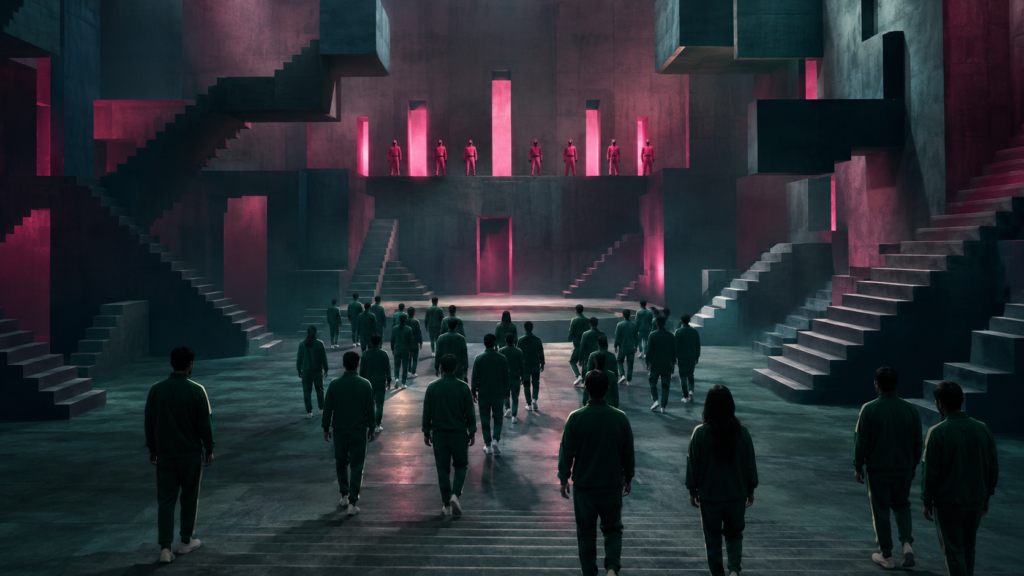
The production design is one of the season’s clearest strengths. Large geometric spaces make the contestants appear small, while bright colors create an artificial sense of playfulness. Staircases, platforms, walls, and open spaces are arranged to emphasize both scale and vulnerability.
Hwang worked with production designer Chae Kyoung-sun on the season’s environments, according to Netflix’s official Season 3 guide. The results expand the show’s familiar visual language without simply reproducing earlier arenas.
Editing is especially effective when the games require viewers to monitor several characters or shifting alliances at once. The camera establishes the rules and physical space clearly before moving closer to individual reactions.
The music alternates between uneasy restraint and heightened spectacle. Rather than maintaining constant intensity, the sound design often allows silence, mechanical noises, or distant movement to build anticipation.
The strongest rounds force contestants to make decisions that reveal relationships and priorities, although a few moments lean more heavily on shock and visual scale.
Pacing Across the Six Episodes
How many episodes are in Squid Game Season 3? There are six. Netflix released all six episodes on June 27, 2025, and the complete season is currently available through the official Netflix title page, subject to regional availability.
The six-episode season creates a fast, escalating structure. The narrative does not spend much time introducing a new status quo because the major conflict is already underway.
That urgency benefits the central Gi-hun–Front Man storyline. Their moral contest develops steadily, and the competition rarely disappears from view for long. The season understands that it is approaching a final destination.
The disadvantage is compression. Some supporting characters are given powerful individual scenes but not enough space for their relationships to develop naturally. At times, the script must move a character from one emotional position to another faster than the moment deserves.
The outside investigation creates a second pacing issue. Jun-ho’s search remains relevant to the larger plot, yet it cannot match the immediate pressure inside the arena. Cutting between the two storylines sometimes reduces tension instead of increasing it.
As a result, the six-episode structure is both a strength and a limitation: it removes unnecessary detours but occasionally rushes material that could have supported a fuller dramatic payoff.
What Squid Game Season 3 Does Well
The season’s most notable strengths include:
- Committed lead performances from Lee Jung-jae and Lee Byung-hun
- A clear ideological conflict between hope and cynicism
- Imposing, readable game and set design
- Sustained suspense across a short season
- Emotionally difficult choices with meaningful consequences
- Continued criticism of systems built around inequality and exploitation
The production never treats scale as a substitute for clarity. Even when an arena is enormous, viewers can generally understand its physical layout and the danger created by its rules.
More importantly, the season preserves the human question beneath the spectacle. Its central conflict is not merely between one contestant and one authority figure. It concerns whether people can make moral choices inside systems specifically designed to reward selfishness.
The performances make that argument more persuasive. Lee Jung-jae and Lee Byung-hun embody opposing positions without reducing either character to a simple speech or symbol.
Where the Final Season Falls Short
The season’s dependence on Season 2 is its most obvious weakness. Because the two chapters were conceived as closely connected parts of the same closing movement, Season 3 lacks the gradual buildup and independent identity of the original season.
Several supporting arcs also feel compressed. Characters with interesting personal conflicts do not always receive enough quiet time between games. Their choices can still carry emotional force, but more development would have made certain turning points feel less abrupt.
The themes occasionally become repetitive. The series has always been direct about class inequality and the manipulation of desperate people. In the final season, some exchanges explain ideas that the images and decisions have already communicated.
Pacing is uneven outside the central competition. The investigation led by Jun-ho contains important information, yet its progression can feel slower than the action inside the facility.
There are also moments when the effort to make every game more severe competes with the character drama. The best suspense emerges from relationships and impossible choices. When spectacle dominates, the show risks making its contestants feel like pieces in an elaborate production rather than fully developed people.
Critical Reception and Squid Game Season 3 Reviews
Reviews offer another perspective on the season’s performances, pacing and conclusion. Readers can compare critics’ assessments and audience reactions on the Rotten Tomatoes Season 3 page.
Scores and review counts change over time. Check the current figures directly, and watch for spoiler warnings before reading individual reviews.
Is Squid Game Season 3 Worth Watching?
Yes, especially for viewers who have finished Seasons 1 and 2. The lead performances, unsettling sets and moral conflict make it a compelling conclusion, although compressed supporting arcs and the slower outside investigation weaken its consistency.
CinePulse24 editorial rating: 8/10.
Season 3 is relentlessly bleak and relies on earlier events. It is best suited to viewers already invested in Gi-hun’s story, rather than newcomers looking for a standalone thriller.
For readers who have finished the season — full spoilers: Our Squid Game Season 3 ending explained examines the finale’s major outcomes.
For the franchise’s future, see our Squid Game Season 4 update, which separates Netflix’s official position from reports about an American spin-off.

