
Major spoiler warning: This article reveals the full ending, character deaths, vampire twists, and both credit scenes in Sinners.
Ryan Coogler’s Sinners ends its supernatural siege but saves its most revealing answers for the morning after—and for two scenes during and after the credits. This sinners movie explained guide covers Remmick’s real objective, the outcomes of Smoke, Stack, Sammie, Mary, Annie, and the juke-joint community, plus what the final images say about freedom, family, and cultural memory.
For a spoiler-free look at the performances, direction, music, and atmosphere, read our complete Sinners review first.
| Movie Information | Details |
|---|---|
| Movie | Sinners (2025) |
| Director and Writer | Ryan Coogler |
| Main Characters | Smoke, Stack, Sammie, Annie, Mary, Remmick, Pearline, Delta Slim, Grace, and Bo |
| Setting | Clarksdale, Mississippi, primarily on October 15, 1932; the first credits scene moves to 1992 |
| Genre | Southern Gothic supernatural horror, period drama, and musical |
Visit the official Warner Bros. page for Sinners for studio information and official promotional material.
Sinners Movie Explained: What Happens in the Final Act?
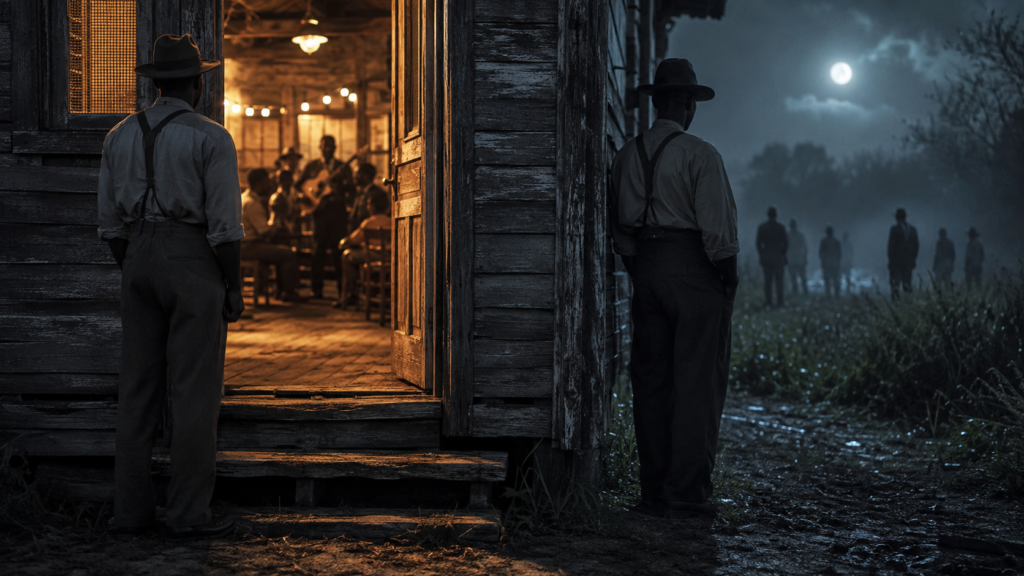
Smoke and Stack Moore return from Chicago and transform an abandoned sawmill into a juke joint for their Black community. Their young cousin Sammie, a preacher’s son with an extraordinary gift for blues music, becomes the night’s creative center. His performance does more than excite the crowd: it briefly joins past, present, and future, bringing generations of Black music into the same spiritual space.
That power attracts Remmick, an Irish vampire who has already begun turning local people. Mary is converted, then bites Stack after returning to the juke joint. The remaining people barricade themselves inside because Remmick and his group cannot cross the threshold without an invitation.
Remmick offers apparent safety and belonging, but his terms require surrender. He wants Sammie, whose music may let him reach the ancestors and culture from which he has been separated. When Grace, desperate over the threat to her daughter, invites the vampires inside, the protective boundary collapses.
The fight destroys the juke joint’s brief sanctuary. Annie, Grace, Bo, Delta Slim, and others are killed or turned. Pearline is turned by Remmick, while Mary ultimately escapes.
Sammie uses his broken guitar to help stop Remmick until sunrise. Sunlight destroys Remmick and the vampires still bound to the exposed group, but Stack is not among those destroyed. Smoke had subdued his brother and later chose to spare him after extracting a promise that Sammie would be left alone.
The supernatural danger is followed by a human one. Smoke knows Hogwood—the white landowner who sold the twins the mill and leads the local Ku Klux Klan—is coming with armed men. Smoke sends Sammie away, confronts the attackers, and defeats them, but he is mortally wounded. The film presents his final vision of Annie and their deceased daughter as an emotional reunion, though viewers can interpret whether it is literally an afterlife or Smoke’s dying vision.
Sammie reaches his father’s church alive. His father wants him to reject the path that brought such pain, but Sammie eventually chooses music and leaves for Chicago. That decision leads directly to the 1992 epilogue.
Sinners Ending Explained: Who Survives the Night?
Sammie, Stack, and Mary survive beyond 1932, while Smoke dies after the vampire attack. Stack and Mary continue as vampires. Sammie remains human and builds a long blues career.
Annie dies defending the others after her knowledge of Hoodoo and vampire protections helps them understand the threat. The film treats her spiritual knowledge seriously, and her bond with Smoke provides the emotional center of his ending.
Remmick is destroyed at sunrise. His death breaks his immediate control over the night, but it does not reverse every transformation. Stack and Mary remain vampires, proving that vampirism continues after its leader is gone.
Pearline is turned and destroyed with Remmick’s exposed group at sunrise. Delta Slim, Grace, Bo, and much of the community also die. A place created for Black ownership, pleasure, music, and safety is wiped out by forces seeking to consume or control it.
What Do the Vampires Want?
The vampires do not behave only like predators looking for blood. Remmick’s converts form a shared collective. They retain recognizable memories and personality, but they are joined through him and offer newcomers a life without loneliness, aging, or conventional racial division.
That offer is tempting in 1932 Mississippi. Stack and Mary’s relationship is constrained by racism, while the Black characters face Jim Crow violence. Remmick promises a community in which those barriers disappear.
The price is autonomy. Membership means entering a collective organized around Remmick’s desire. His invitation to unity therefore has a coercive core: accept assimilation or face violence. The vampires’ warm singing and communal language make the danger more complicated, not less real.
Remmick’s Plan Explained
Remmick wants Sammie because Sammie’s music can open a spiritual passage across generations. During the juke-joint performance, the film visualizes artists from other eras sharing the room. This establishes the supernatural reach of Sammie’s gift before Remmick explains why he values it.
Remmick believes Sammie can help him reconnect with lost ancestors and cultural memory. The film links his longing as an Irishman to displacement. Sammie is not merely another recruit; Remmick wants access to what he can summon.
The broader meaning is interpretive. Remmick can be read as a figure of cultural appropriation: he recognizes the power of Black music, yet tries to absorb its creator into his own collective and use that gift for his purposes. He speaks of connection while denying Sammie the right to choose how his music—and identity—will live.
The film does not argue that cultural exchange itself is evil. Its musical world contains Black and Irish traditions as well as sacred and secular forms. The dividing line is consent: exchange can create, while forced possession consumes.
What Happens to Smoke?
Smoke dies after the confrontation with Hogwood and the Klansmen.
Smoke survives the vampires, saves Sammie, and spares Stack under a condition. He then stays at the ruined juke joint because he knows Hogwood and the Klansmen are approaching. His final confrontation removes the human attackers, but he receives a fatal wound.
Smoke’s choice completes his arc. Earlier, he trusts weapons and experience more than Annie’s spiritual practices. By the end, resistance and spiritual connection are no longer opposites. He protects the younger generation and finally sees Annie and their child again.
The movie confirms Smoke’s physical death. It does not objectively prove the metaphysical status of his reunion, so describing that image as a confirmed afterlife would go beyond what the screen establishes.
Does Stack Die in Sinners?
No, Stack does not die in Sinners. The sunrise sequence encourages uncertainty because Remmick’s visible group burns, but the first credits scene later confirms that Stack survived.
Smoke could not restore Stack’s humanity, yet he could still protect the part of his brother that remained. He spared Stack after making him promise not to harm Sammie. Stack honors that agreement for 60 years.
The contrast between Smoke and Stack in Sinners builds into a central paradox. Smoke dies after securing Sammie’s future. Stack gains immortality but loses daylight, his brother, and the ordinary human world. Survival is not a simple victory.
Stack and Mary’s Relationship
Stack left Mary before the main story partly because their relationship exposed them to racial danger. Vampirism lets them stay together beyond the laws and lifespan of their era, but it does so by removing them from human life.
Mary initially functions as Remmick’s route to Stack, yet the 1992 scene shows that Stack and Mary remain together after Remmick’s destruction. They are no longer shown as members of his singing collective. This suggests that his death left them with greater individual freedom, although the film does not explain the exact supernatural mechanics.
Their survival is bittersweet. They escape the restrictions that separated them, but they cannot enter sunlight or recover the people lost that night. Their love lasts; the life they might have lived does not.
The Meaning of Sammie’s Music
Sammie’s music is both supernatural power and personal inheritance. It connects the blues to ancestors, descendants, sacred expression, pain, joy, and future forms of Black music. The juke-joint sequence makes cultural memory visible: music allows generations that could never meet historically to occupy one imaginative space.
His father fears blues may pull him from salvation. Smoke and Stack see his talent as part of the club’s promise. Remmick sees a gateway he can possess. Sammie ultimately refuses to let others define his gift.
He does not abandon spirituality when he chooses the blues. The final end-credit scene returns young Sammie to church music, showing that sacred and secular traditions coexist inside him. His survival means carrying memory without surrendering choice.
Sinners Post-Credit Scene Explained
Does Sinners have a post credit scene? Yes. It has two credits sequences, and they appear in this order: a substantial mid-credits epilogue set in 1992, followed by a brief scene after the full credits.
In the 1992 mid-credits scene, an elderly Sammie—played by blues legend Buddy Guy—has become a successful musician. After a performance at his club, he receives two unexpected visitors: Stack and Mary, unchanged in age and still living as vampires.
Stack explains that Smoke spared him in exchange for his promise to leave Sammie alone. Having waited six decades, he offers the elderly Sammie immortality. Sammie declines. He has lived the life he selected, and extending it through vampirism would mean accepting the temptation he resisted in 1932.
Instead of taking eternal life, Sammie plays music. The three remember the juke joint before the night became a tragedy. Sammie regards those earlier hours as the best day of his life; Stack shares the feeling because it was his last day with Smoke, his last day in sunlight, and a rare moment of freedom.
The exchange confirms that Stack retains memory, affection, restraint, and regret without excusing the vampires’ actions. It lets Sammie define survival on human terms: a finite life shaped by his own music matters more than immortality obtained through surrender.
Ryan Coogler has said the epilogue is central to the movie’s personal meaning. He connected the scene to his late Uncle James, his love of the blues, and Coogler’s inability to say goodbye before his uncle died. That verified context makes the meeting feel less like sequel bait than a farewell across time.
In an Entertainment Weekly interview, Ryan Coogler explains why the 1992 credits sequence and its connection to his late uncle are central to the film.
Is There a Second End-Credit Scene?
Yes. After the full credits, the final credits scene returns to young Sammie in his father’s church, singing “This Little Light of Mine” while playing guitar. It is brief and does not introduce a new plot twist.
The final credits scene works as a final statement about continuity. The church song belongs to Sammie’s spiritual upbringing, while the guitar is tied to the blues path he chooses. Placing both together refuses the idea that he must erase one inheritance to claim another.
Whether this moment represents a precise event in the timeline or a thematic coda is not explicitly confirmed. Its meaning, however, is clear enough: Sammie will carry his light forward in his own form.
What the Ending Means
The ending rests on competing definitions of freedom. Remmick offers escape from isolation, aging, and racial boundaries but demands entry into his collective. Hogwood represents a system determined to destroy Black independence. The juke joint offers community through ownership, pleasure, work, and music.
That sanctuary lasts only one night, yet its short life does not make it meaningless. The 1992 epilogue shows that Sammie carried the night forward through decades of music. The building is lost; the cultural memory survives.
Family works the same way. Smoke cannot save everyone, restore Stack, or rebuild his life with Annie. He can give Sammie a future and leave Stack with a moral obligation. Sixty years later, Stack keeping his promise turns Smoke’s final act into a living family bond.
The film also resists easy moral categories. The pastor is not wrong that music can open dangerous doors, but fear cannot be the only guide for Sammie’s life. Remmick is not wrong to long for belonging, but longing does not justify possession. Stack survives, but immortality carries loss. Smoke dies, but his choice protects a legacy.
Major Themes and Unanswered Questions
The major themes include cultural memory, appropriation, faith, temptation, grief, family, community, and survival. Music can summon what history tries to bury, which makes it liberating and vulnerable to exploitation at the same time.
The story never fully explains how Stack and Mary lived across the decades, whether other vampires remain, or how independent converts become after their maker dies. Nor does it define Smoke’s final vision.
Those gaps are not evidence for a single confirmed fan theory. They preserve mystery while the character outcomes remain clear: Remmick is gone, Smoke dies, Stack and Mary continue as vampires, and Sammie grows old as the musician he chose to become.
The story is about refusing false choices. Sammie carries church music and blues, memory and change, sorrow and joy. His mortal life proves that survival means more than continuing to exist—it means retaining the freedom to decide what your gift becomes.

