
Lyle Jennings kidnapped Merritt Lingard after assuming the identity of journalist Sam Haig. His motive was revenge for the death of his brother, Harry, which Lyle and his mother blamed on Merritt. The Lyle Jennings Dept. Q revelation also exposes the truth about William’s injuries, the real Sam Haig’s death and Merritt’s four years of captivity.
Spoiler Warning: This article reveals the complete ending of Dept. Q Season 1, including the kidnappers’ identities, major deaths and Merritt Lingard’s fate.
Readers who want a spoiler-free assessment before exploring the finale can read our Dept. Q review, which examines the performances, mystery and pacing without revealing the ending.
Lyle Jennings Dept. Q Ending Explained
The central mystery of Dept. Q Season 1 begins with the apparent disappearance of prosecutor Merritt Lingard from a ferry. For years, the assumption was that she had fallen or been pushed overboard. Department Q eventually proves that Merritt never entered the water.
She was abducted by Lyle Jennings and his mother, who had constructed an elaborate revenge plan around the death of Lyle’s brother, Harry Jennings.
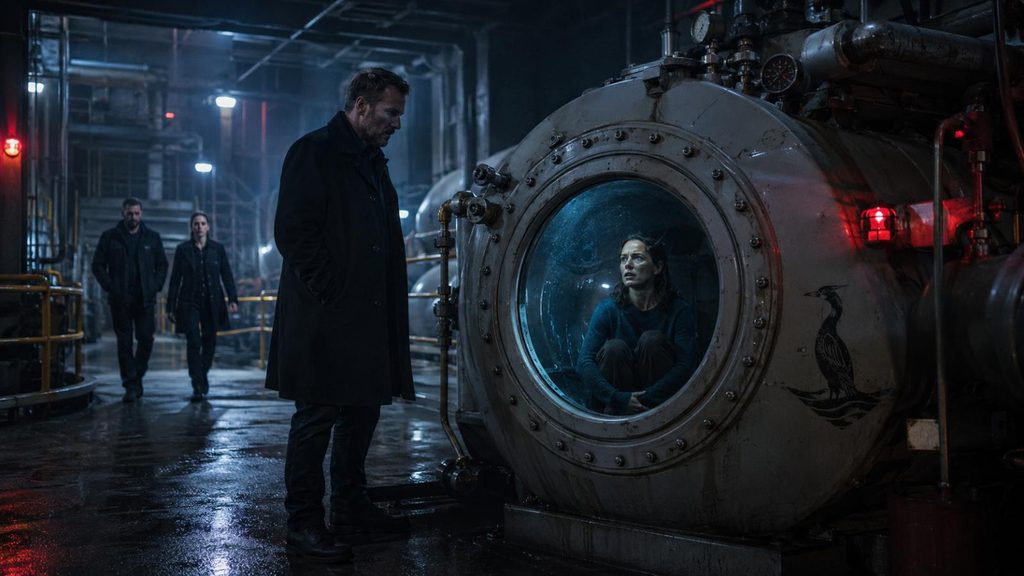
Lyle gained access to Merritt by murdering journalist Sam Haig, taking his identity and beginning a relationship with her. Once he had earned her trust, he helped abduct her and imprisoned her in a hyperbaric chamber at the Jennings family business, Shorebird Ocean Systems.
Netflix Tudum’s official guide to the Dept. Q ending confirms Merritt’s fate, Lyle’s identity and the unresolved Morck shooting.
Who Is Lyle Jennings in Dept. Q?
Lyle Jennings is Harry Jennings’ brother and the person truly responsible for the childhood attack that left William Lingard disabled and nonverbal.
When Merritt was younger, she wanted to escape her isolated home life. She helped plan the theft of her mother’s jewelry, believing the money could help her and Harry leave the island. Harry and Lyle participated in the attempted robbery, but the plan turned violent when William interrupted them.
Lyle attacked William. Harry was subsequently blamed for the assault, allowing the truth about Lyle’s role to remain hidden for years.
This revelation changes the moral foundation of the story. Merritt bears responsibility for helping plan the theft, but she did not attack William and did not intend for him to suffer life-changing injuries. Lyle’s later punishment of Merritt is therefore based on a distorted version of events that conceals his own guilt.
What Really Happened to Harry Jennings?
Harry Jennings was Merritt’s boyfriend and hoped to build a life with her away from the island. His involvement in the jewelry theft placed him at the scene of the attack on William, but Harry did not inflict William’s injuries.
After the robbery failed, Harry attempted to escape from the police. He died during that escape.
Lyle and Mrs. Jennings blamed Merritt for Harry’s death because she had helped devise the theft. Their grief hardened into a desire for revenge, but their version of the story ignored two essential facts: Harry chose to participate in the crime, and Lyle was responsible for the violence that transformed the situation.
The Harry Jennings Dept. Q storyline is tragic because Harry becomes both a participant in the failed robbery and a scapegoat for his brother’s brutality. His death gives Lyle and Mrs. Jennings the justification they use to torment Merritt, even though Lyle caused the most serious harm.
How Did Lyle Become Sam Haig?
Sam Haig was a real journalist who knew Lyle from an institution for troubled boys. Their connection gave Lyle the personal information he needed to imitate him.
As adults, Lyle and Sam reconnected. Lyle then killed Sam at the journalist’s climbing spot and disposed of his body there, making the death appear connected to a climbing accident.
Lyle subsequently adopted Sam’s identity when approaching Merritt. Pretending to be a journalist investigating corruption gave him a convincing reason to contact a senior prosecutor. It also allowed him to exploit Merritt’s professional concerns and gain her confidence.
The investigation initially becomes confusing because the detectives discover evidence that Sam appeared to be conducting two relationships in different places at the same time. That contradiction provides the breakthrough: the man Merritt knew as Sam Haig could not have been the real journalist.
The Sam Haig Dept. Q mystery is therefore more than a false name. Lyle uses an actual person’s history, profession and death to build a credible identity around himself.
Why Did Lyle Kidnap Merritt Lingard?
Lyle kidnapped Merritt as revenge for Harry’s death. Mrs. Jennings shared his belief that Merritt had destroyed their family by involving Harry in the jewelry theft.
Their punishment was designed to last rather than kill Merritt immediately. Lyle and his mother wanted her to experience prolonged isolation, fear and physical suffering.
The scheme also allowed Lyle to avoid confronting his responsibility for the original tragedy. He had attacked William, yet he redirected the blame toward Merritt and treated Harry’s death as though it had resulted solely from her actions.
That is the clear answer to who kidnapped Merritt in Dept. Q: Lyle Jennings and his mother abducted her after Lyle infiltrated her life under Sam Haig’s identity.
Where Was Merritt Being Held?
Merritt was imprisoned for four years inside a hyperbaric chamber located at Shorebird Ocean Systems, the Jennings family business.
The chamber could be pressurized and depressurized to inflict suffering while keeping Merritt alive. It also presented a major problem during the rescue. Opening it or changing the pressure too quickly could have killed her.
The location is connected to one of William’s most important clues. Because William cannot communicate verbally, he repeatedly draws what appears to be a bird. The investigators initially misunderstand the image, but it is eventually identified as a cormorant.
The same bird appears in the Shorebird Ocean Systems branding. Once Department Q understands what William has been trying to communicate, the drawing connects Merritt’s disappearance to the Jennings family operation.
How Does Department Q Find and Rescue Merritt?
Department Q solves the case by combining several discoveries rather than relying on a single piece of evidence.
The team recognizes that the Sam Haig involved with Merritt was an impostor. That leads them to Lyle, his childhood connection to the real journalist and the Jennings family address. William’s cormorant drawing then helps connect the suspects to Shorebird Ocean Systems.
Carl Morck and Akram reach the industrial site and find Merritt inside the pressurized chamber. Because an improper depressurization could kill her, they contact Hardy, who guides them through the chamber’s controls.
Lyle interrupts the rescue and shoots Morck in the shoulder. Akram then fights and defeats Lyle, giving Hardy’s instructions enough time to help them stabilize and release Merritt safely.
The rescue emphasizes what Department Q has become. Morck and Akram locate the victim, but Hardy’s knowledge remains essential even while he is recovering from the opening shooting.
What Happens to Lyle and Mrs. Jennings?
Lyle’s revenge operation ends when Akram defeats him during the confrontation at Shorebird Ocean Systems. Lyle survives the immediate fight and is left incapacitated, allowing the police to take control of the site.
Mrs. Jennings attempts to flee as police close in. After reaching a police cordon, she turns the gun on herself and dies by suicide.
Her death prevents the series from giving Merritt a direct confrontation or complete explanation from the woman who helped hold her captive. However, the evidence uncovered by Department Q establishes Mrs. Jennings’ participation and the motive behind the kidnapping.
Does Merritt Lingard Survive?
Yes. Merritt survives the hyperbaric chamber and is reunited with William.
Her survival is especially powerful because Lyle and his mother tried to reduce her existence to punishment for a mistake she made when she was young. Merritt returns to William carrying the effects of four years of captivity, but she is finally free to begin rebuilding her life.
Merritt and Morck do not formally meet after the rescue. They pass one another at police headquarters without a conventional scene in which Merritt thanks the detective who found her.
That choice keeps the reunion with William at the emotional center of Merritt’s ending. Morck’s reward is not recognition from Merritt but the knowledge that Department Q solved a case everyone else had effectively abandoned.
What Role Does Graham Finch Play?
Graham Finch is a deliberate red herring in Merritt’s disappearance.
Before she vanished, Merritt had prosecuted Finch over the suspected murder of his wife but failed to secure a conviction. Department Q discovers that Lord Advocate Stephen Burns suppressed evidence by pressuring Merritt not to call a witness who could have strengthened the case.
Finch’s threatening behavior makes him appear capable of targeting Merritt. He also sends men to intimidate Morck’s stepson, Jasper, after Department Q begins investigating him.
However, Graham Finch in Dept. Q did not kidnap Merritt. His storyline exposes a separate network of corruption and suspected murder while temporarily drawing the investigators away from the Jennings family.
Finch is not innocent, and Burns’ interference remains significant. Their wrongdoing simply belongs to a different case.
What Does Akram’s Fight Reveal About His Past?
Akram plays a decisive role in locating Merritt and stopping Lyle. When Lyle shoots Morck, Akram responds with an unusually controlled and effective display of combat skill.
The fight confirms that Akram’s background extends far beyond the limited professional history available to his colleagues. He has previously demonstrated strong investigative instincts, technical knowledge and an ability to recognize signs of torture. His defeat of Lyle adds further evidence that he received serious operational or combat training before arriving in Scotland.
The Akram Dept. Q mystery is intentionally left incomplete. Season 1 does not fully explain what he did in Syria or how he acquired his abilities. What the finale confirms is that those abilities help save both Morck and Merritt.
Who Shot Carl Morck and Hardy?
The person who shot Morck and Hardy in the opening attack is not Lyle Jennings, and the series does not reveal the shooter’s identity.
This is the key unresolved answer for viewers searching for Dept. Q ending explained who shot Morck. Lyle shoots Morck in the shoulder during Merritt’s rescue, but that is a separate incident from the ambush that opens the season.
Morck develops a theory that the first shooting was part of a larger trap. The police were sent to the crime scene following a report from a daughter who apparently did not exist. Morck believes the visible crime may have been staged to distract from the killing of the young police officer who died in the attack.
However, this remains Morck’s theory. Season 1 does not identify the gunman, establish the complete motive or reveal who organized the trap. Hardy is eventually assigned to investigate Morck’s theory.
Who Dies in the Dept. Q Ending?
Several deaths shape the complete mystery, although not all happen during the final rescue:
- Harry Jennings died while trying to escape the police after the failed robbery.
- The real Sam Haig was killed by Lyle at his climbing spot.
- Mrs. Jennings dies by suicide after encountering the police cordon.
- The young police officer in the opening ambush was killed, but the identity and motive of the shooter remain unknown.
Lyle is defeated but is not shown dying. Merritt survives, William remains alive, and Morck survives being shot in the shoulder.
What Does the Final Scene with Hardy Mean?
The final scene returns to the Department Q basement, where Morck sees Hardy arriving on crutches. Morck responds with a quiet smile.
Hardy’s return represents progress after the trauma that defined the beginning of the season. He is no longer confined entirely to recovery, and he now has a meaningful role within the department.
The moment also marks the true formation of Department Q. What began as an underfunded public-relations exercise has become a functioning team composed of Morck, Akram, Rose and Hardy. Each member contributes something the others lack.
Morck’s smile signals more than relief at seeing his friend. It suggests that the team finally has a future—and another mystery already waiting for it.
Does the Ending Set Up Dept. Q Season 2?
Yes, but the finale does not promise that Season 2 will immediately solve every outstanding mystery.
The Merritt Lingard case is closed: she is rescued, the kidnappers are identified, and the truth about William and Harry is exposed. That allows a future season to introduce another cold case without undoing Season 1’s resolution.
At the same time, Hardy’s return leaves the opening ambush available for further investigation. Akram’s mysterious past, the full consequences of Stephen Burns’ corruption and Graham Finch’s suspected crimes also remain potential continuing threads.
Netflix has officially renewed Dept. Q for Season 2, with Morck and the core Department Q team returning for another investigation. The Season 1 ending provides the team that will carry the series forward, but it does not confirm when—or whether—the unidentified shooter storyline will be completely resolved.
All nine episodes are available through the official Dept. Q page on Netflix.
Final Ending Summary
The Dept. Q ending reveals that Lyle Jennings was Harry’s brother, William’s real attacker and the man impersonating Sam Haig. After killing the real journalist, Lyle used Haig’s identity to enter Merritt’s life and help his mother kidnap her as revenge for Harry’s death.
Merritt spends four years inside a hyperbaric chamber at Shorebird Ocean Systems before Morck, Akram and Hardy work together to rescue her. Akram defeats Lyle, Mrs. Jennings dies while fleeing, and Merritt is reunited with William.
The case proves that Department Q is no longer an administrative punishment for Morck. It is a real investigative team. Yet the person responsible for the opening attack on Morck and Hardy remains unidentified, leaving the show’s most personal mystery open for the future.

