Opening Verdict
The short answer is yes: The Fantastic Four: First Steps is worth watching. This fantastic four first steps review finds Marvel Studios’ latest reboot most successful when it behaves less like a franchise assignment and more like a family drama staged on a cosmic scale. Matt Shakman’s film has an inviting retro-futuristic identity, a well-matched central cast, and a refreshingly sincere tone. Its story sometimes moves too quickly through ideas that deserve more space, but the movie finally gives Marvel’s First Family a screen adventure built around the quality that defines them: their bond with one another.
It is also accessible and largely self-contained. Viewers do not need to complete a pile of Marvel homework before sitting down.
The Fantastic Four First Steps Review — A New Beginning for Marvel’s First Family
Rather than retelling another lengthy origin story, The Fantastic Four: First Steps introduces Reed Richards, Sue Storm, Johnny Storm, and Ben Grimm as established heroes in an alternate, 1960s-inspired world. They are scientists, celebrities, public protectors, and—most importantly—a family. Their comfortable position is disrupted when the Silver Surfer arrives with a warning about Galactus, a cosmic force whose threat turns a global crisis into a deeply personal test.
That setup gives the film immediate momentum. Shakman trusts viewers to understand the basic powers and relationships without watching the team acquire them all over again. The decision creates room for family dinners, public pressure, scientific problem-solving, and the emotional consequences of being responsible for an entire world.
The official Marvel movie page confirms the principal cast and describes the film’s retro-futuristic setting. More importantly, that design choice is not just decoration. The optimism of the world makes the approaching danger feel sharper: this is a civilization that believes tomorrow will be better, suddenly confronted by something its best minds may not be able to stop.
Story and Premise
The screenplay makes a smart distinction between a team and a family. A team can break up after a failed mission; a family has to return home and deal with the fear, blame, and affection left behind. First Steps repeatedly brings its huge cosmic stakes back to that intimate truth.
The story is strongest when Reed’s instinct to solve every problem collides with Sue’s more human understanding of what people need. Johnny and Ben also contribute to the central problem rather than functioning as comic-relief satellites.
However, the film’s efficient structure can become overly compressed. Several major decisions arrive before the emotional or political consequences have fully developed. The movie raises interesting questions about public trust, sacrifice, parenthood, and the limits of scientific control, but it occasionally treats those questions as bridges to the next set piece rather than destinations worth exploring.
The Fantastic Four Finally Feel Like a Family
The ensemble chemistry is the film’s greatest victory. These characters tease, challenge, protect, and occasionally frustrate one another with the ease of people who share years of history. The humor usually grows from personality instead of stopping the story for a punchline.
Reed and Sue form the emotional center, but the group does not feel divided into a leading couple and two supporting heroes. Johnny’s impulsiveness is balanced by genuine intelligence and attention. Ben’s calm presence gives the household a lived-in warmth. Small exchanges around a table or inside the Baxter Building often communicate more about the Four than the louder action scenes.
For an MCU introduction, Marvel needs viewers to want more time with these four people. On that measure, First Steps succeeds.
Pedro Pascal as Reed Richards
Pedro Pascal plays Reed as a brilliant man who can calculate extraordinary possibilities but cannot always manage the emotional weight of those calculations. His performance is restrained, even anxious. This Mister Fantastic is not built around swagger. He is a husband, scientist, and protector whose intelligence becomes a burden when everyone expects him to produce an answer.
The screenplay sometimes keeps Reed so worried that it limits his sense of wonder. Still, Pascal makes the character’s guilt and determination believable.
Vanessa Kirby as Sue Storm
Vanessa Kirby gives the film its strongest performance. Sue Storm is not presented merely as Reed’s wife or the person who keeps the men from arguing. She is a leader with political instincts, emotional intelligence, and formidable power. Kirby can communicate steadiness and fear within the same moment, which lets Sue remain authoritative without making her invulnerable.
The film also understands that compassion is not passivity. Sue’s desire to protect her family and her wider community drives decisions rather than simply reacting to Reed’s plans. Her power sequences have physical impact, but Kirby’s grounded presence is what makes Invisible Woman feel central to this version of the team.
Joseph Quinn and Ebon Moss-Bachrach
Joseph Quinn’s Johnny Storm is charming without being reduced to a reckless joke. The familiar confidence is there, but so are curiosity and competence. Johnny pays attention, makes connections, and earns a meaningful place in the team’s response to the crisis. Quinn keeps the performance lively while avoiding a one-note imitation of earlier versions.
Ebon Moss-Bachrach brings a gentler rhythm to Ben Grimm. The Thing’s physical appearance could easily dominate every scene, yet the performance emphasizes patience, loyalty, and quiet loneliness. Ben feels comfortable inside the family even when he remains visibly separate from the wider world. The film could have given his private life more room, but Moss-Bachrach makes limited moments resonate.
Silver Surfer and Galactus
Julia Garner’s appearance as the silver surfer fantastic four 2025 audiences searched for gives the movie an eerie, almost mythic presence. Her Surfer moves with controlled precision and speaks with the gravity of someone carrying an unbearable purpose. The character is visually elegant, and Garner finds traces of conflict beneath the metallic surface without requiring long speeches.
The fantastic four silver surfer 2025 interpretation works because the film treats her as more than an effects showcase. She is threatening, mysterious, and emotionally relevant to the story’s larger questions about choice and obligation. Some of her internal conflict develops faster than ideal, but Garner makes the transition convincing enough to hold attention.
As for Galactus in Fantastic Four: First Steps, Ralph Ineson’s voice supplies exactly the scale the role demands. He sounds ancient rather than theatrically wicked. The character’s physical presentation is imposing and recognizably cosmic, correcting the temptation to make Galactus an abstract cloud or a conventional human villain.
The fantastic four first steps Galactus storyline succeeds as spectacle and as an existential threat, though Galactus remains more force than fully textured character. That simplicity fits the movie’s immediate purpose, but viewers hoping for a psychologically complex antagonist may find him remote.
Retro-Futuristic Visuals and Matt Shakman’s Direction
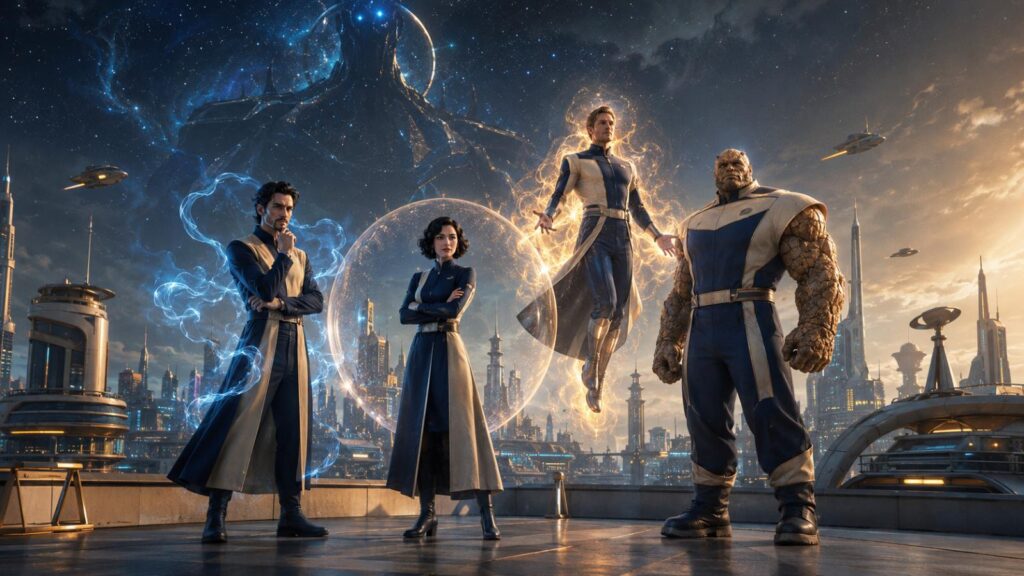
The film’s most memorable creative decision is its 1960s-inspired future. Curved screens, analog controls, launch towers, bright uniforms, household robots, and streamlined vehicles suggest a tomorrow imagined by mid-century designers. The Baxter Building feels like both a research center and a family home. Even public broadcasts contribute to the sense that this Earth has its own culture rather than serving as another anonymous superhero city.
Matt Shakman, working on a far larger canvas than his television projects, handles domestic scenes with particular confidence. He understands how to stage a group conversation so that every member of the family remains present. His direction also preserves sincerity. The movie does not apologize for rocket ships, impossible science, or a planet-eating cosmic giant.
The cinematography supports the production design with bold shapes, warm interiors, and cool cosmic expanses. A few environments become less tactile when the action grows heavily digital, but the visual identity remains coherent.
Action, Visual Effects and Michael Giacchino’s Music
The action sequences favor rescue, invention, and cooperation over simple exchanges of punches. Each hero’s ability contributes differently, which makes the Four operate as a unit rather than four solo fighters sharing a frame. The larger sequences communicate scale clearly, and several images capture the strange wonder that cosmic Marvel stories need.
The Thing has expressive weight; Sue’s force fields feel powerful; Johnny’s flight has speed; and Reed’s stretching generally avoids becoming distracting. Not every effects shot is equally convincing, but the stylized world remains consistent.
Michael Giacchino’s score is one of the film’s defining elements. Its central theme is heroic, melodic, and immediately recognizable, with choral and orchestral textures that sell both scientific optimism and cosmic danger. The music sometimes does emotional work that the rapid pacing has not fully earned, but it gives the movie a grand identity of its own.
Fantastic Four Runtime and Pacing
The official Fantastic Four runtime is 1 hour 55 minutes. Disney lists the film at that length on its official movie page, while IMDb’s title page likewise lists 115 minutes.
For much of that time, the pacing is brisk and engaging. Skipping the origin story helps the opening act establish the world without feeling like a checklist. The middle moves confidently between domestic tension, scientific planning, and escalating danger.
The drawback is that 115 minutes does not always feel generous enough for the number of ideas introduced. Supporting relationships and shifts in public opinion could use additional breathing room. The final stretch favors momentum, and some emotional transitions feel tidier than the situation warrants. The movie is never dull, but a few more quiet minutes might have made its biggest moments hit harder.
Fantastic Four Rotten Tomatoes and Audience Reception
Interest in fantastic four 2025 reviews has been matched by broadly positive reception. As checked on August 24, 2026, the film’s Rotten Tomatoes page shows an 86% Tomatometer from 408 critic reviews and a 90% Popcornmeter from more than 10,000 verified audience ratings. Those numbers may change as additional ratings are recorded.
The current Fantastic Four Rotten Tomatoes 2025 results suggest that critics and audiences agree on the broad verdict: this is a successful introduction. Aggregate scores are not a substitute for analysis, however. The movie’s family chemistry and design deserve the praise, while its compressed character development remains a real limitation even when most reviews are positive.
Fantastic Four Parents Guide: Is It Suitable for Kids?
The official Fantastic Four rating for 2025 is PG-13 for action/violence and some language. Parents should expect sustained superhero danger, large-scale cosmic threats, peril involving a family, and intense action that may be too much for younger or sensitive children. The violence is stylized rather than graphic, and the film’s emphasis on courage and family makes it a reasonable option for many older children and teenagers, depending on individual sensitivity.
This concise Fantastic Four parents guide avoids story-specific warnings to preserve the movie’s surprises. Parents who need a scene-by-scene assessment should consult a dedicated content guide before family viewing.
What Works
- The four leads share convincing family chemistry.
- Vanessa Kirby gives Sue Storm agency, authority, and emotional depth.
- The retro-futuristic world has a clear, appealing identity.
- The film skips a familiar origin and remains accessible to newcomers.
- Michael Giacchino’s theme gives the adventure musical personality.
- Galactus and Silver Surfer bring genuine cosmic scale.
What Does Not Work
- The pacing compresses several emotional and social consequences.
- Supporting characters and Ben’s life outside the team need more development.
- Galactus is imposing but intentionally remote rather than layered.
- A few visual-effects-heavy moments lose the tactile quality of the production design.
- The story sometimes chooses efficient franchise movement over deeper exploration of its best ideas.
Is The Fantastic Four: First Steps Worth Watching?
For MCU fans, yes. The movie introduces major characters without drowning them in references to earlier installments. It feels connected to a larger universe while telling a story that can be followed on its own.
For Fantastic Four fans, it is the most convincing feature-film expression of the team’s family identity. Not every character receives equal depth, but the essential relationships are in place.
For casual superhero viewers, the distinctive setting and clear emotional stakes make it more approachable than continuity-heavy Marvel entries. Anyone tired of cosmic destruction may recognize familiar machinery, but the family perspective gives that machinery purpose.
For families with older children, the PG-13 action and peril deserve consideration, but the film is ultimately hopeful and centered on cooperation. Availability may differ by region, so readers can consult our guide to where to watch The Fantastic Four: First Steps for current viewing options.
Final Verdict
The Fantastic Four: First Steps works because it understands that the Fantastic Four are not four separate heroes assembled for a mission. They are a complicated, affectionate household that happens to confront impossible scientific and cosmic problems. Matt Shakman’s confident visual approach, Vanessa Kirby’s commanding performance, the ensemble’s chemistry, and Michael Giacchino’s music outweigh a rushed script and an underdeveloped supporting world.
This fantastic four first steps review recommends the film as a sincere, visually distinctive MCU introduction with enough personality to justify future adventures.
CinePulse24 Rating: 8/10
Readers who have already watched the movie can explore our full-spoiler breakdown of the Fantastic Four post credit scene and ending, including Sue Storm’s fate, Franklin Richards’ powers, Galactus and Doctor Doom’s appearance.
Frequently Asked Questions
Is The Fantastic Four: First Steps worth watching?
Yes. It is especially worthwhile for viewers who want a character-driven superhero film with strong family chemistry, a distinctive retro-futuristic world, and accessible MCU storytelling.
How long is Fantastic Four 2025?
The Fantastic Four: First Steps runs for 1 hour 55 minutes, or 115 minutes.
What is The Fantastic Four: First Steps rated?
It is rated PG-13 for action/violence and some language.
Who plays Silver Surfer in Fantastic Four 2025?
Julia Garner plays Shalla-Bal, the Silver Surfer and herald of Galactus.
Who plays Galactus in The Fantastic Four: First Steps?
Ralph Ineson plays Galactus, bringing the cosmic character to life through his physical and vocal performance.
Is The Fantastic Four: First Steps suitable for kids?
It may suit many older children and teenagers, but parents should consider the PG-13 rating, sustained superhero peril, cosmic threats, action/violence, and some language.