
Enola Holmes 3 ends by solving Sherlock’s kidnapping, exposing a conspiracy involving stolen Afghan gold, and answering the biggest question surrounding Enola and Tewkesbury’s future. However, the final underwater shot leaves one detail open for a possible sequel.
This Enola Holmes 3 ending explained guide breaks down Moriarty’s plan, the meaning of the gold, Tewkesbury’s decision, Enola’s wedding, and the mysterious ship shown in the last scene.
Major spoiler warning: This article reveals the complete ending, central villain, major twists, and final scene of Enola Holmes 3. Watch the film before continuing if you want to avoid spoilers.
Readers who have not watched the movie can begin with our spoiler-free Enola Holmes 3 review.
Enola Holmes 3 Ending Explained: Who Kidnapped Sherlock?
Moriarty kidnapped Sherlock Holmes. The villain from Enola Holmes 2, also known as Mira Troy, returns under the false identity Professor Adeline Rathe.
The film initially makes Moriarty’s escape appear mysterious. It eventually reveals that a corrupt sergeant used his authority to release her because he needed her intelligence. He wanted her to locate missing treasure and help uncover a secret connected to the Tewkesbury family.
After adopting the Professor Rathe identity, Moriarty travelled to Malta and created an elaborate plan. A woman working for her persuaded Lady Tewkesbury to arrange Enola and Tewkesbury’s wedding on the island. Once the Holmes family arrived, Moriarty kidnapped Sherlock and planted clues for Enola to follow.
Sherlock was therefore both a hostage and bait. Moriarty knew Enola would refuse to abandon her brother and would use her detective skills to solve the mystery. By directing Enola toward the conspiracy, Moriarty hoped she would unknowingly lead her to the missing gold.
Why Does Moriarty Target the Holmes Family?
Moriarty has more than one motivation. She wants revenge against Enola and Sherlock after the events of the second film, but she is also angry about what she sees as the Holmes family’s hypocrisy.
From Moriarty’s perspective, Enola and Sherlock condemn her crimes while accepting Eudoria’s more radical actions. She believes wealthy and powerful families present themselves as respectable even when their position was built on exploitation.
The Tewkesbury family’s hidden history gives her an opportunity to prove that point. Nevertheless, Moriarty is not acting only in the name of justice. She also intends to take the treasure for herself. Her desire for revenge and personal wealth ultimately prevents her from escaping with the gold.
What Is the Truth About the Afghan Gold?
Enola, Tewkesbury, and Dr. Watson connect the case to the Battle of Khost. Tewkesbury’s late father and his godfather, Brigadier Sampson, were among the British soldiers involved in the operation.
The investigation reveals that British forces took a large amount of gold from Afghanistan. Although the seizure was presented by those responsible as compensation for the cost of war, the film treats it as theft connected to imperial power.
Tewkesbury’s father later regretted what had happened. Instead of returning the treasure, however, he hid it in a coastal cave in Malta. He sank the ship used during the journey, claimed that the gold had been lost at sea, and allowed Maltese soldiers to be blamed.
The medal found during Enola’s investigation links the sergeant, Brigadier Sampson, and others involved in the cover-up. The word “Khost” and the dying sergeant’s reference to “Wrath” also point toward the hidden history of the treasure and the sunken ship.
How Does Enola Find the Missing Gold?
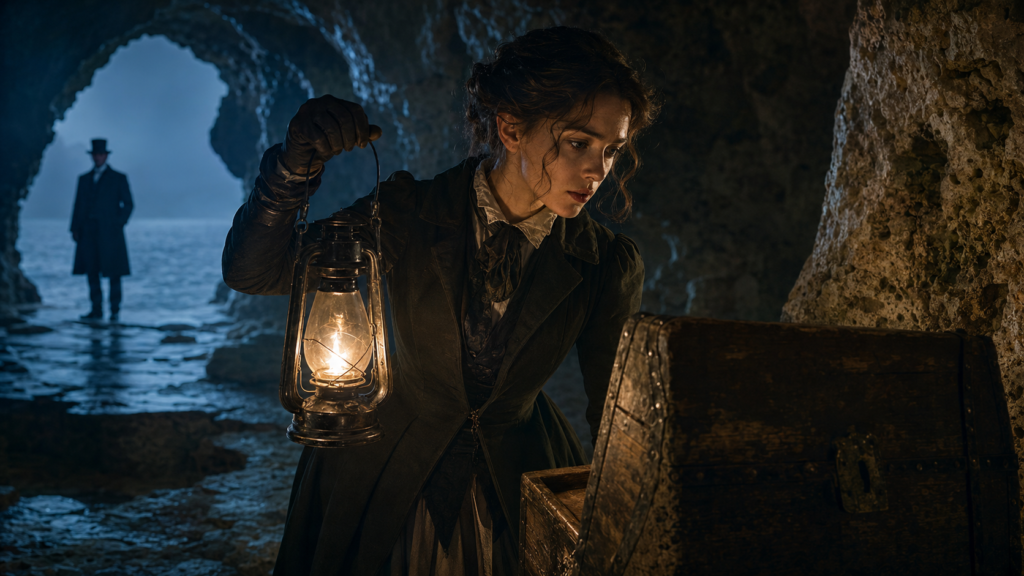
Enola remembers a story Tewkesbury shared during their first evening in Malta. His father had once described a cliffside cave containing treasure. What initially sounded like a childhood tale becomes the final clue.
She realizes that the Afghan gold did not go down with the ship. Tewkesbury’s father had placed it inside the cave before sinking the vessel and constructing the false story.
Enola knows that finding the treasure will also draw Moriarty into the open. She deliberately follows the clue, expecting the villain to watch her movements. Moriarty’s complicated game succeeds in leading Enola to the gold, but Enola prepares for the confrontation rather than simply handing over the treasure.
What Happens During the Final Confrontation?
The last confrontation unfolds near the cave and the dungeon where Sherlock and Lady Tewkesbury are being held. Enola receives help from Tewkesbury, Dr. Watson, Mikiel Mizzi, and Maltese freedom fighters.
Moriarty reaches the location but fails to escape with the gold. During the struggle, Lady Tewkesbury helps overpower her captor. Sherlock is freed, and the Holmes siblings bring Moriarty’s latest plan to an end.
Sherlock briefly has the opportunity to take revenge, but Enola stops the situation from going further. Moriarty is apprehended and returned to prison. The decision reinforces a central difference between Enola and her enemy: Enola exposes injustice without allowing revenge to become her only purpose.
What Happens to Moriarty and the Stolen Gold?
Moriarty is arrested, while the stolen gold is returned to Afghanistan. This detail is important because the ending does not allow the treasure to remain with the Tewkesbury family or become a reward for the heroes.
Tewkesbury also authorizes the Maltese authorities to investigate everyone involved in the crime. Brigadier Sampson and the British governor are arrested for their roles in the conspiracy and its long cover-up.
The outcome forces Tewkesbury to confront the source of his family’s wealth and position. Rather than protecting the family name, he chooses to reveal the truth and correct as much of the damage as he can.
Netflix’s official ending explanation confirms Moriarty’s arrest, the return of the gold to Afghanistan, and the prosecution of the officials involved.
Why Does Tewkesbury Give Up His Title?
Tewkesbury learns that his inherited title is connected to exploitation, stolen wealth, and a false account that harmed innocent Maltese soldiers. Keeping the title would mean continuing to benefit from that legacy.
He therefore gives it up and chooses to use his birth name, Earnest Tebbity-Gore. The decision is not simply a rejection of his father. It represents Tewkesbury’s attempt to build an identity based on his own choices instead of the social position he inherited.
His action also resolves one of Enola’s fears about marriage. She had worried that marrying a lord would require her to become a conventional lady, abandon her work, or lose the Holmes name. Tewkesbury’s rejection of the title removes that expectation and allows their relationship to continue on more equal terms.
Do Enola and Tewkesbury Get Married?
Yes. Enola and Tewkesbury finally marry in a simple ceremony attended by close friends and family.
Enola does not surrender her identity to do so. She remains Enola Holmes and intends to continue working as a detective. Sherlock also changes his earlier position and accepts that marriage does not make his sister any less worthy of the Holmes name.
The wedding completes Enola’s personal journey in the film. At the beginning, she treats independence and marriage as two paths that cannot exist together. By the end, she understands that accepting help and choosing a partner do not require her to abandon her independence.
Tewkesbury’s compromise is equally important. Instead of asking Enola to fit into the traditional role expected by his family, he leaves behind the title that created much of that pressure.
What Does the Final Ship Scene Mean?
After their wedding, Enola and Tewkesbury swim together in the Mediterranean. The camera moves beneath the water and reveals the wreck of a ship bearing the name The Wrath of Adeline 1863.
The name explains two major clues. “Wrath” was the word spoken by the sergeant, while “Adeline” inspired Moriarty’s alias, Professor Adeline Rathe. Director Philip Barantini confirmed that Moriarty took the name from the sunken vessel.
The ship is the one Tewkesbury’s father sank while pretending that the stolen Afghan gold had disappeared with it. Its appearance brings the mystery back to the original cover story, even though the treasure was actually hidden in the cave.
The scene also creates a small opening for another story. It does not prove that a fourth film has been confirmed, nor does it reveal a new villain. Instead, it suggests that the ship or the people connected to its history may contain more secrets.
Is There an Enola Holmes 3 Post-Credits Scene?
No traditional post-credits scene is required to understand the ending. The important sequel tease occurs in the final underwater shot before the credits, when the wreck of The Wrath of Adeline 1863 is revealed.
Viewers should therefore treat the ship as the movie’s final clue rather than as confirmation of Enola Holmes 4. Netflix had not officially confirmed a fourth movie at the time this article was prepared.
Is the Battle of Khost Story True?
The movie mixes historical themes with a fictional mystery. Its official historical explainer states that the film’s version of the Battle of Khost and the stolen treasure forms part of the story, while the wider references to British colonialism, Afghanistan, India, West Africa, and Malta reflect real historical contexts.
Netflix’s guide to the history behind Enola Holmes 3 provides additional context about how the writers combined fiction with real imperial history.
The film also avoids presenting Enola as the person who wins Malta’s independence. Her investigation exposes one injustice and may encourage change, but Malta’s struggle remains much larger than the actions of the fictional characters.
The Real Meaning of the Enola Holmes 3 Ending
The ending is mainly about refusing to let an inherited name determine a person’s future.
Enola keeps the Holmes name but defines it for herself. Tewkesbury gives up the title connected to his family’s wrongdoing. Moriarty creates a new name to manipulate others, yet her inability to move beyond revenge leads to her defeat.
The stolen gold strengthens that theme. Tewkesbury cannot change what his father did, but he can decide whether to protect the lie or confront it. Returning the treasure and exposing the people responsible show that accountability matters more than preserving a respectable public image.
The wedding does not end Enola’s independence. Instead, it shows that she can accept partnership without becoming someone else. Her final choice is not between love and detective work; it is to continue both on terms she has helped create.
Final Answer
The complete Enola Holmes 3 ending explained is that Moriarty kidnapped Sherlock and manipulated Enola into finding Afghan gold hidden by Tewkesbury’s father. Enola rescues Sherlock and Lady Tewkesbury, Moriarty is arrested, and the stolen treasure is returned to Afghanistan.
Tewkesbury exposes the conspiracy, gives up his title, and marries Enola. She keeps the Holmes name and continues her life as a detective. The final image of The Wrath of Adeline 1863 explains Moriarty’s alias and leaves the franchise with one last mystery, but it does not officially confirm another sequel.
To understand the film’s verified streaming performance, discover the seven reasons behind Enola Holmes 3’s Netflix success.